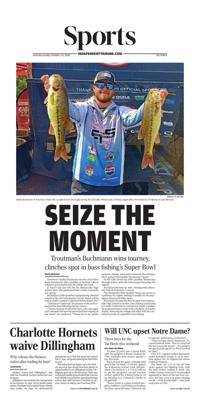

Charlotte Hornets waive Dillingham
Why release the Hickory native after trading for him?
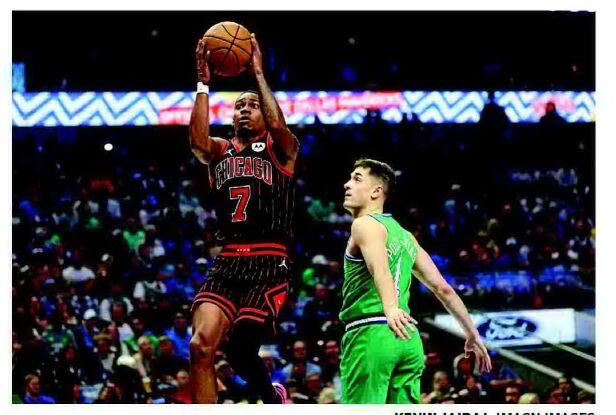
Chicago Bulls guard Rob Dillingham shoots past Dallas Mavericks guard John Poulakidas during the first half on April 12 at American Airlines Center in Dallas. Dillingham was traded to Charlotte and then waived by the Hornets earlier this week.
Hickory native Rob Dillingham's stay with the Charlotte Hornets lasted just over 48 hours.
Dillingham was traded by the Chicago Bulls to the Hornets on Sept. 26 for Buddy Heild, whom Charlotte had acquired from Atlanta days earlier. On Sept. 28, @HornetsPR announced via X that the team had waived the 21-year-old guard entering his third NBA season.
The initial deal got hopes up in the Hickory area that fans would now have plenty of opportunities to see Dillingham nearby. Dillingham grew up in the Mountain View area and played middle school basketball at Jacobs Fork Middle School before spending his high school days split between Combine Academy, Donda Academy and Overtime Elite.
What does this mean? Placing Dillingham on waivers means Charlotte is still responsible for his contract unless another team claimed him off waivers within 48 hours. That didn't happen by the deadline, so Dillingham is now an unrestricted free agent. Charlotte is still on the hook for Dillingham's $6.89 million salary this year. Plus, he will have the opportunity to earn additional salary from a team if they claim him as an unrestricted free agent.
Does this mean Dillingham won't play this year?
Not necessarily. It's impossible to know for sure whether he will reach a deal with a new team, but there are a few factors working in Dillingham's favor.
First, he will likely come cheap. Since Charlotte still has to pay his salary this year, a player like Dillingham, who clears waivers and becomes an unrestricted free agent, often gets picked up at a reduced price.
The second big factor working in his favor is his youth. Dillingham will turn 22 during the season and already has two full years of NBA experience.
After a year-and-a-half of limited action in Minnesota, Dillingham's production ramped up last winter when he was traded to Chicago. With the Bulls, Dillingham averaged 9.6 points, 3.0 rebounds and 2.8 assists per game over 30 games. His shooting efficiency number still needs some work, though (.428 fg%, .300 3pt%), but Dillingham still has a high potential upstart despite a slow start in the league.
Why did Charlotte trade for him and then waive him so fast?
Again, it's impossible to know for sure. The team's announcement Monday just said Dillingham had been waived. However, it is important to note that while some basketball deals are meant to improve an organization's product on the floor, others are more geared toward the bottom line.
Regardless of the Hornets' motivations, the Dillingham trade and then release are two of several moves the organization has made that will free up money and allow them to make some potentially big deals in the near future. Dillingham's $6.89 million salary in 2026-27 replaced Buddy Heild's $9.658 million. In addition, Heild would have had an option to make Charlotte pay again in 2027-28, Dillingham's contract does not include a player option.
In turn, Heild's salary replaced Dorian Finley-Smith's nearly $14.2 million he would have been owed before that trade on Sept. 22. Had the Hornets simply waived Finley-Smith, they would have been on the hook with him for the next two years with a player option for 2028-29.
The moves with Heild, Finley-Smith and Dillingham also created two more trade exceptions for Charlotte valued at $4.5 million and $9.6 million, according to jjnba.com. Trade exceptions are created when players with mismatched contract values are traded. They can be used within one year to acquire another player or help manage the league's salary cap and luxury tax obligations, according to NBC Sports.
The Hornets have been wheeling and dealing all year and have the most exceptions and the largest one of any team in the league, according to Sportrac. The trade exception created by last summer's LaMelo Ball deal is the largest in NBA history at $40.7 million. Charlotte currently holds six exceptions valued at $66 million, according to jjnba.com.