
Cruise ship's residents left stranded
Company cites fuel price increases as cause
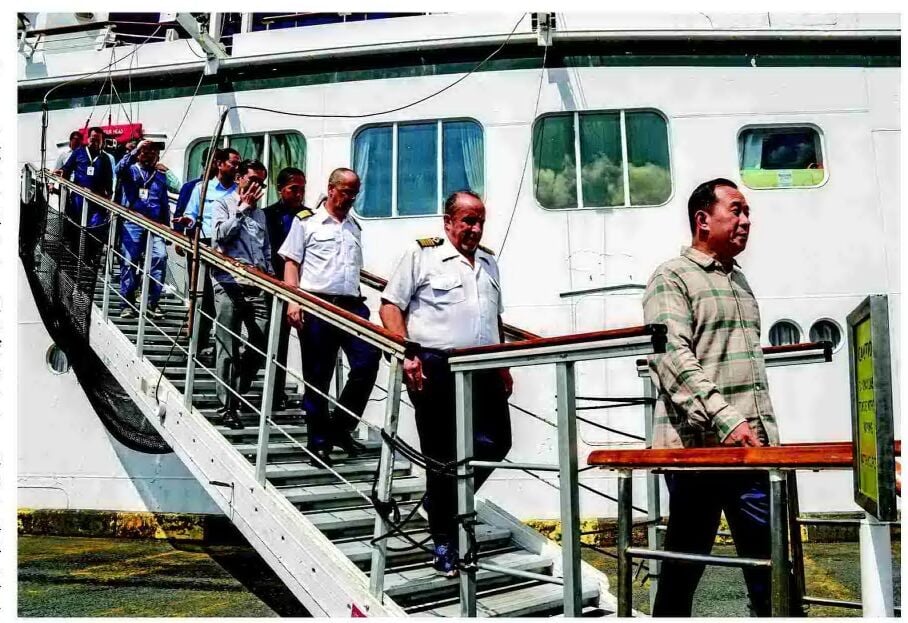
Capt. Emanuele Giudice of the villa vie odyssey cruise ship and Cambodia's minister of Tourism Huot Hak disembark the vessel Thursday at Sihanoukville autonomous Port in Preah Sihanouk province, Cambodia.
Hundreds of people permanently living aboard a touring cruise ship were forced to disembark in Cambodia last week after the vessel's operator said fuel price increases from the U.S.-Israeli war with Iran made operations prohibitively expensive.
The Villa Vie Odyssey had cruised the world for at least 755 days as one of only a handful of ships that offered passengers the opportunity to rent or buy longterm or even permanent residences on board.
On Oct. 27, ship owner Villa Vie Residences announced it was suspending operations and disembarking those passengers in Cambodia while working to find them temporary accommodation.
"Fuel costs have risen sharply in the regions where the company has been operating," Villa Vie said in the release. "On an equivalent per-cabin basis, monthly fuel expense that historically averaged approximately $1,800 has recently reached an estimated $6,000 to $8,000 in parts of Asia. The company cannot simply pass increases of that scale on to residents, and the resulting shortfall has placed its current operating model under unsustainable financial pressure."
Villa Vie Residences did not immediately respond to emailed questions or phone calls. The Odyssey can house 650 people but its rooms, including "villa suites" that cost $440,000, were still being filled. An inside villa on the vessel costs $120,000.
There were 203 passengers and 156 crew members on the ship, said Long Dimanche, deputy governor of Preah Sihanouk Province.
Some passengers departed on flights, while others were waiting in the port city of Sihanoukville, he told media. The ship was scheduled to refuel before leaving Cambodia on Saturday, he added.
Dream in ruins
Americans Lynn and Paul Montoya sold their house and cars in Wyoming so they could afford to buy a $179,000 cabin on the ship, plus about $6,000 a month in fees, to spend their retirement sailing the globe.
"We really hadn't traveled that much out of the United States until probably a few months before we boarded the ship … and we just saw it as a great opportunity to be able to see the world," Paul told Reuters.
Their dream lasted 17 months on the ship before its operator abruptly announced soaring fuel prices were forcing it to suspend operations. Villa Vie Residences informed the Montoyas and other passengers that they had to disembark from the Odyssey at a port in Cambodia, along with pets and any personal items they could carry from their homes at sea.
Uncertainty over the ship's future is more than just a travel hiccup for those who spent tens of thousands of dollars hoping to make it their home for years to come.
"They've run out of money," Paul said. "That's why they couldn't buy fuel. They've even had difficulties paying the crew on the ship, which even makes it more difficult. So we're really not expecting any money back."
In a statement Oct. 27, Villa Vie said it was seeking to restructure and recapitalize, but no deals had been finalized.
"That work is ongoing, and no outcome is assured," the company said, and added it was working to support those affected.
Plans disrupted
Villa Vie Odyssey began a planned cruise in October 2024, aiming to circumnavigate the globe every 3½ years. The voyage was originally scheduled to start in May of that year, but faced setbacks leading up to departure.
Odyssey formerly sailed as MS Braemar for Fred Olsen Cruise Lines before Villa Vie bought it in 2023. Mike Petterson, Villa Vie Residences' founder, told USA Today in August 2024 that the company was "quite humbled by the scale of what it takes to reactivate a 30-year-old vessel from a four-year layup."
In July, the company announced plans to expand its fleet with a second residential cruise ship, noting at the time that more than 85% of Odyssey's available residences had been sold.
The war began Feb. 28 with U.S.-Israeli strikes on Iran and led to closures and blockades of key export routes for oil in the Middle East, driving up energy prices around the globe. Villa Vie took steps to reduce fuel consumption, including slowing the itinerary and spending more time in port, but those measures were not enough to offset the "extraordinary" increase in fuel costs, the company's statement said.
"We have been unable to continue carrying the resulting operating losses," it added.
Signs of trouble
As the war with Iran dragged on and fuel prices rose, Paul said residents noticed growing problems aboard the Odyssey. The company asked passengers to contribute more, and asked residents to provide a loan for fuel, he said.
"And then when we got to Cambodia, absolutely no internet," he said. "And the food quality began to deteriorate about three months ago, and we knew that the company was running out of money at that time."
The Montoyas said they now planned to live off the money they budgeted for the monthly fees and spend some time in Malaysia.
Lynn said they would miss the community aboard the ship more than the lost money.
"It's hard to lose that money," she said, "but I also look at it as, we've had 17 months of going to the most amazing places and meeting the most amazing people."
Social media videos by residents showed uncertainty and disappointment as they heard the news. Others said they would relish the extra time to explore Southeast Asia.
Randy Cassingham, who lived on the Odyssey with his wife and who writes about his lifestyle on ResidentialCruising.com, said Florida-based CEO Kathy Villaba posted a message shortly after 7 a.m. Tuesday in Cambodia telling residents they had until 2 p.m. to disembark and to coordinate with staff if they were unable to remove all their belongings in time.
It was not entirely surprising, he wrote in a post on his website.
"It was a cascade of problems piling up on one another," he wrote, "from the business model to mistakes by management to the mentioned crisis in fuel cost and availability, and more."