

A kick for America
World Cup here cements soccer in US culture

JONATHAN GRELLA
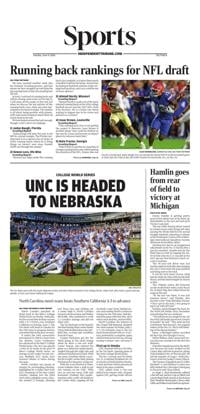
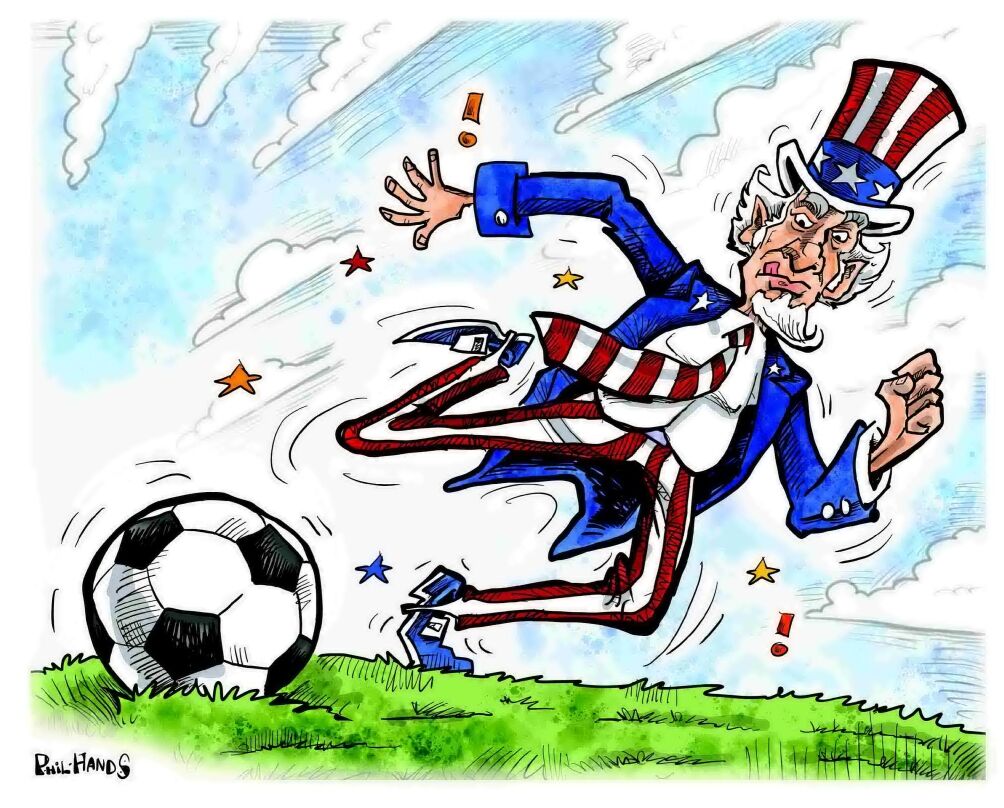
The World Cup is coming to America, beginning June 12 at Los Angeles Stadium when the United States faces Paraguay.
For many, this represents soccer's arrival in the U.S. But it's really the culmination of a transformation that has been underway for half a century.
I've probably watched "Once in a Lifetime" more times than I should admit. The 2006 documentary is about the rise and fall of the New York Cosmos. The North American Soccer League team became a sensation in the 1970s with Brazilian soccer legend Pelé as its star. I first watched it as I was beginning my professional career in sports and political public relations. As a fan, I was drawn to the story. As a professional, I became fascinated by the question underneath it: How do new ideas break through?
The older I get, the more I think "Once in a Lifetime" is less a documentary about soccer than a documentary about cultural change.
As a kid growing up on Long Island in the glow of Pelé's Cosmos era, I drew crayon pictures of Pelé, Giorgio Chinaglia, Steve Zungul and Shep Messing. His name was spoken on the schoolyard with the same reverence reserved for larger-than-life sports figures such as New York Yankees slugger Reggie Jackson.
We caught the occasional highlight on local sports broadcasts. But more often we heard stories — especially about Pelé's acrobatic kicks and impossible goals. His legend traveled faster than the footage.
The documentary shows just how close soccer came to a breakthrough in the 1970s. The ingredients were seemingly all there: global superstars, celebrity owners, sold-out crowds, media attention and cultural cachet.
Looking back, I increasingly think one ingredient was still missing: time.
The stars, attention and excitement were all there. What wasn't there yet were the generations of fans.
The seeds had been planted, but they needed time to take root. The breakthrough wasn't denied. It was delayed. Soccer needed time to grow in American life.
One observation in the film has stayed with me for years. Even as the North American Soccer League was collapsing, millions of American kids had begun playing soccer. I was one of them.
Like many children growing up in Nassau County, New York, I played soccer as much as — if not more than — Little League baseball and eventually played high school soccer.
The kids inspired by soccer's first boom became the next generation of players. Players became parents. Parents became coaches. Coaches became consumers.
The payoff took decades.
Pelé and the Cosmos introduced the sport to a broader American audience. Then the World Cup came to the United States in 1994, demonstrating the U.S. could embrace the global game on a massive scale. Major League Soccer provided the foundation. Later stars such as David Beckham and Lionel Messi helped deepen soccer's place in American culture.
What strikes me today is how often we confuse moments with movements. The World Cup is a moment.
The more important story is the movement underneath it. Cultural change rarely happens all at once. It happens through repetition. Children play. Families return.Communities invest. Habits become traditions. The event gets the attention. The repetition changes the culture.
That's why I believe the significance of the 2026 World Cup is often misunderstood. The tournament is not creating a soccer culture in America. It is revealing one.
For half a century, generations of Americans have been making soccer part of their lives and passing it on to their children.
The World Cup is not the beginning of that story. It is the payoff.
The World Cup is coming to America. In many ways, that's the point. America has already come to soccer.
Grella is the founder of JAG Public affairs. He wrote this for Insidesources.com.
Sport will never become our national pastime

MICHAEL GRAHAM
As America prepares to celebrate 250 years of kicking butt and taking names, I'm celebrating that we aren't kicking something else: soccer balls.
Our victory over the Brits did more than guarantee life, liberty and the pursuit of happiness. It also freed us of the menace of European culture. We dumped tea, and we drink coffee. We pushed away Parliament and penned a Constitution. The Brits got to keep their fish and chips, while we chose quality dental care. And our greatest victory:
We got football. Britain got stuck with soccer.
Soccer is a 90-minute toothache on grass, a boring contest between incredible athletes wasting their time at a tedious task. It was spread around the world via global oppression. As the British Empire grew in the 19th century, it inflicted soccer on its subjects. While the redcoats patrolled the streets, the British television series "Jeeves and Wooster" forced the locals to learn about red cards and heading.
So why is America hosting the World Cup smack dab in the middle of the celebration of our national greatness? Why are my airwaves jammed with ads celebrating third-world kickball while I'm trying to salute the red, white and blue?
I refuse to participate. When they gather in Los Angeles on June 12 to hoist the tipoff or drop the puck or whatever they do to start a soccer game, I will be tuned into something more exciting, such as the Knitting Channel or the latest video on AllAboutAccounting.com.
Spare me your outrage, soccer fans. I already know your arguments. Or rather, "argument," because when you point out how boring their game is, the soccer fan's ready answer is, "What about baseball? Now that's boring."
Let me tell you about baseball. It's not just America's sport because it rocks. It's America's sport because it was perfected here in the good old U.S. and then sent on to take over the world — well, significant parts of Asia and Central America, anyway.
(OK, so baseball isn't America's sport. The NFL is. But go with it, I'm on a roll.)
Is baseball more boring than soccer? Please. In soccer, nearly all the activity is away from the goal. How many actual scoring opportunities in a typical World Cup match? A dozen? Maybe 20?
In baseball, every pitch is a scoring opportunity. Sure, the vast majority are just balls and strikes, but every pitch could be turned into a home run. That's why a 3-2 baseball game is so much more exciting than a 3-2 soccer match. (And why the crowd cheers every goal for about 20 minutes. They know nothing else is likely to happen for a while.)
It's also not a coincidence that soccer and socialism often go together. (British prime minister and unapologetic socialist Keir Starmer is a lifelong Arsenal fan.) Socialism leads to poverty, which means buying bats, gloves and helmets is a problem. For soccer, all you need is a ball and a mob of people to kick it around. And socialist nations always have people standing around with nothing better to do.
We're Americans. We demand more.
Once, during a trip to Ireland, I was stuck in a sports bar for a couple of hours waiting for a friend. The Irish and their Guinnesses (Guinni?) were gathered around the flat screens on the wall, watching "football."
I glanced up at another screen, where a handful of locals were glued to something called "hurling."
To this day, I have no idea what the rules are, but it involved guys with club-like sticks running around a field and hitting a fist-size ball while engaged in high-speed collisions. After half an hour, I turned to the room and cried, "Why isn't everybody watching this?!"
Bring the World Cup of Hurling to the U.S., and I'm in. Or even Formula 1 racing, or that weird Canadian ice game with the rocks and brooms. Anything but soccer.
American presidents from George Washington to FDR, Ronald Reagan and Donald Trump all had one thing in common: They weren't boring. They knew how to put on a show.
We fought the British to keep things like soccer out of America. And if it takes another revolution to keep it out, I say "live free or die."
Graham is the managing editor of Insidesources.com.