

SUPERSIZED DEBATE
Communities wary as AI facilities grow in scale and number

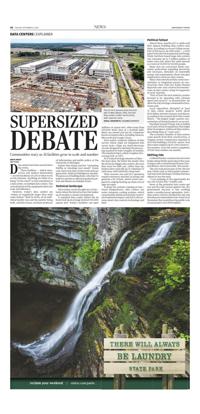
This 67-acre Amazon Data Services plot in New Albany, Ohio, has four data centers under construction, with room for more.
DATA CENTERS | EXPLAINER
Data centers have been around since the 1940s. These facilities — which store, access and analyze information — are the backbone of a lot of what we do on the internet. Anything we think of as being "in the cloud" is tied somewhere to a data center, or multiple data centers. The centralization of this equipment allows for scale and efficiency.
However, today's data centers are "orders of magnitude larger than what came before," both in terms of an individual facility size and the number being built, said Ben Green, assistant professor of information and public policy at the University of Michigan.
Rather than being used for "streaming Netflix or checking your email," Green said, these new data centers train and run generative artificial intelligence models. The process of building them, who they're built for and who is affected sparked backlash and debate on multiple fronts.
Technical landscape
Data centers can be thought of as AI factories where the infrastructure that makes up AI models is stored and deployed.
A standard data center before the AI boom took up an average of about 100,000 square feet. Today's facilities can span millions of square feet, often more than 100,000 times that of a football field. Many are owned and run by companies known as hyperscalers, including Amazon, Microsoft and Google Cloud.
Data centers comprise millions of data servers where chips are integrated into server racks. Chips are small electronic circuits designed to optimize the processing required to train complex AI models. The standard chip is called a Graphics Processing Unit, or GPU.
AI is trained on huge amounts of data — the more data, the better the model, thus the desire for bigger data centers. Because they must be built out, rather than up, hyperscalers typically go to suburban or rural areas with relatively cheap land.
Their massive size and 24/7 operation require enormous amounts of energy and generate a lot of heat, which Green compared to a laptop heating up when a lot of apps are open.
To keep the systems running at functional temperatures, data centers use water-intensive cooling systems, which caused public debate around data centers' environmental impact and led to discussions about who controls technology and land.
Political fallout
Almost three-fourths of U.S. adults said they oppose building data centers near them, according to a recent Gallup survey. Part of this has to do with water — a 2025 report from the Environmental and Energy Study Institute found large data centers can consume up to 5 million gallons of water every day, about the same amount as a town of 10,000 to 50,000 people.
Many also are concerned about consumer protections regarding electricity rate increases, demands on renewable energy and requirements about who gets employed to construct data centers.
Many cities introduced data center moratoriums, or temporary pauses on construction. New York Gov. Kathy Hochul imposed a one-year construction moratorium on data centers using 50 megawatts or more of power.
"Part of how the tech industry pushes forward is by operating with extreme speed and secrecy," so moratoriums are often the only leverage communities have, Green said.
Local opposition disrupted at least 75 data center projects worth about $130 billion between January and March, according to the research firm Data Center Watch — the largest single-quarter concentration of blocked projects on record.
President Donald Trump, who is bullish on AI and critical of regulations that might delay its progress, embraced data centers, describing them as "cash cows."
The economic benefits of data centers come mostly from their construction. A Virginia review commission reported in 2023 that building a 250,000-square-foot data center employs up to 1,500 construction workers. Once the work is completed, 50 full-time workers are needed.
Shifting tide
Coldwell Banker commercial real estate broker Adam Shultz spent almost five years trying to sell a contaminated former General Motors site in Janesville, Wisconsin.
The city took possession of the site last year, Shultz said, at which point commercial real estate developer Viridian Partners offered to buy the land.
"I was jumping at the opportunity for our city to have this," Schultz said.
News of the potential data center got out and the tide turned against the city government because it was working under a nondisclosure agreement. Antidata center activists blocked the sale and introduced a referendum to be voted on in November that would have the public vote on any project over $450 million.