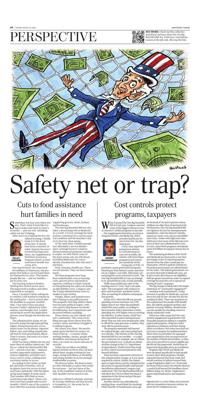

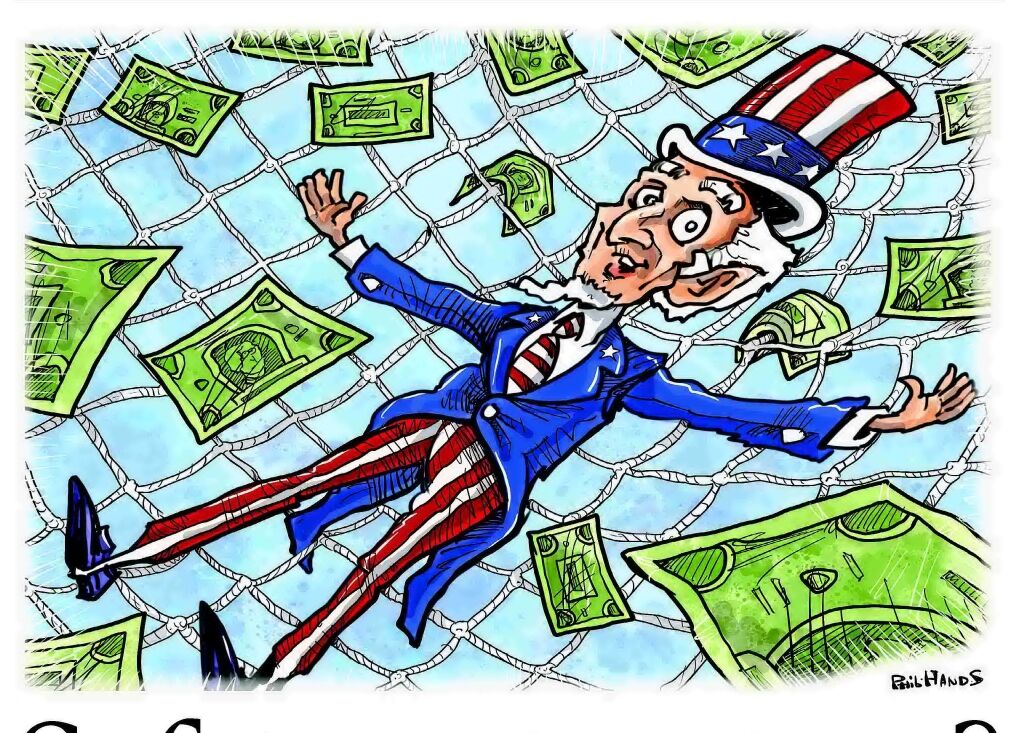
Safety net or trap?
Cuts to food assistance hurt families in need

KELLEY OSBORNE
Sometimes you lose even when you win. That's what it feels like try-ing to make ends meet in today's economy — and our ever-shrinking safety net isn't helping.
After years on a waiting list for subsidized housing, I finally made it to the front of the line. It should have been a moment of relief. Instead, because I received housing assistance, my Supplemental Nutrition Assistance Program (SNAP, or food assistance) benefit was cut by 42%.
One step forward, two steps back.
For millions of Americans, the pro-grams that help us survive hard times are themselves in crisis. That means people like me — and our families — are in crisis, too.
Our housing system is broken. Waiting lists stretch on for years. The paperwork is endless and often impossible to navigate.
Once, I received a letter asking me to confirm I still wanted to remain on the waiting list — but it arrived after the deadline to respond. Another time, I was told I'd lose my place because I hadn't updated my information, even though I had. I ended up having to restart the application process, even though the mistake was theirs.
The administrative hoops we are forced to jump through keep getting higher. Fixing bureaucratic errors means hours on the phone, repeated follow-ups, and taking unpaid time off work to visit government offices. Time is money, and many of us have neither to spare.
SNAP has been a lifeline for me and more than 40 million Americans. Yet the so-called One Big Beautiful Bill Act — passed a year ago — imposes harsher paperwork requirements, reduces eligibility and shifts enormous costs to states, making food assistance harder to access.
According to the Center on Budget and Policy Priorities, 10% of recipients have lost access to food assistance nationally, with the figure rising much higher in some states. That number will climb as more restrictions take effect. Those cuts won't just hurt people who receive benefits. SNAP is one of the country's most effective economic multipliers, supporting grocery stores, farmers and businesses.
The One Big Beautiful Bill Act also takes a devastating toll on Medicaid. As a result, I've lost coverage for medications, treatment for a serious medical condition and the machine I rely on to treat my sleep apnea.
At the same time, 4 million people lost Affordable Care Act Marketplace coverage because Congress allowed enhanced premium subsidies to expire. As with SNAP, some of the most severe cuts are still ahead, including Medicaid cuts conveniently scheduled for after this year's elections.
Food. Housing. Healthcare. These are not luxuries. They are basic human needs.
Yet these programs have long been underfunded, even as housing costs, grocery prices and medical expenses continue to climb. Instead of strengthening the safety net during an affordability crisis, Congress and the Trump administration chose to weaken it even further.
Hunger, illness and homelessness don't belong to any political party. The programs that help address them have become political targets, with cuts used to help finance tax breaks for billionaires and corporations and increased military spending.
These choices are anti-family and anti-community. They send a troubling message about whose lives this country values and whose struggles it is willing to ignore.
We cannot stay silent. We need to speak up for the kind of country we want to live in — a country where working families, seniors, people with disabilities and anyone facing hard times can count on a basic measure of security.
Today, the sacrifices are falling almost entirely on those who can least afford them: people working for low wages, living with illness or disability, and raising families in an increasingly unaffordable economy.
We deserve better. We deserve leaders who will build a country that works for everyone — not just those at the top. In the wealthiest nation on Earth, that shouldn't be too much to ask.
Osborne is a RESULTS volunteer advocate for housing, healthcare and food security in Orangeburg, S.C. She wrote this for InsideSources.com.
Cost controls protect programs, taxpayers

JEREMY NIGHOHOSSIAN
When it passed the One Big Beautiful Bill Act last year, Congress enacted some of the biggest reforms to two of America's welfare programs in decades — the Supplemental Nutrition Assistance Program (SNAP), and Medicaid, which provides healthcare for one in four low-income Americans.
Critics may argue that paring back reforms is cruel and unnecessary, but in reality, the reforms will resize these programs back toward pre-pandemic levels. During the COVID-19 pandemic, many government programs blasted past their historic norms and were set on a higher-cost orbit. Afterward, several programs never returned to Earth. The One Big Beautiful Bill Act was an attempt to re-ground those costs, if only partially.
While many politicians refer to the funding reset as "cuts," that's not quite right. These programs will continue to grow and exceed pre-pandemic levels, after accounting for inflation and population growth.
In July 2025, when the bill was passed, spending on food assistance was 54% higher than it was when the pandemic started five years earlier, according to the Economic Policy Innovation Center. Spending was 20% higher even accounting for inflation. In other words, SNAP benefits expanded so much during the pandemic that not only were beneficiaries able to afford the same groceries as before, they were able to purchase more.
The program expanded well beyond its original design, and some paring back was overdue. The reforms in the One Big Beautiful Bill Act are sensible — a scalpel, not a chainsaw. For example, the act allows the government to re-evaluate an administrative change to the U.S. Department of Agriculture's Thrifty Food Plan made in 2022, which increased payments well beyond inflation.
There has been substantial criticism of this administrative change, as it was never required by statute. Rather, the Department of Agriculture used its administrative discretion to expand benefits well beyond the inflation adjustment Congress had authorized. The One Big Beautiful Bill Act will allow the USDA to limit this kind of expansion in the future and put the program back on track.
Another reform was extending the existing three-month limit for receiving SNAP benefits to beneficiaries up to age 64 (instead of 54) and to parents whose children are older than 14 (instead of 18). Furthermore, the One Big Beautiful Bill Act tightens the test for unemployment exemptions, ends the internet subsidy, and passes more costs and accountability onto states. States with high error rates will have to foot more of the bill and cover more of their own administrative costs. In 2025, state SNAP programs mistakenly spent $10 billion in taxpayer money due to errors.
The underlying problem is that SNAP and Medicaid are financed in a way that encourages states to expand programs beyond what the states would pay for themselves. SNAP is paid for entirely by the federal government yet administered by the states. The federal government covers more than half of Medicaid costs, yet it gives states discretion to set eligibility. Both programs incentivize states to expand coverage because the cost is spread out among all states' taxpayers.
The big change to Medicaid is the implementation of "community engagement" — meaning work requirements. Going forward, to qualify for Medicaid, a person must not only be low-income but also be working (if able). There are exceptions to this requirement for people with disabilities, the elderly, pregnant mothers and parents of young children. Beneficiaries can also qualify by attending school or doing community work.
Detractors often argue that the community engagement requirements will disqualify people for failing to complete paperwork properly, citing two states' experiences (Arkansas and New Hampshire) as evidence. But states have had several years to prepare for implementation. Most states use privately run managed care organizations that are paid based on the number of Medicaid enrollees, so they have every incentive to ensure eligible people fill out the paperwork. Predictions of paperwork disqualification are overblown.
Programs like SNAP and Medicaid were designed specifically to help people in most need. Both programs, though, expanded beyond that basic remit and would continue to balloon beyond their scope if legislators didn't act. To provide for those truly in need, the reforms deserve a careful look beyond the headlines about billions being cut. Better-targeted programs help beneficiaries and taxpayers alike.
Nighohossian is a senior fellow and economist with the Competitive Enterprise Institute. He wrote this for InsideSources.com.