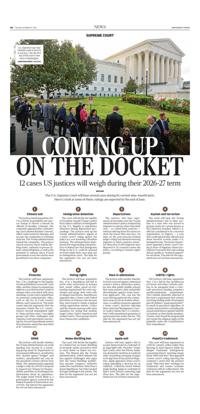

COMING UP ON THE DOCKET
12 cases US justices will weigh during their 2026-27 term
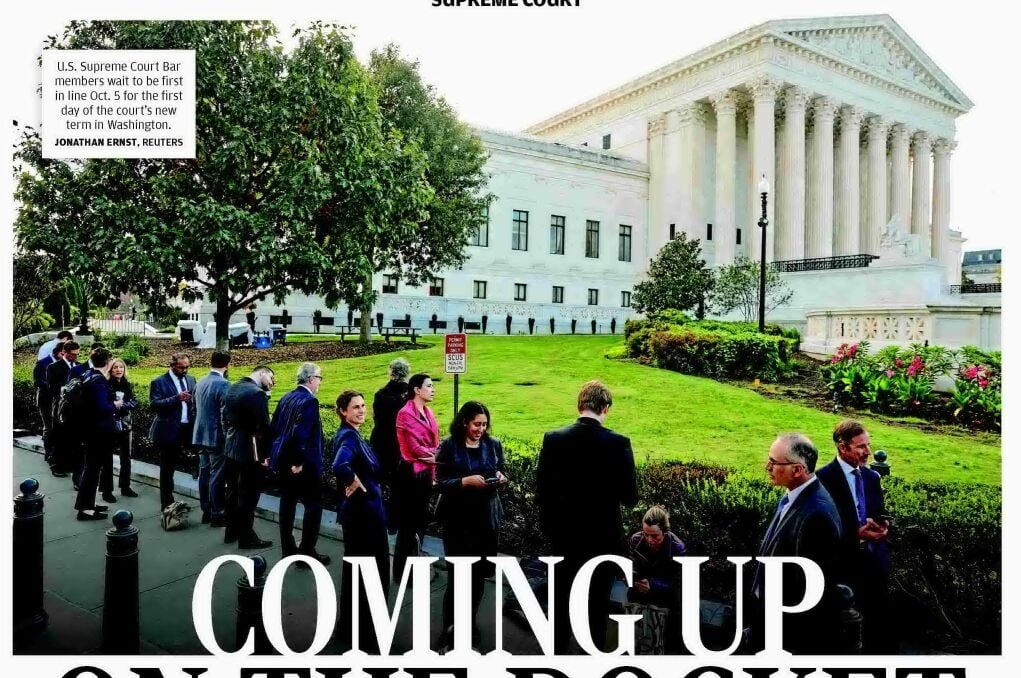
U.S. Supreme Court Bar members wait to be first in line Oct. 5 for the first day of the court's new term in Washington.
SUPREME COURT
The U.S. Supreme Court will hear several cases during its current nine-month term.
Here's a look at some of them; rulings are expected by the end of June.
1 Climate suit
The justices heard arguments Oct. 5 in a bid by ExxonMobil and Suncor Energy to thwart a lawsuit by officials in Boulder, Colorado. The companies appealed after Colorado's top court allowed Boulder's lawsuit, which seeks monetary damages and accuses the companies of violating state law. The Trump administration backed the companies. The justices voiced concerns about unduly limiting states' authority to pursue climate-related litigation, as well as the potential to unleash chaos if local governments across the country were permitted to sue these companies.
2 Immigration detention
The court will decide the legality of President Donald Trump's policy that subjects millions of immigrants in the U.S. illegally to mandatory detention during deportation proceedings. The justices took up the Trump administration's appeal of a lower court's ruling against the policy in a case involving a Brazilian national. The administration abandoned the longstanding interpretation of federal law that immigrants living in the U.S. could be released on bond while their cases play out in immigration court. The date for the arguments has not yet been announced.
3 Deportations
The justices will hear arguments in December over the Trump administration's policy of deporting migrants to nations other than their own — so-called third countries — without offering them the chance to show the harms they may face. On Sept. 29, the court paused a federal judge's ruling that deemed removing migrants to third countries unlawful. More than 25,000 migrants were deported to 29 countries under the policy, according to human rights groups.
4 Asylum and terrorism
The court will hear the Trump administration's bid to deny asylum to a man who was forced to prepare meals for a group known as the Unknown Gunmen, which U.S. officials considered to be a terrorist organization, in Nigeria — a case that could expand what officials may deem terrorist activity under U.S. immigration law. The Justice Department appealed a lower court's ruling in favor of Nigerian citizen Izuchukwu Ozurumba that said cooking did not qualify as "material support" for terrorism. The date for the arguments has not yet been announced.
5 Firearms
The justices will hear arguments Dec. 2 in a challenge to the legality of state prohibitions on assault-style rifles, another chance to expand gun rights in a case that involves a type of weapon often associated with mass shootings. Lower courts upheld bans on powerful semiautomatic rifles, such as AR-15s, in Cook County, Illinois, and Connecticut. The lower courts rejected arguments that the measures violate the U.S. Constitution's Second Amendment right to "keep and bear arms." Gun rights groups and other challengers said Supreme Court precedents concerning the Second Amendment protect these firearms, which they described as in "common use."
6 Voting rights
The justices will hear arguments Dec. 8 in a Republican-led bid to revive voter restrictions in Arizona that would stiffen proof-of-citizenship requirements for voter registrants and purge state voter rolls of alleged noncitizens. Republicans appealed after a lower court halted provisions of Arizona's law because they were found to violate a federal voting registration statute. Critics said the Arizona measure adds extra mandates for voting that unfairly target Latino, Native American and student voters. Those groups tend to favor Democratic candidates.
7 Race in admissions
The justices will consider whether to revive a lawsuit against a Maryland county's lottery admissions policy for four elite public middle schools that some parents claim unlawfully discriminates against Asian American applicants. The case has the court delving again into the contentious issue of race in student admissions. A coalition of parents appealed a lower court's decision rejecting their claim that Montgomery County's policy violates the U.S. Constitution's 14th Amendment guarantee of equal protection under the law. The date for the arguments has not yet been announced.
8 LGBTQ+ rights
The justices will hear arguments Nov. 3 in a bid by the Archdiocese of Denver and other Catholic entities to be exempted from a Colorado preschool funding program's nondiscrimination requirement. The Catholic plaintiffs objected to the state's requirement that schools receiving funding under the program give all children "equal opportunity" to enroll in preschool regardless of certain characteristics, including the sexual orientation or gender identity of students or their family members. A lower court found the program did not violate the religious rights of the plaintiffs under the Constitution's First Amendment.
9 DOGE
The justices will decide whether the Trump administration can avoid handing over records to a watchdog group about its Department of Government Efficiency, an initiative that slashed agency budgets and workers, spearheaded last year by the president's former adviser Elon Musk. The administration appealed a judge's order for DOGE to respond to requests by Citizens for Responsibility and Ethics in Washington for information about its operations. The judge found DOGE likely is a government agency covered by the federal Freedom of Information Act, or FOIA. The date for the arguments has not yet been announced.
10 Home distilling ban
The court will decide the legality of a federal ban on home distilling of alcoholic spirits enacted in 1868 to crack down on liquor tax evasion. The dispute pits the Trump administration, which defends the law, against challengers who argue that the home-distilling prohibition exceeds Congress' authority under the Constitution. More than a dozen Republican-led states backed the legal challenge t o the statute. The date for the arguments has not yet been announced.
11 Apple suit
Justices will hear Apple's bid to escape being found in contempt in its legal fight with Fortnite maker Epic Games after the iPhone maker was deemed in violation of a judicial order mandating sweeping changes to its App Store in the antitrust litigation. Apple appealed a lower court's ruling upholding a decision by an Oakland, California-based federal judge finding Apple in contempt in Epic's 2020 lawsuit contesting App Store fees. The date for the arguments has not yet been announced.
12 Trademark spat
The court will hear arguments in a bid by canned-coffee maker Rise Brewing to hold PepsiCo liable for alleged trademark infringement concerning Pepsi's morning energy drink "Mtn Dew Rise." Rise appealed a lower court's ruling rejecting the company's claim that the product name "Mtn Dew Rise" infringes its trademarks and creates customer confusion with its coffee brand. The date for the arguments has not yet been announced.