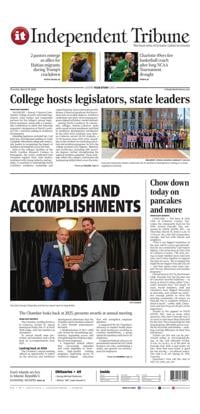

College hosts legislators, state leaders
SALISBURY — Rowan-Cabarrus Community College recently welcomed legislators, state leaders and community partners for the college's annual Legislative Luncheon, along with a Community Celebration to mark Site Selection magazine's designation of North Carolina's No. 1 national ranking in workforce development.
Attending legislators included Sen. Carl Ford, Sen. Chris Measmer and Rep. Dr. Grant Campbell, who joined college and community leaders in recognizing the impact of workforce development across the state.
Held at the college's facilities at the North Carolina Research Campus in Kannapolis, the events reaffirmed that sustained support from state leaders, combined with strong industry partnerships, is essential to maintaining North Carolina's workforce leadership and supporting long-term community growth. Rowan-Cabarrus transforms that investment into accessible degrees, workforce credentials and short-term training programs aligned with labor-market demand.
Among North Carolina's 58 community colleges, Rowan-Cabarrus ranks sixth overall in total enrollment and third in workforce development enrollment. In the 2024-2025 academic year, Rowan-Cabarrus served 24,305 students, a 13.7% increase since 2021-2022, including 14,380 students in continuing education and workforce programs. In 2025, the college awarded 2,015 degrees, diplomas and certificates, including 848 associate degrees, further strengthening the regional workforce pipeline. Those rankings reflect the college's substantial role in preparing skilled talent across the state.
"North Carolina is the top state in the nation for workforce development, a distinction that reflects strong leadership, strategic investment and the impact of our community college system," said Rowan-Cabarrus President Dr. Carol S. Spalding. "We appreciate the opportunity to highlight the work happening here at Rowan-Cabarrus to support students, employers and the continued growth of our region."
Leaders emphasized that North Carolina's workforce leadership is not accidental, but the result of strong partnerships among community colleges, local leaders and industry. They noted that new investments in workforce training are critical to expanding high-demand programs, modernizing facilities and strengthening the economic foundation of local communities.
Rowan-Cabarrus board of trustees member and chair of the Institutional Advancement and Legislative Committee, Dakeita Vanderburg, emphasized the need for sustained workforce investment. She noted that many of the college's workforce-aligned programs that support key regional industries are in high demand, with several operating at capacity and maintaining waitlists as enrollment continues to grow.
"When we invest in community colleges, the return is immediate and measurable. Employers gain skilled workers. Students gain career opportunities and stability.Communities gain economic strength," Vanderburg said. "North Carolina's number one ranking reflects the strength of our state, and we are committed to doing our part to keep our state at the top."
"If we want North Carolina to remain competitive, we must ensure our community colleges are funded in a way that matches workforce demand," said Rep. Campbell. "Propel NC modernizes the funding formula so colleges can expand high-demand programs and respond quickly to industry needs. I'll gladly buy a cup of coffee for my colleagues in Raleigh to keep that conversation going."
Executive Vice President of Site Selection magazine Ron Starner spoke about the broader impact of workforce development on economic mobility and long-term opportunity, noting that the publication's annual Workforce Development Rankings evaluate states on factors such as workforce readiness, credential attainment and alignment between education, industry and economic growth. Site Selection's rubric highlights the importance of workforce skills and productivity in corporate location and expansion decisions, reinforcing that strategic investment in education and training is critical to building talent pipelines that fuel community prosperity.
"At the end of the day, this whole educational ecosystem is about creating better wages and improving the standard of living," Starner said. "Moving forward, every job is going to require specialized skills and specialized training. The North Carolina Community College System is providing just that."
North Carolina Community College System President Dr. Jeff Cox attended the Community Celebration event alongside leaders from the system office, presidents and representatives from surrounding community colleges, and faculty and staff from Rowan-Cabarrus. Together, they represented a coordinated statewide effort to align education with employer needs and strengthen regional economies.
"The goal of the North Carolina Community College System is to provide what is needed in each local community," said Cox. "We are making sure that we are a strong partner for every business and every industry. And for every student coming through our system, we are connecting their education to the workforce of today."
North Carolina's national workforce recognition reflects years of sustained investment and strong collaboration across education, industry and government. Continued support from state and local leaders remains essential to expanding access, increasing capacity in high-demand programs and ensuring that community colleges can meet the evolving needs of employers. At Rowan-Cabarrus, that investment translates into expanded training opportunities, industry-aligned programs and measurable economic impact.
According to a 2021 Light-cast Economic Impact Report, Rowan-Cabarrus graduates contribute an estimated $238 million annually to the regional economy, demonstrating the college's significant return on investment. Through continued partnership and innovation, Rowan-Cabarrus remains committed to strengthening talent pipelines and expanding opportunity across Rowan and Cabarrus counties.