
TOP 50 DONORS
Bloomberg lands No. 1 spot for a third consecutive year
PHILANTHROPY
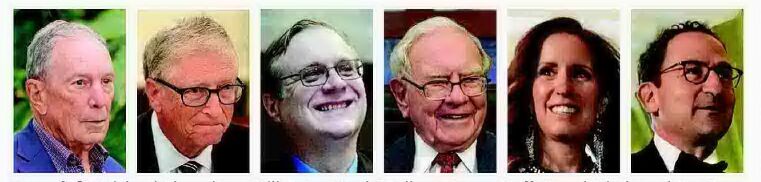
For the third consecutive year, Michael Bloomberg landed the No. 1 spot on the Chronicle of Philanthropy's ranking of the 50 biggest donors. The founder of the Bloomberg financial-news empire and former New York mayor gave $4.3 billion in 2025 to support arts, education, the environment, public health and programs to improve city governments.
The list's next three donors each gave $1 billion or more to charity last year. Bill Gates (No. 2) gave $3.7 billion to the Gates Foundation, and his former Microsoft colleague, the late Paul Allen (No. 3), left a $3.1 billion bequest to start a foundation focused on science and technology. Warren Buff ett donated $1.3 billion to four family foundations that support a range of causes.
The donors on the Philanthropy 50 list contributed a total of $22.4 billion to charity in 2025. The median gift was $105 million.
The financial industry was the source of wealth for most donors on the list, with 20 philanthropists giving a total of $4.1 billion. Next was technology, with 12 tech donors contributing $10 billion, and then real estate, with four donors giving $466.7 million.
More donors live in New York and California than any other state, and nonprofits in those states received the most gifts.
Range of giving
Only 19 of the richest Americans on the Forbes 400 list donated enough to appear in this year's rankings.
High-profile philanthropist MacKenzie Scott is not in the ranking, though she donated about $26 billion to charities since 2020. She likely made gifts to her donor-advised funds that would have earned her a spot on the list, but she and her representatives declined to provide information about how much money she funneled to the grantmakers.
Some lesser-known philanthropists on the list include:
■ Robert and Karen Hale (No. 25): The Granite Telecommunications founder and his wife gave a $100 million gift to Boston Children's Hospital and almost $11 million to education, human-service, social-justice and youth groups in the greater Boston area.
■ James and Patricia Anderson (No. 39): The automotive consultant and his wife gave $50 million to Wayne State University, his alma mater, and more than $8 million to charities that serve the elderly and people with special needs.
■ Melanie and Richard Lundquist (No. 42): The Los Angeles real estate investors are longtime donors to Southern California nonprofits, primarily backing health care and the city's public schools. Along with a $50 million donation they gave Torrance Memorial Medical Center, they also donated $3 million to nonprofits that help cancer patients and young people.
Reasons for giving
Billionaires and millionaires give for many of the same reasons that everyday donors do. Jon and Mindy Gray (No. 34, at $63.6 million) primarily support research on inherited cancers related to BRCA mutations — Mindy's sister died of BRCA-related ovarian cancer at age 44 — and empowering young people in New York City. One of their initiatives, the Gray Scholars program, provides scholarships to 10 New York City students per year to attend a historically Black college or university. Every year, the Grays participate in a gathering for all the scholars.
"We're very hands-on people — we enjoy it," Mindy Gray says. "Other people often come to us and say, 'I want to do something, but what should I do?' And it really is what you feel in your heart. You should not be doing this work in areas that don't move you."
Many donors are drawn to groups that seek their input, understand their passions, are open to collaboration and have eff ective programs. Most important, they give to people and charities they know and trust.
The Chronicle found more than 35 of 51 donors on the list had long-term relationships, often lasting five to 10 years or more, with the charities to which they gave the most in 2025.
Variety of causes
Foundations and donor-advised funds created by the donors and colleges and universities were the biggest recipients of last year's gifts. Many donors also supported a diverse range of causes that included:
■ Science and technology, which received more than $3 billion, including Allen's big bequest and a $60 million donation to support the quantitative science program at the University of Pennsylvania's Wharton School.
■ Health care and medical research, which got a total of $1.5 billion, including a $500 million donation from Nike co-founder Phil Knight and his wife, Penny, for cancer research and treatment; a number of eightand nine-figure gifts to back pediatric health care; and two gifts to support dementia research and care.
■ Athletics, which received a total of $871 million, including two donations of $300 million apiece for university athletics and a $100 million gift to provide financial aid to Olympic athletes.