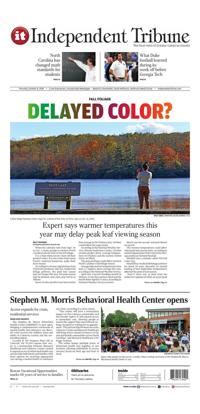


DELAYED COLOR?
Expert says warmer temperatures this year may delay peak leaf viewing season
A Blue Ridge Parkway visitor stops for a photo of fall color at Price Lake on Oct. 16, 2025.
A rock outcropping glows in golden hour light against a backdrop of fall color at Rough Ridge on the Blue Ridge Parkway on Oct. 16, 2025.
Maple leaves glow red against a clear blue sky at the Grandview Overlook on the Blue Ridge Parkway near Boone on Oct. 16, 2025.
FALL FOLIAGE
When the calendar rolls from Sept. 30 to Oct. 1, many people in western North Carolina look forward to the fall foliage.
It is a time when forests show off their greatest colors. It is also a time when many tourist-centered businesses make their most money.
According to a former Appalachian State University professor who has studied fall foliage patterns, the peak leaf season may last longer this year, but peak season may be delayed, and colors may not be as vibrant.
Seven of nine months have been hotter than average in the Hickory area. October could follow the same trend.
According to the National Weather Service Climate Prediction Center, October models predict above-average temperatures for Hickory and the Eastern United States are likely.
The expected heat could affect western North Carolina's fall foliage season.
Average high and low temperatures have been 2.3 degrees above average this year, according to the National Weather Service.
April was a record-breaking month in Hickory. It was the warmest April and the fourth driest April in 77 years, according to National Weather Service records.
March was the second-warmest March on record.
The warmer temperatures could affect when peak leaf season starts, according to retired Appalachian State University biology professor Howard Neufeld.
Neufeld runs a website called The Fall Color Guy.
Neufeld has studied fall foliage patterns for about 20 years. Recently, he started looking at how September temperatures affected the peak of leaf season.
"And it turns out, at least from my subjective opinion of when we reach peak color each year, that September is important," Neufeld said.
September temperatures in Hickory were 4 degrees above normal.
Neufeld said temperatures at higher elevations of about 2,500 to 4,500 feet in elevation, where visitors and North Carolina residents often flock for the fall leaves, were about 4 to 6 degrees above normal.
Those higher temperatures may mean that the peak comes eight to 12 days later than normal.
Tree species change their leaf colors at different times. Some trees pay attention to temperature, and some pay attention to the amount of sunlight. Trees that pay attention to sunlight and day length will turn when they should, Neufeld said, while trees that pay more attention to temperature will turn at different times.
If the weather is warm, trees like maples will extend their photosynthesis period and stay green. If the weather is cool, they will change.
"You spread out the fall color season to last longer, but it's not as good because you've diluted the color," Neufeld said. "Instead of all the trees exploding in color for a week or so, you've spread it out so it doesn't look as good."
Neufeld said he noticed colors, especially reds, were less vibrant if the weather was warmer.
Neufeld said visitors planning trips to see the leaves at their peak may need to delay their plans for a week or more. According to his analysis, for every degree above normal, the peak of leaf season is delayed by two days.
"We're looking at anywhere from eight to 12 days (delay) in peak color," Neufeld said. "If the peak is around Oct. 12, we're looking at around the 20th to the 27th."
Neufeld posts fall color reports on his website, fallcolorguy.org. He hikes trails to make observations and gather information. The website also has an interactive, up-to-date map that uses weather reports from Ray's Weather.
As of Oct. 5, according to the map, areas above 5,000 feet in elevation were experiencing peak colors. Areas around Blowing Rock and Boone should expect to see peak fall foliage around the third week in October. South Mountains State Park should see peak colors in early November.
Neufeld said forecasts for peak leaf viewing can change quickly.
"If we get a drop in the temperature that lasts more than one day, we can pull that back a day or two," Neufeld said.
However, he thinks fall foliage will peak later this year.
"If I was hedging my bets, I'd say later is more probable than sooner," Neufeld said.
Billy Chapman is a reporter with the Hickory Daily Record. wchapman@hickoryrecord.com