

'DEVASTATING IMPACT'
Roadless Rule removal could strip 152K NC forest acres from protection
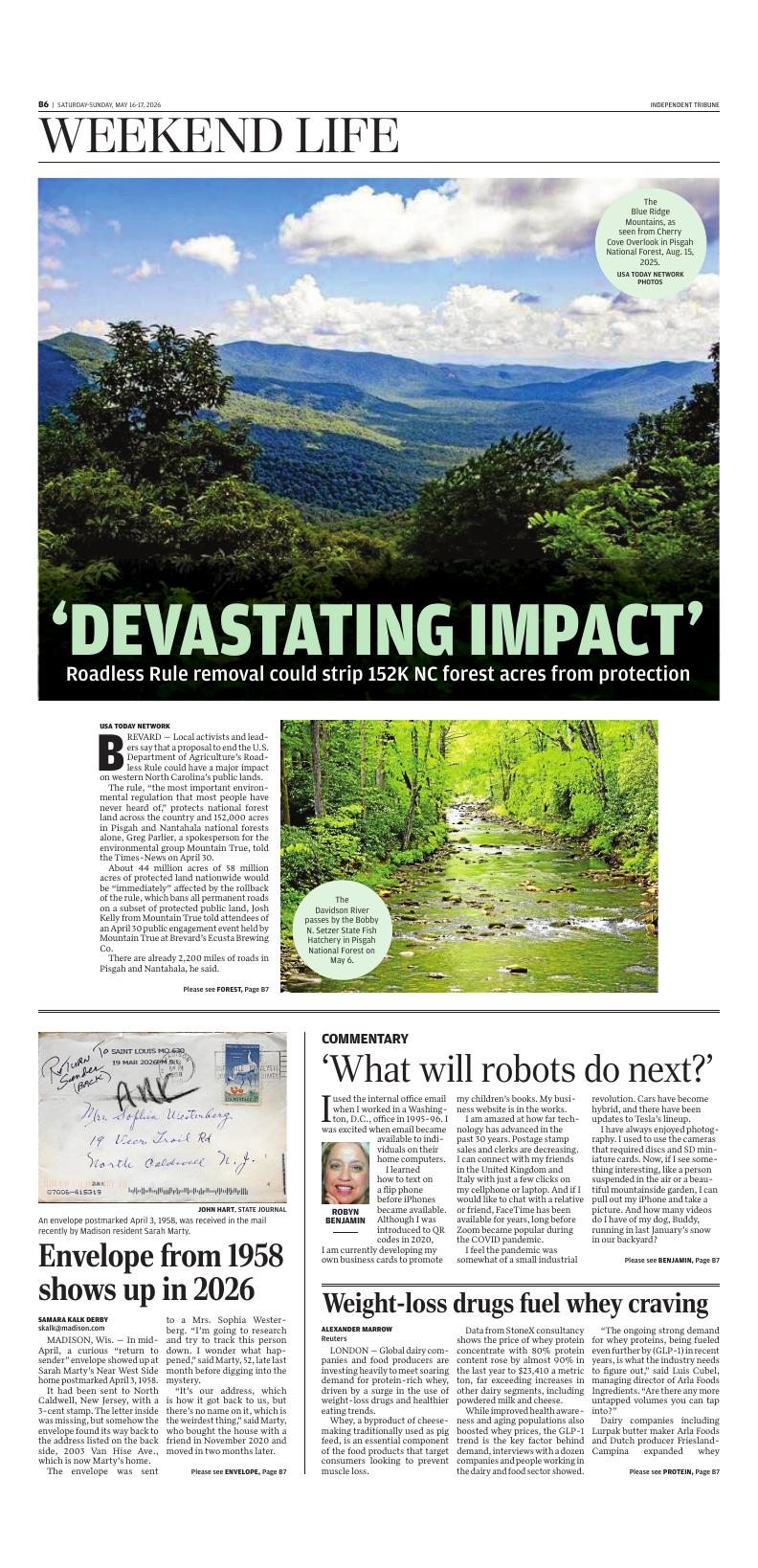
The Davidson River passes by the Bobby N. Setzer State Fish Hatchery in Pisgah National Forest on May 6.
The Blue Ridge Mountains, as seen from Cherry Cove Overlook in Pisgah National Forest, Aug. 15, 2025.
BREVARD — Local activists and leaders say that a proposal to end the U.S. Department of Agriculture's Road-less Rule could have a major impact on western North Carolina's public lands.
The rule, "the most important environmental regulation that most people have never heard of," protects national forest land across the country and 152,000 acres in Pisgah and Nantahala national forests alone, Greg Parlier, a spokesperson for the environmental group Mountain True, told the Times-News on April 30.
About 44 million acres of 58 million acres of protected land nationwide would be "immediately" affected by the rollback of the rule, which bans all permanent roads on a subset of protected public land, Josh Kelly from Mountain True told attendees of an April 30 public engagement event held by Mountain True at Brevard's Ecusta Brewing Co.
There are already 2,200 miles of roads in Pisgah and Nantahala, he said.
Together, the Pisgah and Nantahala national forests cover 1.1 million acres of mountainous terrain in 18 counties of western North Carolina and draw more than 5 million visitors a year. They are two of North Carolina's four national forests, which include the Uwharrie in the south-central part of the state, and the Croatan on the coast. The forests protect drinking water, offer valuable wildlife habitat and support many activities, including hunting and fishing, hiking and mountain biking, bird watching, kayaking and more.
Helene caused "moderate to catastrophic" damage to more than 187,000 acres of national forest land, according to a report from the Forest Service.
Helene caused around $44 million in damage to vegetation, including downed trees, and the land itself including from landslides, the Asheville Citizen Times previously reported. Parts of Pisgah, Nantahala and other national forests in the region were closed for weeks or months after the storm from that damage.
President Donald Trump signed an executive order in March 2025 calling for federal agencies to roll back land protections, USA TODAY reported. USDA Secretary Brooke Rollins began the process of rescinding the Roadless Rule in June 2025, according to a USDA news release.
"The intent to rescind the 2001 Roadless Rule is to return to local decision making as part of individual national forest and grassland plans, which include robust public involvement and focus on land management decisions at the right scale. The proposed rulemaking would not compel or authorize immediate ground-disturbing activities. Any future actions would continue to follow the forests plans, comply with federal laws, and include environmental review," the U.S. Forest Service told the Times-News in a May 13 email.
"Because of steep terrain, remote locations and statutory limits, road construction in these areas is generally impractical, and the practical effect of rescinding the Roadless Rule on current management is expected to be minimal" in Pisgah and Nantahala, according to the email.
'I do not want roads'
Attendees at the April 30 spoke about the Roadless Rule's importance and wrote postcards to send to the U.S. Forest Service when a public comment period opens.
"I do not want more roads," said Seth Gerring of Brevard. "I enjoy mountain biking, I enjoy going up there with my kids, I enjoy fishing … Flat Laurel Creek, if we put a road (upstream), it's going to have silt," he said.
About 14.5 million people get their drinking water from watersheds in roadless areas nationwide, Kelly said.
The Mills River watershed, an important source of Henderson County's drinking water supply is protected by the Mills River and Laurel Mountain roadless areas, he said.
"Roads are vectors for non-native invasive plant species and animal species," as well as for human-caused wildfires, Transylvania County ecologist and angler Owen Carson said.
It's unclear when the public comment period will start. Parlier said that it would open May 15, he told the Times-News on May 12. He said he now expects it to begin by the end of May.
"There were 600 public hearings when the original rule was adopted back in 2001. This time there were zero," David Reid, National Forests Issues chair for the North Carolina Sierra Club, told the Times-News on April 30.
"This is a huge deal because these (roadless) areas are so popular ... it just amounts to another raid on our public lands," he said.
Roadless Rule removal would be 'devastating'
Local elected officials said they're concerned about the potential impacts of the change.
"It's not just the financial impact it might have on tourism, it's what we might lose immediately … part of a precious heritage for our future," Brevard Mayor Maureen Copelof told the Times-News on May 11 of the rule's potential rollback.
"It could impact drinking water. It could fragment the habitat for wildlife. It could have drastic changes if we are not very, very careful in terms of management, once that rule is rescinded. And I have no confidence that it would be carefully managed," she said.
Hendersonville City Council member Gina Baxter told the Times-News on May 1 that she expected rolling back the rule to have a "devastating impact" in North Carolina in particular because of the way its people are culturally and economically connected to the land.
"All of the protected forest is outside of the city boundary, but so much of what brings people here and what keeps people here is having all of that protected land around us. It's so pivotal to our economic development," she said.
Reporting by George Fabe Russell, Hendersonville Times-News