
Bill mock-up features Trump
He'd be the first sitting president on American currency in 100 years
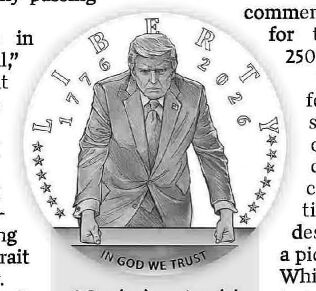
A Semiquincentennial commemorative gold coin design featuring U.S. President Donald Trump

Treasury Secretary Scott Bessent holds up a Washington Post article about a possible $250 bill with the portrait of U.S. President Donald Trump during a May 28 news briefing in the James S. Brady Press Briefing Room at the White House in Washington.
The Treasury Department prepared mock-up designs for a new $250 bill that would feature President Donald Trump's portrait — a move that would make him the first living person featured on American currency in 100 years.
According to the American Numismatic Association, which deals with artifacts related to money, one other living president appeared on a coin: Calvin Coolidge. In 1926, a half-dollar for the Sesquicentennial, or 150th anniversary, featured Coolidge and George Washington.
However, whether the Trump $250 bill will ever be released as official currency likely depends on the passage of Republican-backed legislation that failed to advance in Congress.
A Treasury spokeswoman confirmed the department is "conducting appropriate planning and due diligence" to prepare for a bill sponsored by Rep. Joe Wilson, R-South Carolina, that would direct Treasury to produce a $250 bill with Trump's portrait on it to commemorate the 250th anniversary of the nation's founding.
U.S. Treasurer Brandon Beach provided the Bureau of Engraving and Printing with mock-up designs for the bill that featured Trump's face, the Washington Post reported May 27. The mockups alarmed staff at the printing bureau, according to the Post, because it typically takes several years to produce new currency because of legal and procedural obstacles.
A copy of the $250 bill, obtained by the Post, shows Trump's signature to the left of the president's portrait and Treasury Secretary Scott Bessent's signature to the right. The portrait was designed by British painter Iain Alexander. Trump personally signed off on the designs, the Post reported.
The Treasury Department said Beach "never asked staff to print the bill before congressional passage."
"Should this legislative mandate be signed into law, the BEP is moving proactively to produce a $250 commemorative note which will appropriately recognize the 250th Anniversary of our great nation," the Treasury spokeswoman said.
Legislation stalled
Federal law states "only the portrait of a deceased individual" maybe appear on U.S. currency and securities. The prohibition of living people appearing on currency goes back to 1866, when Congress took action after a Treasury official, Spencer Clark, was able to put himself on notes.
Reporters asked Bessent about the $250 bill mock-ups featuring Trump, and Bessent said the Treasury Department "prepared in advance" of the legislation potentially passing Congress.
"It's all up in Capitol Hill," Bessent said at a White House news briefing, later adding that he doesn't see anything inappropriate with putting Trump's portrait on the currency. Wilson's bill would eff ectively supersede the 1866 prohibition on using images of living people on currency. It remained stalled in the House Committee on Financial Services for more than a year, and would need 60 votes to pass in the Senate to block a Democratic filibuster.
The printing bureau doesn't plan to release final artwork for the $250 bill unless Congress approves the legislation.
If the bureau follows its own rule and procedures, it seems unlikely a $250 bill could be produced this year to mark the nation's founding.
The bureau's website says the banknote development process requires "extensive testing which can take years to successfully complete" and designs of notes are "typically made public six to eight months ahead of time for global public education and cash handler education purposes."
Some precedents
The $250 bill isn't the first 250-related currency the Treasury proposed to honor Trump. This year, the agency announced plans to print Trump's face on a $1 circulating coin commemorating the 250th anniversary of the Declaration of Independence. It's also preparing to emblazon the president's image on a small batch of 24k gold commemorative coins for the country's 250th anniversary.
The $1 coin features a side portrait of the president, while the commemorative gold coin design includes a picture the chief White House photographer took of Trump leaning over the Resolute Desk.
The Commission of Fine Arts, an advisory board whose members were hand-picked by Trump, unanimously approved both eff orts.
Democratic members of Congress argued the president's eff orts to mint his image on dollars and coins violates the 1866 law. However, commemorative coins are exempt from the prohibition.
Treasury argued its authority for the $1 coin comes from a 2020 law allowing the pressing of celebratory 250th anniversary pieces.
In March, the Treasury announced plans to print Trump's signature on all future paper currency, starting with the $100 bill in June — the first time a sitting president's signature will appear on U.S. banknotes.