
NC BUDGET DEAL UNVEILED TO PUBLIC
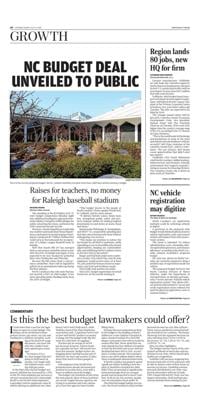
Raises for teachers, no money for Raleigh baseball stadium
Prior to the current proposed budget, the N.C. General Assembly has gone more than 1,000 days without passing a budget.
The unveiling of the $34 billion 2025-27 state budget compromise Monday night lists additional funding for a planned statewide children's hospital, fulfills pledges for public school teacher raises, and lowers the state's personal income tax rate.
However, Senate Republican leadership was unable to persuade their House Republican counterparts to include taxpayer funding for a proposed $1.7 billion stadium that could serve as the home park for an expansion of a Major League Baseball team in Raleigh.
Now that Senate Bill 257 has emerged from a concurrence committee almost a year after the 2025-26 budget year began, it was expected to be fast-tracked for potential floor votes Wednesday and Thursday.
Because the bill comes from a concurrence committee, there will by legislative policies be no amendments taken up during the floor debates.
North Carolina is the only state that has not enacted a 2025-26 state budget. It has been operating under funding totals from the 2024-25 budget.
"This budget invests in the people of North Carolina," House speaker Destin Hall, R-Caldwell, said in a news release.
"It delivers historic raises, keeps taxes low, strengthens public safety and protects taxpayer dollars by making targeted investments to crack down on waste, fraud and abuse."
Senate leader Phil Berger, R-Rockingham, said SB257 "is a responsible spending plan that takes aim at bureaucratic bloat without endangering core services.
"This keeps our promise to reduce the tax burden for all North Carolinians, while expanding access to incredible educational opportunities, keeping our communities safe, and solidifying North Carolina's status as the best state in the nation."
Berger and Hall held a joint news conference on May 12 in which they said all state employees would receive raises of at least 3%, plus potential bonuses based on experience, pay level and workforce needs.
Those talks took another six weeks. Since 2011, budget negotiations have had
Democrats on the outside looking in.
If Democratic Gov. Josh Stein were to veto the bill, House Republicans would need the support of at least one House Democrat at full attendance to override the veto.
Because 20 House Democrats voted for the House version of the 2025-26 budget, and Stein has stated his preference for the House version, the House could be more successful than usual in securing its priorities in the final budget.
After House Republicans successfully overrode four vetoes in June, Stein said that "as the legislature leaves teachers and law enforcement officers waiting for hard-earned and desperately needed pay raises, members of the General Assembly are stoking the culture wars that divide us rather than fulfilling their long-overdue responsibility of passing a budget."
"It's time for them to do their jobs for the people of North Carolina."
Children's hospital funding
Perhaps the most contentious budget compromise issue is the proposed $3 billion, 500-bed children's hospital in Apex that would serve patients statewide and be jointly operated by Duke Health and UNC Health.
The hospital, which is projected to have at least 8,000 employees, has been a Berger priority for several years, to the point that political observers have described it as a legacy accomplishment.
Meanwhile, Hall has said he and several House colleagues were considering clawing back the state's funding because they questioned the need for taxpayers to help pay for the joint venture.
Hall cited the state's five regional children's hospitals, including Atrium Health-affiliated Brenner Children's Hospital in Winston-Salem and Levine Children's Hospital in Charlotte, as part of his reluctance to fund the Apex site.
The 2023-24 state budget includes $320 million toward the hospital.
The 2025-27 budget dispute involved siphoning an additional $105 million from the N.C. Care initiative that supports rural hospitals and helps establish three rural care centers. That $105 million is expected to meet the legislature's funding obligation.
According to Raleigh TV station WRAL, at least $216 million in taxpayer funds has been spent on the children's hospital so far.
Teachers, prison workers get raises
Senate Bill 257 grants public school teachers an average 8% pay hike, plus potential bonuses of $1,000 for teachers with at least 16 years of experience and $500 for teachers with less than 16 years of experience.
Hall said the 8% raise would lift the pay for first-year teachers to the highest in the Southeast.
"It would be the largest teacher pay raise since at least 2006," Hall said during the May 12 presentation.
Salary increases for state law enforcement and prison employees would be provided on a step scale ranging from 10.1% to 17.7% — down from a potential peak of 20.3%.
In both instances, the raises would not be made retroactive to 2025-26, but would begin on July 1.
The bill also includes a onetime $1,750 bonus for state employees who earn less than $65,000 annually, and a one-time $1,000 bonus for state employees who earn more than $65,000 annually.
Individual income tax changes
The budget compromise has the individual income tax rate reduced from 3.99% to 3.49% for years 2027-29, then drop to 3.24% for 2030-32, and then lowered to 2.99% for 2033-34.
The income tax rate reduction schedule would eliminate the requirement of meeting state revenue targets to trigger tax cuts.
Berger said reducing the individual income tax rate to 3.49% beginning on Jan. 1 "was important for keeping a promise to taxpayers."
"We also need some assurances that the rate would not bounce back up at some point."
To that end, Berger and Hall agreed to support a constitutional amendment bill that would put the question on the Nov. 3 general election ballot: whether voters want to prohibit state legislators from raising the individual income tax rate above 3.5%. The current maximum is 7%.
Senate Bill 1080, titled "Lower taxes for all NC," became law on May 21 after passing both chambers on mostly partisan lines.
Constitutional amendments have to be approved by a threefifths vote of the legislators in each chamber. The governor cannot veto the bill.
"There is no question that North Carolina has one of the strongest, fastest-growing economies in the country, and that's a direct result of Republican-led fiscal policies," Sen. Michael Lee, R-New Hanover, said in May.
"A crucial pillar of that success has been consistently lowering taxes and putting money back into the pockets of hardworking North Carolinians. When it comes to setting the maximum rate, the people of our state deserve to have a say."
Property tax bill on ballot
Berger and Hall agreed to support House Bill 1089, which also represents a constitutional amendment before voters.
HB 1089 would allow voters to determine whether there should be restrictions on how much counties and municipalities can increase their property tax levies.
The bill became law on May 21 after also clearing both chambers, mostly along partisan lines.
Voters would be asked to approve allowing the legislature to set a property tax levy cap that bill sponsors have not announced. State law currently limits the authorization of municipality property tax levies to $1.50 per $100 of value.
Hall has set the property tax issue as one of his top five legislative priorities for the 2026 session, saying it "places responsible limits on local property tax hikes."
rcraver@wsjournal.com 336-727-7376; @rcraverWSJ