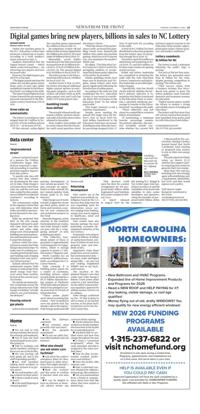


WHO PAYS FOR DATA CENTERS?
NC AG wants data centers placed in a separate Duke Energy rate class
N.C. Attorney General Jeff Jackson speaks during the 41st Annual North Carolina Peace Officers' Memorial Ceremony on April 14 at Lawndale Baptist Church in Greensboro.
A building rises from the Microsoft site in Conover off N.C. highway 16.
North Carolina's attorney general says data centers should pay their fair share of Duke Energy expenses.
Jeff Jackson also wants to limit Duke Energy customers' exposure to "cost shifting" from risks created by developing data centers.
Jackson made a statement on Monday urging the state's Utilities Commission to create a new rate class for Duke Energy's data center customers. He posted his data center rate class proposal and his full proposed order.
"Duke Energy is onboarding an unprecedented number of data centers without a clear plan on how to protect ratepayers from higher rates and unacceptable risk," Jackson said.
"These data centers are upending our energy system, and we need to know that the Utilities Commission is making sure data centers pay for the strain they put on the grid and don't unfairly burden ratepayers."
On Dec. 18, the Trump administration's Federal Energy Regulatory Commission unanimously approved allowing technology companies, such as Apple, Google, Meta and Microsoft, to build data centers with direct connections to power plants, along with loosened environmental regulations.
The controversial present and future of data centers in the Triad and N.C. have drawn the attention of Gov. Josh Stein.
Stein released a Jan. 16 statement that he says "reaffirms his commitment to keeping electricity costs down" in the state.
"That means making sure data centers pay their fair share for the electricity they require to be generated."
'Unprecedented strain'
Jackson's proposal is part of a process the Utilities Commission began after Jackson requested a separate proceeding to examine potential negative impacts from data centers.
"A specific rate class will ensure that data centers are all playing by the same set of rules, Duke Energy's customers know what those rules are, and the costs and risks created by data centers are not shifted to residential customers," according to Jackson.
The commission's ruling in the ongoing Carbon Plan case will determine what Duke can build to meet projected demand in the coming years.
Duke has projected that 80% of the new energy demand it will need to meet will come from new data centers and other large energy users. It has proposed building new power generation and transmission assets to meet this demand.
Jackson asked the commission to require that Duke Energy take several steps "to make sure it's making reasonable growth projections and building (and charging ratepayers for) only necessary infrastructure."
Jackson advised that the commission require Duke Energy to make projections about energy load forecasts every three months, instead of the current every six months.
He said the recommendation would help ensure the energy infrastructure Duke Energy is building "actually reflects, not overestimates, the demand."
Pausing natural gas plants
Jackson also recommends pausing development of new natural gas plants "to give everyone an opportunity to fully evaluate the last-minute updates Duke Energy made to its load forecast."
Duke Energy says it wants to build 2.8 gigawatts of new gas-fired power plants in Davie and Davidson counties for new commercial and residential projects in the Triad.
Munashe Magarira, senior attorney at the Southern Environmental Law Center, said Duke Energy's buildout plan calls for a "staggering amount" of new, polluting gas plants.
"The collective, maximum output of these 12 gas plants is approximately 9,650 megawatts (9.65 gigawatts), which is enough capacity to power 5.7 million homes," Magarira said.
North Carolina has an estimated 5.1 million households, according to the U.S. Census Bureau.
Duke contends it is building power plants for a variety of customers, including JetZero, which recently broke ground for a $4.72-billion manufacturing campus at Piedmont Triad International Airport, where it has pledged to create more than 14,500 jobs at full production.
"These power plants aren't about recruiting data centers — they're needed to serve the growth that has already come to the region," Duke Energy spokesman Bill Norton said.
Polarizing development
Data centers are at the forefront of an artificial-intelligence boom in the U.S. because they help meet the ever-expanding need for information across sectors ranging from banking, energy and search engines to healthcare, retail and manufacturing.
Data centers have also become perhaps the most polarizing economic-development initiative of the 21st century.
Proponents tout projects valued at billions of dollars of capital investment, millions of dollars in new local property taxes and hundreds of jobs.
Opponents claim those projections are not realistic, but environmental risks — air, noise, water and higher energy bills — are very real and stoking heightened NIMBY (not in my backyard) stances.
The location of the planned Walnut Cove data center near Duke Energy's Belews Creek power plant could be a key motivation for the utility to pursue federal regulatory approval for adding nuclear reactors on its campus.
Duke Energy confirmed on Dec. 30 that it plans to add as many as six nuclear reactors at the plant that's located just across the Forsyth County line.
That decision could open the door for a power arrangement for the proposed multi-billion-dollar Engineered Land Solutions data center complex in Walnut Cove.
A report released in August 2025 by the left-leaning N.C. Budget & Tax Center urges state legislators to reduce or end the availability of local and state subsidies to data center developers and operators, citing the benefits of proposed multi-billion-dollar campuses.
A March poll by the conservative-leaning Carolina Journal found that North Carolinians want existing or proposed data centers to rely on their own energy supply.
The poll asked 600 likely voters on March 22-23 whether they support a policy requiring data centers to generate their own energy.
More than 78% said yes, including 60% who strongly agree with establishing such a requirement. Meanwhile, just 9.9% said they would oppose such a policy.
Staff reporter Ginger bumgarner contributed to this article rcraver@wsjournal.com 336-727-7376; @rcraverWsJ