

HIDING IN PLAIN SIGHT
Tips for making your TV a design feature instead of an eyesore
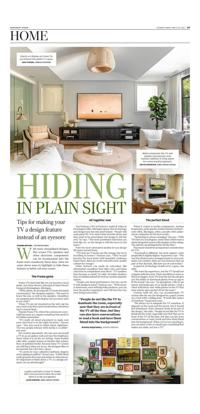
Colorful art displays on Frame TVs can enhance the palette in a space.
Media components like TVs and speakers have become more seamless additions to living spaces for a more practical approach.
A gallery wall with a Frame TV (shown with a horse picture) makes the screen blend in to the arrangement.
With more streamlined designs, flat-screen TVs, speakers and other electronic components can be incorporated into the home more seamlessly these days. Here are some clever ways to highlight or hide these features to better suit your rooms.
The Frame game
Frame TVs that look like art can become a focal point, says Anna Versaci, principal of Anna Versaci Design in Birmingham, Michigan.
"With clients, we incorporate TVs from the initial conversation," the designer explains. "We need to know the size, as well as the speakers. Soundbars are a popular part of the display, but you never want to see cords."
When TVs are not mounted on the wall, zip ties can corral cords that can be tracked down a furniture leg to conceal them.
Popular Frame TVs, where the screensaver essentially becomes art, require a small box that needs to be hidden somewhere.
"It's really all about placement to make sure your electrical is in the right location," Versaci says. "You also need to think about sightlines. The way people interact with media is so different now."
For creative placement, she says you can install a TV in an art gallery wall and turn the brightness down when it is on the art setting. Some models offer after-market frames in finishes like walnut, brass or polished nickel. Because many TV screens are still black when not in use, the designer likes to incorporate the color into a space.
"It can be for your cabinetry hardware, drapery rod or piping on a pillow," Versaci says. "A little black really grounds the room and relates to other pieces. It's important to think about a TV as a design element, not an afterthought."
All together now
Dan Paulson, CEO of Paulson's Audio & Video in Farmington Hills, Michigan agrees that technology and design have become intertwined. "People still want great Wi-Fi to watch their favorite shows and they want to be entertained, but design is still the star," he says. "The most prominent television can look like art, so the design is still the focus in the space."
Even the most substantial models let you design the space around them.
"TVs that are 75 inches are the average size we're installing in homes," Paulson says. "They've just become the focal point with beautiful credenzas below them. Most are on the wall with a low-profile cabinet for storage."
Other features can easily be concealed, like aftermarket soundbars that offer color and frame selections to complement your décor. "TV speakers have become so small," he adds. Invisible speakers that are hidden behind drywall are another popular option.
"People care about performance, but you can do it with design in mind," Paulson says. "With music or televisions, even with big bulky products, you can have the perfect experience and still love the way your living room looks."
The perfect blend
When it comes to media components, Armina Kasprowicz, principal for Armina Interiors in Rochester Hills, Michigan, often consults with audio/ visual companies for the best results.
"Technology is always changing," she says. "With TVs that you can disguise, many times clients have a whole integrated system with speakers in the ceiling. The options are getting better all the time."
Placement should be an important consideration for TVs.
"Everybody is different. For neck support, some people like it slightly higher," Kasprowicz says. "The way the whole room is arranged needs to serve your needs. For comfort, there are a lot of factors that are part of that decision, like how you sit and recline."
In general, technology should serve a space, she adds.
"We want the experience, but the TV should not compete with the room. There should be no wires or black rectangles. Even TVs from the last decade give you the ability to download photos from an app to fit the mood," she says. "In springtime, I like to see nature and landscape art or family photos. I had a client with black-and-white photos on the TV that were artistic and a perfect fit for the room."
Custom built-ins also can accommodate TV screens like the one she designed in a panel system on a track with a sliding door. "It looks like a piece of furniture," Kasprowicz says.
"We always try to integrate the TV somehow. It depends on the room and the layout, but it should feel intentional. Every element needs to be part of the design," she adds. "People do not like the TV to dominate the room, especially now that they are in front of the TV all the time, but they can also have conversations or read a book and have them blend into the background. When you're not watching it, you can enjoy a view or a landscape; something that makes you smile, not just a TV."
"People do not like the TV to dominate the room, especially now that they are in front of the TV all the time, but they can also have conversations or read a book and have them blend into the background."
Armina Kasprowicz, Armina Interiors