
OVERMOUNTAIN MEN HELPED TURN TIDE
NC Patriot forces played 'significant' role in Revolutionary War
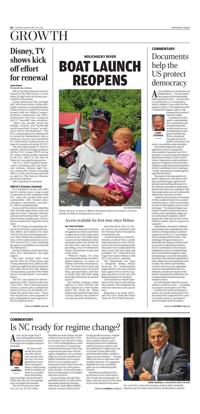
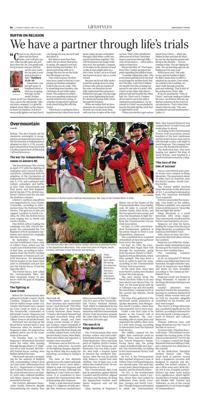
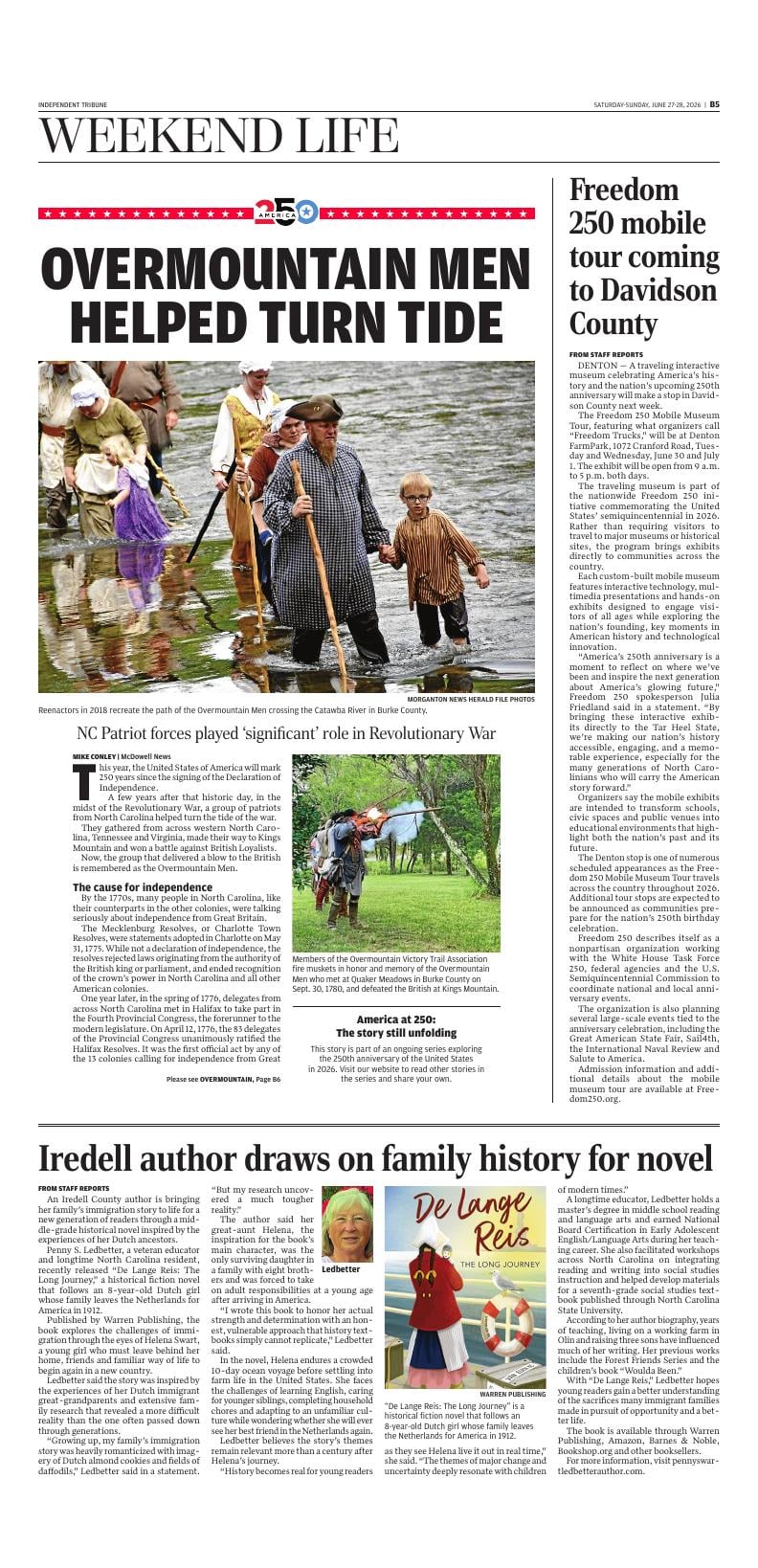
Reenactors in 2018 recreate the path of the Overmountain Men crossing the Catawba River in Burke County.
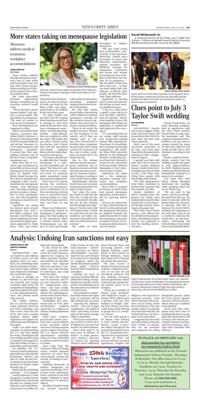
Members of the Overmountain Victory Trail Association fire muskets in honor and memory of the Overmountain Men who met at Quaker Meadows in Burke County on Sept. 30, 1780, and defeated the British at Kings Mountain.
Reenactors in Burke County celebrate revolutionary War days at the Catawba river in 2018.
The Overmountain Men were frontier settlers who had established homes in the Appalachian Mountains. they came from parts of Virginia, north Carolina, and what is now Tennessee and Kentucky.
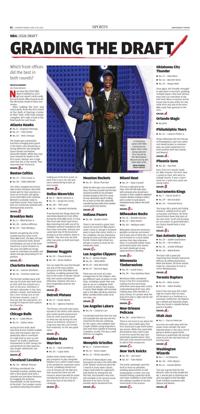
These students learn about life during the American revolution, 250 years ago, from reenactors in McDowell County.
This year, the United States of America will mark 250 years since the signing of the Declaration of Independence.
A few years after that historic day, in the midst of the Revolutionary War, a group of patriots from North Carolina helped turn the tide of the war.
They gathered from across western North Carolina, Tennessee and Virginia, made their way to Kings Mountain and won a battle against British Loyalists.
Now, the group that delivered a blow to the British is remembered as the Overmountain Men.
The cause for independence
By the 1770s, many people in North Carolina, like their counterparts in the other colonies, were talking seriously about independence from Great Britain.
The Mecklenburg Resolves, or Charlotte Town Resolves, were statements adopted in Charlotte on May 31, 1775. While not a declaration of independence, the resolves rejected laws originating from the authority of the British king or parliament, and ended recognition of the crown's power in North Carolina and all other American colonies.
One year later, in the spring of 1776, delegates from across North Carolina met in Halifax to take part in the Fourth Provincial Congress, the forerunner to the modern legislature. On April 12, 1776, the 83 delegates of the Provincial Congress unanimously ratified the Halifax Resolves. It was the first official act by any of the 13 colonies calling for independence from Great Britain. The first formal call for American sovereignty is recognized as an important precursor to the Declaration of Independence, adopted on July 4, 1776, according to information from the North Carolina Department of Natural & Cultural Resources.
America at 250: The story still unfolding
This story is part of an ongoing series exploring the 250th anniversary of the United States in 2026. Visit our website to read other stories in the series and share your own.
The war for independence comes to western NC
The Revolutionary War started in April 1775 with the fighting at Lexington and Concord in Massachusetts, culminating with the adoption of the Declaration of Independence in Philadelphia on July 4, 1776, and continued with various campaigns and battles in New York, Pennsylvania and New Jersey and New England. But by the late 1770s, British Gen. Henry Clinton took the war into the Southern colonies.
Clinton's southern expedition was supported by Lt. Gen. Charles Cornwallis, according to information from the National Parks Service. The goal was to join and support Loyalists in North Carolina. By 1780, the British forces were waging war in North and South Carolina.
One British officer leading the campaign was Maj. Patrick Ferguson. He commanded the 71st Regiment of Foot (an infantry regiment) and started his campaign into the Carolinas.
By September 1780, Ferguson had established a base camp at Gilbert Town, which was the county seat of Rutherford County at that time, according to information from the North Carolina Department of Natural and Cultural Resources. He threatened Patriot leaders to lay down their arms to intimidate and put fear into the Patriot forces. It had the opposite effect.
The Patriot forces, now called the Overmountain Men, left their mountain homes to join forces with the goal of stopping Ferguson.
The fighting at Cane Creek
Before the Overmountain Men gathered in Burke County, North Carolina, Ferguson heard that Patriot militia troops under Col. Charles McDowell were camped on Cane Creek in what is now the Dysartsville community of McDowell County. Ferguson and Loyalist forces marched up from Gilbert Town to attack McDowell.
McDowell was moving up the Broad River toward what is now Tennessee when he learned of Ferguson's plan. He prepared an ambush above one of the many fords of the creek.
On Tuesday, Sept. 12, 1780, Ferguson's detachment marched down the valley after passing through the gap where U.S. Highway 64 is now located. McDowell's Patriot forces, waiting, were hidden behind the trees.
"McDowell selected a strategic site for the ambush at Bedford Hill, commanding Cowan's Ford on Cane Creek," information from the N.C. Department of Natural and Cultural Resources said. "In the clash between forces on Sept. 12, both sides suffered fatalities and Major (James) Dunlap was wounded in the leg."
The Patriots defended themselves briefly. However, despite outnumbering the enemy, they then took off.
"McDowell's party surveyed their situation and counted their losses," reads the book "The Other Side of the River" by McDowell County historian Anne Swann. "Charles McDowell himself had escaped unscathed along with his brother Joseph and their young cousin Joseph of Pleasant Gardens. James Hemphill of Dysartsville had been killed in the action, along with Peter Brank and a soldier named Scott, both from present Burke County. Most likely, there were others not reported. A number were wounded."
Historians concur that the outcome was indecisive. Accounts of the fighting disagree depending on which side was doing the reporting, according to Swann's book.
The news of this skirmish spread across the region and made the Patriot forces more determined to seek out Ferguson and his Loyalist troops. Although the fighting at Cane Creek was indecisive, it is considered to have inspired the Overmountain Men to keep going after Ferguson.
Today, a state historical marker along U.S. Highway 64 tells people that American revolutionary history occurred nearby. U.S. Highway 64 is part of the Overmountain Victory National Historic Trail, which is maintained by the National Park Service. Every year, reenactors with the Overmountain Victory Trail Association recreate the route taken by those Patriots more than 200 years ago.
The march to Kings Mountain
The Overmountain Men were frontier settlers who had established their homes in the Appalachian Mountains. They came from parts of Virginia, North Carolina and what is now Tennessee and Kentucky. One was John Crockett, who built a frontier home in present-day northeast Tennessee. After the war, he and his wife, Rebecca, would have nine children. One of them was a son whom they named David. He was better known as Davy.
The Overmountain Men took part in operations against British Loyalists and the British-aligned Cherokee and Shawnee all along the Appalachian frontier years before Ferguson sent out his threat.
Upon hearing of Ferguson's threat, one of the leaders of the Overmountain Men, Isaac Shelby, rode 40 miles to consult with another leader, John Sevier, and the two agreed to raise armies and cross the mountains to fight Ferguson, according to information from the Overmountain Victory Trail Association.
On Sept. 25, 1780, several hundred frontiersmen gathered at Sycamore Shoals in what is now Elizabethton, Tennessee.
The assembled force consisted of hundreds of men who gathered from across the region.
On Sept. 26, 1780, the Overmountain Men began their trek through the mountains, going from Sycamore Shoals to Shelving Rock at Roan Mountain, where they camped. The men drove a herd of cattle to feed the army, according to the Overmountain Victory Trail Association.
At the same time, more men from North Carolina were headed to meet the main group.
The men moved along the North Toe River Valley to an area near what is now Spruce Pine. On Sept. 29, the main group split up at Gillespie Gap and descended the mountains, camping north of the current-day Marion, North Carolina.
The force then gathered at the McDowell family plantation at Quaker Meadows, near Morganton, North Carolina, where they were joined by 300 or more men.
Under a tree that came to be known as the Council Oak at Quaker Meadows, the commanding officers made plans and organized the militia, then close to 1,400 men strong, according to information from the National Park Service.
The militia camped for the night, then continued south to Gilbert Town, near Rutherfordton, toward Ferguson's troops. Facing heavy rain, the group camps at Bedford Hill, near present-day Dystartsville, according to the Overmountain Victory Trail Association.
By Oct. 4, the Overmountain Men reached Ferguson's base at Gilbert Town, but found Ferguson was already gone. The next day, scouts learn where Ferguson was headed, and the Patriots follow.
On Oct. 6, the frontiersmen reached Cowpens, South Carolina, where they were joined by militiamen from South Carolina, Georgia and North Carolina. Though Ferguson attempted to elude the Overmountain Men, they learned Ferguson was camped about 30 miles away, and made plans to attack.
According to the Overmountain Victory Trail Association, several hundred of the best marksmen and the fastest horses were sent to ride through a rainy, cold night to reach Ferguson. The company had to cross the flooded Broad River.
The dedicated men, who were waging war against the king of Great Britain, were headed to a small mountain named for a king.
'The turn of the tide of success'
About 1,000 British and Loyalist troops were camped on Kings Mountain. The mountain is about 50 miles west of Charlotte, near the North Carolina–South Carolina border.
The Patriot militia reached Kings Mountain on the afternoon of Oct. 7, according to information from The American Battlefield Trust nonprofit.
Patriots surrounded the mountain. One leader of the militia, William Campbell, was reported to have told his men to "shout like hell and fight like devils."
Kings Mountain is a small mountain with steep slopes. They were heavily wooded and the Patriot men had plenty of cover.
Ferguson sat atop his horse, leading his troops from the top of Kings Mountain, according to The American Battlefield Trust.
After about an hour, the Overmountain Men had taken a toll on the Loyalists.
Ferguson was killed by sharpshooters while attempting to lead his men past the American militia. He was shot multiple times.
The remaining Loyalists surrendered.
In all, an estimated 157 British soldiers were killed and about 160 wounded, though estimates vary. About 28 Americans were killed and about 60 were wounded, according to The American Battlefield Trust.
Ferguson's body was buried at Kings Mountain. It remains at the Kings Mountain Battleground Cemetery.
Loyalist prisoners were marched toward the mountains, pausing in northern Rutherford County, where several were put on trial for atrocities allegedly committed on the frontier, and nine were hanged.
The victory at Kings Mountain was considered significant for the Patriots, according to information from the North Carolina Department of Natural and Cultural Resources.
Thomas Jefferson later said Kings Mountain was the "turn of the tide of success."
A century later, Theodore Roosevelt wrote: "This brilliant victory marked the turning point of the American Revolution." In 1931, the U.S. Congress created the Kings Mountain National Military Park, and a memorial was dedicated at the summit.
At the dedication, President Herbert Hoover said, "This small band of patriots turned back a dangerous invasion well designed to separate and dismember the united colonies. It was a little army and a little battle, but it was of mighty portent. History has done scant justice to its significance, which rightly should place it beside Lexington and Bunker Hill, Trenton and Yorktown, as one of the crucial engagements in our long struggle for independence."