
Memorial dilemmas
Proposals to honor slain activist Charlie Kirk haven't come to fruition

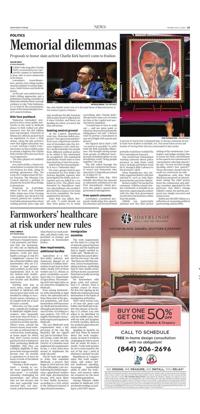
Rep. Alex Kolodin works June 11 in the state House of Representatives at the Arizona Capitol in Phoenix.

A portrait of Charlie Kirk is displayed sept. 21 during a memorial service at state Farm stadium in Glendale, Ariz. The conservative activist and founder of Turning Point USA was assassinated 11 days earlier.
POLITICS
It didn't take long after Charlie Kirk's assassination on a uni-versity campus in September to hear calls to erect memorials in his honor.
Lawmakers, councilmembers, pastors and college leaders announced plans to rename highways, build statues and dedicate plazas.
As the one-year anniversary of Kirk's killing approaches and a preliminary hearing concludes to determine whether there's enough evidence to take Tyler Robinson, 23, to trial for the assassination, many of the memorial plans haven't come to fruition.
Bids face pushback
Tennessee lawmakers' proposal to force every public university in the state to dedicate plazas to Kirk stalled out after concerns over the $18 million price tag emerged. University of Minnesota officials pushed back on legislation to erect a Kirk statue, citing the late activist's view that higher education was a scam. Bastrop County Commissioners in Texas tabled a plan to rename a highway the Charlie Kirk corridor after pressure from vocal opponents.
The story played out similarly in Arizona.
Gov. Katie Hobbs, a Democrat, vetoed plans to rename the Loop 202 freeway for Kirk, citing its existing eponymous title, the Loop 202 Congressman Ed Pastor Freeway. The Phoenix City Council rejected a petition to rename the Seventh Street Bridge in downtown.
Proposals in Scottsdale, where he lived, and Fountain Hills, where one of his Turning Point staffers was elected to the council, petered out. Leaders in Scottsdale raised questions about waiting periods, price tags and who would pay the bill. Fountain Hills leaders haven't talked about it since October, and there's no deadline for when, or even if, the idea will return.
Seeking neutral ground
At the Capitol, Republican state Sen. Shawnna Bolick proposed a "free speech monument." Every year, a bipartisan commission of lawmakers plus the Arizona Supreme Court chief justice would nominate two people from different political parties to be added to the monument for recognition. The nominated individuals would need to have been dead for at least five years.
Bolick told The Arizona Republic it was a "tiebreaker idea."
For years, groups tried to pass a memorial for Don Bolles, the Arizona Republic reporter who investigated the Mafia and corruption and was killed by a car bomb in 1976. The efforts were thwarted by Republican state Sen. Jake Hoffman, who wouldn't give the bills a chance to be voted on in his committee. He never explained his decision.
After Kirk was killed, Bolick said, "I could already see they were gonna try to name everything after Charlie Kirk." She pictured some sort of statue for him at the Capitol and worried about vandalism.
"I would hate to have to walk out … and see spray paint or whatever desecration potentially taking place," she said. "I did not want to portray a monument in any sort of light with a particular person."
She figured she'd draft a bill "as neutral as possible" to solve both the Kirk and Bolles dilemmas. She thought having names from people of different backgrounds and philosophies on one installation could "bring people together," she said.
The bill sailed through the Senate but crashed in the House. It wasn't just Democrats who rejected it; 12 Republicans joined in. It failed 19-35.
Republican state Rep. Alex Kolodin described the measure as inherently antithetical to the First Amendment, which protects the public's speech from government infringement.
Free speech concerns
Lawmakers considered proposals implicating free speech, but attorneys said several of them probably would have violated the First Amendment if passed.
One would have criminalized warning someone about police presence to help them avoid arrest. Kolodin and Bolick voted for it, though it didn't advance to the governor's desk.
Some Republicans who initially supported Bolick's bill later rejected it, such as state Reps. Rachel Keshel and John Gillette.
Keshel couldn't be reached for comment. Gillette echoed similar sentiments as Kolodin in an interview, expressing discomfort with the idea that government would select the honorees rather than the public.
Gillette was particularly alarmed over the chief justice sitting on the commission. Lawmakers and judges picking who to honor for their contributions to free speech was tantamount to "government selecting speech," he said. "So now we have a judge deciding what's free speech?" Those decisions should only be made in a courtroom, he said.
Republican state Rep. Walt Blackman proposed an amendment nixing the chief justice from the commission and adding a member appointed by the governor; that didn't change Gillette's mind. He said the proposal was simply excessive and unnecessary.
Bolick sees the bill's failure as a reflection of worsening political partisanship and hostility.