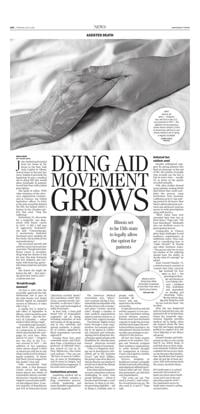

DYING AID MOVEMENT GROWS
Illinois set to be 13th state to legally allow the option for patients

After almost 30 years — Oregon's law, the first in the U.S., was enacted in 1997 — the addition of two populous states means almost a third of Americans will live in one where medical aid in dying is legally available.

Medical aid in dying laws allow terminally ill patients to end their lives with a lethal prescription.
ASSISTED DEATH
Jules Netherland traveled from her home in the Bronx to the New York state Capitol in Albany several times in the past few years, hoping to persuade the legislature to pass a medical aid in dying bill that would allow terminally ill patients to end their lives with a lethal prescription.
She spoke at rallies. With other members of the advocacy organization Compassion & Choices, she visited legislators' offices. In 2024, as the state Assembly debated the bill, she helped unfurl a banner in the chamber gallery that read, "Stop the Suffering."
Netherland, 59, who works for a nonprofit, was diagnosed with breast cancer in 2019. "I did a full year of aggressive treatment," she said. "Chemotherapy. A mastectomy. Radiation treatment every weekday for five weeks. Six months of two oral medications."
She recovered and felt well until the cancer returned a few years later. Though metastatic breast cancer is incurable, drugs keep her disease at bay for now. She feels fortunate but also fatigued, and contends with brain fog, gastrointestinal symptoms and joint pain.
She feared she might die before the bill — first introduced in New York in 2016 — could become law.
'Breakthrough moment'
On June 9, 2025, after the Assembly approved the bill, Netherland saw it pass in the state Senate. Gov. Kathy Hochul signed an amended version in February; it takes effect Aug. 5.
A similar law is slated to take effect in September in Illinois, which would become the 13th state — plus the District of Columbia — where medical aid in dying is legal.
"A breakthrough moment," said Kevin Díaz, president of Compassion & Choices, which spearheaded the campaign for such laws. After almost 30 years — Oregon's law, the first in the U.S., was enacted in 1997 — the addition of two populous states means almost a third of Americans will live in one where medical aid in dying is legally available. "It shows that there's broad support for this model," Díaz said.
Polls consistently back that claim. A Pew Research Center survey last spring found almost two-thirds of respondents did not consider the practice "morally wrong." Support crossed many political and religious lines: A narrow majority of Republicans and 76% of Democrats found "physician-assisted death," also sometimes called "physician-assisted suicide," permissible; so did most Catholics, Jews and nonevangelical white Protestants.
In New York, a Siena poll found 54% of respondents supported aid in dying, including majorities of men and women of all age groups, and of city, suburban and upstate residents. A plurality of Latinos supported it; Black respondents narrowly opposed it.
Passing these laws grew somewhat easier, said Thaddeus Pope, a bioethicist and professor at Mitchell Hamline School of Law in St. Paul, Minnesota, who tracks such policies. "You can say, 'We have 10 years in California, 18 years in Washington and 29 years in Oregon, and nothing bad has happened.' It becomes more accepted."
Contentious process
Legalizing medical aid in dying, or MAID, remains a long, contentious process. Catholic leadership and many disability organizations staunchly oppose it.
The American Medical Association says, "physician-assisted suicide is fundamentally incompatible with the physician's role as healer" and poses "serious societal risks," though a number of state medical organizations opted to remain neutral or, as in New York, support passage.
The Patients' Rights Action Fund, through a sister organization, has lawsuits pending or on appeal in California, Delaware and Colorado, arguing aid in dying laws discriminate against people with disabilities by steering them toward physician-assisted suicide instead of treatment.
"This is a litigation strategy we've developed to ultimately get to the Supreme Court," said Matt Vallière, the group's executive director, who declined to say whether it would sue to block the Illinois and New York laws.
Even when aid in dying laws succeed, using them can prove challenging. In every state except Montana — where it became legal through a court decision, so there is no statute governing eligibility — aid in dying is available only to people with incurable illnesses who are expected to die within six months.
It typically involves oral and written requests to two doctors, with mandated waiting periods between requests. Patients must have the mental capacity to make the decision and they must ingest the medication without assistance. An amendment Hochul insisted on adds a psychologist or psychiatrist to the process.
All but two states require patients to be residents. Oregon and Vermont scrapped their residency requirements to settle lawsuits brought by Compassion & Choices. Courts ruled against a similar suit in New Jersey.
Doctors, hospitals or healthcare systems can legally decline to provide aid in dying, and religiously affiliated institutions often opt out. Those that participate can add their own requirements.
"The state can say 'You need A, B and C,' and Columbia-Presbyterian can say, 'We also want D, E and F,'" Pope said.
Despite widespread support for giving patients this kind of autonomy at the end of life, the number of people who actually use the law is tiny in every state — usually 1% or fewer of the deaths recorded annually.
Still, after studies showed many patients seeking MAID died before they could complete the process, some restrictions were loosened. California cut its 15-day waiting period to 48 hours; New Mexico allows physician assistants and advanced-practice nurses to write prescriptions along with doctors.
“Most states have now amended their laws two or three times,” Pope said. “We have liberalized.” Telehealth also can facilitate access to participating doctors.
Compassion & Choices plans legal challenges to end residency requirements in additional states, Díaz said, and is considering how to “make inroads” in Florida and other Southern states. “The person who has to bear the burden of the suffering should have the ability to decide when it’s enough,” he added.
Anne Gurnett Bander, 72, a retired research scientist in Carmel, New York, cared for her husband for four years as ALS — the neurological disorder also known as Lou Gehrig’s disease — rendered him bedridden and dependent on feeding and breathing tubes. :By the time he died, the only thing he could do was nod his head,” she recalled.
After she was diagnosed with ALS herself last year, she planned to fly to Switzerland, where the nonprofit organization Dignitas provides medical aid in dying, when she learned about the New York bill and began speaking publicly in support of it, her voice faltering as her illness advanced.
Gurnett Bander and Netherland say they’re not certain they’ll use lethal drugs to end their lives as their symptoms intensify. Patients often complete the necessary steps, secure the prescribed medication, decide they don’t need it after all and die of their diseases. Still, both women insist the choice should be theirs.
KFF Health News is a national newsroom that produces in-depth journalism about health issues and is one of the core operating programs of KFF — the independent source for health policy research, polling and journalism.