

US deficits are supercharged
ANOTHER VIEW | BLOOMBERG NEWS
Faced with soaring deficits, an aging population, a teetering pension system, unsustainable healthcare obligations, $1 trillion in annual interest costs, rising long-term bond yields and net public debt at around 100% of gross domestic product, what's a country to do?
For the 119th Congress, the answer has been simple: Tax less and borrow more. As Republican leaders ponder yet another party-line spending bill — expected to include at least $95 billion in new outlays with no offsetting revenue — they might reflect for a moment on America's budgetary crisis in the making.
Over less than two years, this Congress has worsened the nation's fiscal trajectory dramatically. Its main accomplishment, last year's One Big Beautiful Bill Act, will by itself increase deficit spending by at least $4.1 trillion from 2025 to 2034. Add an additional $1 trillion or so once many of the law's "temporary" tax cuts are inevitably extended, and the U.S. will soon be looking at annual deficits approaching $3 trillion and a debt-to-GDP ratio exceeding post-war highs.
As things stand, across nearly two years of unified government, Republicans have imposed enormous new costs on Americans with precious little to show for it.
Canceling wind projects wrong
ANOTHER VIEW | NEW YORK DAILY NEWS
President Donald Trump's weird hatred of offshore wind energy is costing a lot as Uncle Sam has to pay off the companies which had invested in the canceled projects.
For the fifth time now, the Trump administration has agreed to pay an energy firm a huge sum of money, not for building something, but for not building it. The German firm RWE announced that it would receive $1.22 billion to stop development of already-planned offshore wind farms, including one that was set to go up in New York.
That brings the total that Trump has committed specifically to kill wind energy to just about $4 billion.
All Trump had to do was stay out of the way and allow these already-planned wind projects to move forward, creating jobs and advancing the cause of American energy independence. That's an especially attractive objective in light of the president's war against Iran, which may end up the Strait of Hormuz being under some level of restrictions indefinitely.
Instead, we are now giving away public money to stop much-needed projects that could lessen our reliance on what happens in this water channel halfway across the globe.
Going all-in on dirty and outdated energy sources is lose-lose-lose.
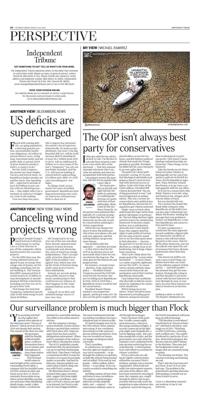
The GOP isn't always best party for conservatives

JONAH GOLDBERG
I often get asked for my advice on how to vote. I'm the first to concede these requests come from a very niche slice of the electorate — that tiny remnant of people who know who I am, value my opinion and share my exasperation with both parties.
I am going to answer the question. But first let me explain why I don't like it. Too many pundits on the left and right fall into the habit of confusing or conflating the fortunes of a party with that of their philosophy. Many come by this tendency honestly. As the parties have polarized ideologically, it's a natural assumption to think that the GOP and Democrats are the sole vessels for conservatism and progressivism, respectively.
Add in the very human tendency to favor the politicians who return your phone calls and seek your approval, and that rooting interest can get even more intense.
One problem with this approach — and there are many — is that what is best for the GOP in an election year is not necessarily what is best for conservatism in the long run. The same goes for the Democrats and progressivism.
For instance, on many issues — abortion, trade, industrial policy — President Donald Trump has moved the GOP leftward over his two terms. But just try telling most Republicans in 2016, 2020 or 2024 that a Republican victory would be bad for conservatism.
President Barack Obama wanted a very progressive agenda, and he got some of it. He also cost his party roughly 1,000 elected offices across his two terms, and left behind a political climate that made the Trump presidency possible. President Joe Biden left his cause and party in an even uglier ditch.
The point isn't about political point-scoring. It's to note that ideological and intellectual progress doesn't move in lockstep with electoral success or failure. In his 1996 State of the Union address, President Bill Clinton declared that "the era of big government is over" and moved rightward on welfare reform. This was a victory for conservatism and a political loss for Republicans, because his triangulation got Clinton reelected.
Single-issue activists often understand this logic better than generic ideologues or partisans do. The last thing abortion rights activists want is for antiabortion Democrats to become a major faction, just as antiabortion advocates don't want Republicans who support abortion rights to gain political traction. But the same activists would love to see the other party move in their direction — because the goal isn't to use the issue of abortion as a wedge issue or for fundraising, but to forge a bipartisan consensus.
That's how I think about the proper goal of the "conservative movement" — to move America's center of gravity rightward, not just the GOP's. So conservatives should celebrate when conservative Democrats are nominated, even if that's bad for Republicans electorally.
I also believe that candidates who discredit or deform conservatism by claiming to be conservative should lose.
Which brings me to my advice. Voters should be more interested in rewarding good behavior and good character than in ideological or partisan purity. That doesn't mean ideology and partisanship are irrelevant. These things can be balanced.
Take the Senate race in Texas. Democrat James Talarico is ideologically not my cup of tea, and he is quite far to the left for Texas. But his Republican opponent, Texas Attorney General Ken Paxton, is in my view a corrupt gargoyle unfit for any office.
So if you're a conservative who thinks Talarico is too left-wing and Paxton is bat-winged, don't vote for either of them.
But you should still vote. You can leave the Senate line blank while voting for other Republicans on the ballot (you can also select Libertarian candidate Ted Brown). Sending the message that your problem is Paxton, not Republicans, is one that Republicans and conservatives need to hear.
If I were a progressive, I would have the same approach toward candidates aligned with the Democratic Socialists of America who will hurt either the party or the cause. Vote for all the other Democrats, just not the radicals who spout the sort of nonsense that turns off more mainstream voters than they attract.
One reason our politics are such a mess is that fringe candidates know they can count on the reflexive support of their parties — and their pundits — the moment they get the nomination. Strategically voting to end that dynamic is not inconsistent with the best interests of your ideological cause or your party, because those interests are often in tension in an election year.
Goldberg is editor-in-chief of The Dispatch: thedispatch.com.
Our surveillance problem is much bigger than Flock

STEPHEN L. CARTER
'You are being watched" was the tagline that opened every episode of the television series "Person of Interest," which ran from 2011 to 2016 and already feels ancient. The conceit of the show was that the good guys, aided by friendly artificial intelligence, could use information from a sea of cameras and microphones to stop crimes before they happened.
That fictional world comes to mind in light of the controversy surrounding Flock Safety, a company that has installed some 120,000 cameras in cities and towns across the U.S. Flock's automatic license plate recognition system identifies passing cars and stores their identifying details (make, model, a Mets bumper sticker, a cracked rear window) in a searchable database. The utility to law enforcement is obvious.
But the company is facing a serious backlash. Dozens of jurisdictions canceled their contracts with Flock since 2025. Some are angry Flock has been used for immigration enforcement. Others point to examples of law enforcement officers abusing the system.
The ACLU published a model resolution that city governments can use to end their relationship with Flock. Then there's DeFlock, a crowdsourced effort to map the locations of as many license plate readers as possible. And back in February, Amazon publicly canceled a plan to link its Ring cameras with Flock's systems.
My libertarian heart is always warmed when signs, however faint, suggest the future might contain less surveillance. And critics of Flock's misuse are right to be alarmed. But Flock is only part of a much bigger problem.
The more fundamental mistake was letting surveillance become a ubiquitous part of American life.
It's hard to imagine now, but in the 19th century, when cameras were young, it was considered discourteous to take a person's picture without permission. Now, once we've exited our homes, our images are being recorded constantly.
That's a problem. In a democracy, we ought to have the right not simply to privacy but to anonymity — to go through the ordinary occupations of daily life without being tracked and surveilled. To be seen by real people — fellow walkers, fellow drivers — is one thing. To be constantly recorded is something else entirely.
Installing cameras all over cities and towns is mass surveillance. The cameras capture images, which the AI then helpfully labels, and — surprise! — law enforcement suddenly wants to sift through those images.
That's the heart of the problem. A traffic camera might seem innocuous, a device to discourage running red lights. A security camera up on the light pole might seem insignificant, a tool for fighting crime. But combine enough bits of data, and the government can create what the Supreme Court condemned in its June decision restricting the use of geofencing: "a virtual panopticon with which to scrutinize its citizens' activities."
Privacy advocates are calling for tighter controls before authorities can query Flock's database, perhaps even a warrant requirement. Flock itself now audits law enforcement requests, and some of the officers who have been arrested for misusing it were, the company says, caught through its efforts. But no government will ever fully resist the temptation to mine whatever data is gathered. And in the long run, the Fourth Amendment will never keep up with technology.
"The Machine is everywhere," Harold Finch of "Person of Interest" said back in the horse-and-buggy era of 2011. "Watching us with 10,000 eyes. Listening with a million ears." The capital M referred to a particular AI system, which Finch designed. But the eyes and ears didn't belong to the Machine. They were just the background sounds and images that are constantly being recorded.
The Machine was fiction. The constant watching and listening are real.
That's why the true issue isn't just Flock. It isn't ICE or a few bad cops. The problem is the government's growing obsession with keeping a constant eye on those it exists to serve.
Carter is a Bloomberg columnist and professor of law at Yale University.