This content is unavailable. Please contact customer service for more information.
Already a subscriber? Login or Activate your account.
You've reached the end of the standard E-Edition.
This content is unavailable. Please contact customer service for more information.
Events
Top StorySpotlight
KANNAPOLIS
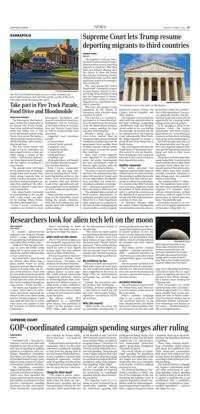
Kannapolis Fire Department hosts Fire Truck Parade, Food Drive, Bloodmobile
From staff reports
Updated
The Fire Truck Parade will begin at 6 p.m. Onlookers are
encouraged to bring a chair and enjoy seeing a variety of fire
trucks from departments throughout the region
City of Kannapolis photo
The Kannapolis Fire Department invites the community to its annual Fire Truck Parade, Food Drive and Blood Donation event this Friday, Oct. 2. The event will feature a parade of fire trucks from across the region, a nonperishable food drive to benefit local families, and a community blood drive.
The Fire Truck Parade will begin at 6 p.m. Onlookers are encouraged to bring a chair and enjoy seeing a variety of fire trucks — both historic and modern–from departments throughout the region, according to a news release.
The parade route will begin at the intersection of Biotechnology Lane and Laureate Way, travel along Laureate Way to North Carolina Research Campus Drive, then returning to Laureate Way, ending at the intersection of Watson Creek Drive and Laureate Way.
From 3-6 p.m., community members are invited to meet Kannapolis firefighters and drop off canned food donations. Firefighters will be stationed at the intersection of Laureate Way and Watson Creek Drive to collect nonperishable food donations.
Suggested food donations include:
• Canned meats
• Peanut butter and jelly
• Spaghetti sauce
• Spaghetti noodles
• Canned fruit
• Pork and beans
• Pudding cups
All donated items will benefit local families through Cooperative Christian Ministry.
From 2-7 p.m., community members can also help save lives by donating blood. OneBlood’s Big Red Bus will be on-site from 2-7 p.m. at the intersection of Laureate Way and Watson Creek Drive. Appointments are encouraged and can be scheduled at: www.oneblood.org/donate-now.html.
Please note the roundabout in front of City Hall will be closed during the parade. However, both City Hall parking lots will remain open and available for public parking.
Supreme Court lets Trump resume deporting migrants to third countries
ANDREW CHUNG Reuters
The Supreme Court is seen Sept. 1 in Washington.
AARON SCHWARTZ, REUTERS
The Supreme Court on Tuesday let President Donald Trump's administration resume deporting migrants to countries other than their own without offering them the chance to show the harms they may face, bolstering a tool his administration has used for rapid expulsions as part of his immigration crackdown.
The court granted the Justice Department's emergency request to pause Boston-based U.S. District Judge Brian Murphy's ruling that the Department of Homeland Security's policy to remove migrants to so-called third countries is unlawful.
The court also agreed to hear arguments in the dispute in December, with a formal ruling on policy to follow.
The court has a 6-3 conservative majority. Its three liberal justices dissented from the decision to let the deportations immediately resume pending the final outcome of the litigation.
Murphy's ruling came in a class-action lawsuit filed by immigrant rights groups on behalf of migrants seeking to prevent the government from sending them to third countries without notice and a chance to assert the harms they could face.
More than 25,000 migrants were deported to 29 countries under the policy implemented last year, according to a tally by human rights groups, with the vast majority going to Mexico.
The policy is one of a number of measures the administration has taken in its pursuit of Trump's goal of mass deportation. The Republican president has enforced a sweeping crackdown on immigration — among his top priorities — since returning to office last year.
The administration carried out third-country deportations to politically unstable South Sudan, which the U.S. State Department urges Americans to avoid due to the risks of crime, kidnapping and armed conflict, as well as Uganda Equatorial Guinea, Liberia, the Central African Republic and other nations.
The Supreme Court previously sided with the administration in the legal challenge, suspending a preliminary order that Murphy issued earlier in the case halting the removals. In another win for the administration, the Supreme Court subsequently lifted limits the judge imposed to protect a group of men from being sent to South Sudan.
The case began in 2025 after the Department of Homeland Security moved to step up deportations of migrants who cannot be returned to any country listed on their deportation orders.
Swiftly removed
The policy provided that migrants could be swiftly removed without notice to third countries that provided credible diplomatic assurance that they will not persecute or torture the individuals. For countries that didn't provide such assurance, deportees would be notified of their destination and U.S. authorities would assess the likelihood of persecution or torture only if the individual raises such fear on their own.
In February, Murphy ruled the policy violates immigration law procedures and due process protections under the Constitution's Fifth Amendment. Due process generally requires the government to provide notice and an opportunity for a hearing before taking certain adverse actions.
In its emergency filing to the Supreme Court, the Justice Department said third-country deportations are "an essential tool to remove certain aliens, including some of the worst criminal aliens."
But both Murphy and critics of the administration said the policy is also targeting migrants who were granted legal protection from being sent back to their home countries.
The policy resulted in deportees being unlawfully transferred by third countries back to their home countries from which the U.S. already granted them protection, while others have been beaten, sexually assaulted, detained or have disappeared, the plaintiffs said in a court filing.
The administration is ignoring "the significant harm resulting from deporting thousands of longtime U.S. residents, many with no criminal history, to third countries without regard to the persecution or torture they face there," the plaintiffs said.
The Boston-based 1st U.S. Circuit Court of Appeals upheld most of the judge's ruling Sept. 18.
Researchers look for alien tech left on the moon
ERIC LAGATTA USA TODAY
NASA released thousands of new photos taken during the Artemis
II mission around the moon. The astronauts selected for the mission
thoroughly documented the 10-day voyage, which included an April 6
lunar flyby as they traveled more than a quarter-million miles from
Earth.
PROVIDED BY NASA
If ancient extraterrestrial explorers ever traipsed through Earth's cosmic neighborhood, it's possible they left behind some interstellar litter in their wake.
Think of it like the loose hubcaps on your old family sedan being left to waste away on the side of the road for millennia after a cross-country trip.
And what better place to look for leftover alien refuse than a place nearby where no pesky planetary features like an atmosphere or flowing water can dispose of the evidence? That's why in a new study researchers propose looking no further than the moon to find signs that other advanced life-forms wandered through our solar system — if they ever did.
The moon also happens to be a place where fleets of astronauts and robotic spacecraft are bound in the years ahead under NASA's Artemis program. Could that make the time ripe to collect some lunar soil samples to look for remnants of extraterrestrial technology?
Here's everything to know about why the moon may be a good place to begin the search.
Alien tech on the moon
The SETI Institute is famous as the nonprofit organization that uses ground-based telescopes to search for radio or laser signals in deep-space that may indicate advanced alien civilizations.
But one researcher at the institute proposed looking much closer to home — the moon — for evidence of extraterrestrial life.
In a new study, geologist Lewis Pinault suggests soil on the moon's surface, known as lunar regolith, could conceal microscopic "engineered particles" known as technosignatures that accumulated over billions of years. In other words, if alien civilizations produced debris while exploring Earth's neck of the cosmos, there's a chance at least some of it ended up on the moon.
The theory, which SETI highlighted in a September press release, was published in August on the preprint server arXiv while under peer review by the International Journal of Astrobiology.
"The moon has been quietly accumulating material from space for billions of years, much of it likely billions of years older than the moon itself," Pinault said in a statement. "We're asking whether that ancient collection might contain microscopic traces of technologies that existed long before humans ever looked up at the sky."
No evidence so far
Before you allow your head to be filled with visions of moon men, not only would such material not have originated on the moon to begin with, no extraterrestrial technology has actually been found.
Instead, the researchers simply propose that technology — including artificial intelligence — now exists to search for and test such "microscopic technosignatures," according to SETI's news release.
Why the moon?
Unlike Earth, the moon has no atmosphere, flowing water or active geological features like volcanoes that would erase evidence of ancient artifacts. In fact, the moon's surface famously remains cratered and pockmarked from billions of years of being battered by asteroids and other objects from space.
That makes Earths' celestial neighbor — and only natural satellite — a potential repository of "dust from across the solar system and interstellar space," according to SETI.
The researchers modeled how extraterrestrial tech could theoretically not only travel between stars, but survive the journey and become a permanent feature of the lunar surface.
Artemis missions
The new research comes as both the United States and China race to return humans to the moon in the years ahead.
NASA's Artemis campaign aims to use a series of crewed and uncrewed missions in the years ahead to build a $20 billion moon base where rotating crews of astronauts can live and work long-term. Following the Artemis II mission in April, the U.S. space agency is targeting one more test mission in 2027 before attempting a human moon landing the following year.
SETI researchers say future moon missions offer "an unprecedented opportunity" to collect lunar samples that can be analyzed not only to better understand the moon's history, but to determine whether extraterrestrial technology ever landed on the surface — whether intentionally or by happenstance.
GOP-coordinated campaign spending surges after ruling
SUPREME COURT
JOHN KRUZEL Reuters
WASHINGTON — Since the U.S. Supreme Court in June sided with Republicans and struck down federal caps on spending by political parties in coordination with candidates, Republican committees have blown past the former limits as President Donald Trump's party fights to retain control of Congress in November's midterm elections.
The Republican committees supporting the party's candidates in Senate and House of Representatives races have exceeded the former national caps by more than $48 million, according to Federal Election Commission spending disclosures for July and August. Their Democratic counterparts also eclipsed the former limits, but by much less — just under $4 million.
Political analysts said Republican committees seek to use the newly unfettered coordinated spending to help level the playing field in key races in which individual Democratic candidates outraised their Republican opponents. Another surge in spending by both parties is expected in the coming weeks in the run-up to the Nov. 3 elections.
'Bang for their buck'
"The political parties anticipated that the court was likely to strike down the limits on coordinated party spending and had been planning in advance for that outcome. That's particularly true on the Republican side," said New York University School of Law professor Richard Pildes, an expert in campaign finance. "Given that, it's not surprising that the Republican Party has quickly shifted the structure of its spending. The parties get a much bigger bang for their buck on broadcast ads when they engage in coordinated spending with their candidates, rather than independent spending," Pildes added.
A 1971 law called the Federal Election Campaign Act imposed the restrictions on coordinated spending with the aim of preventing corruption.
The Supreme Court, in a 6-3 ruling on June 30 powered by its conservative majority, rejected the restrictions, agreeing with challengers including Trump's Vice President JD Vance that the limits violated the U.S. Constitution's First Amendment protections against government abridgment of freedom of speech.
The overall volume of coordinated spending by Republican committees with candidates in July and August was more than quadruple what they spent during the same months of the last midterm elections in 2022.
The National Republican Senatorial Committee, or NRSC, was one of the challengers in the case decided by the Supreme Court. It supports Republican Senate candidates, while the National Republican Congressional Committee, or NRCC, supports the party's House candidates. Both can accept funding from the Republican National Committee.
These three national Republican committees ended August with about $233 million in cash. Their Democratic counterparts held about $130 million but also carried almost $18 million in debt, according to Federal Election Commission filings.
The Federal Election Campaign Act imposes contribution limits and other restrictions on campaign spending. Under it, spending by a political party to advocate for or against a candidate that is not coordinated with a candidate's campaign is considered an "independent expenditure" — and was not subject to a cap.
Click and hold your mouse button on the page to select the area you wish to save or print.
You can click and drag the clipping box to move it or click and drag in the bottom right corner to resize it.
When you're happy with your selection, click the checkmark icon next to the clipping area to continue.