
STORY OF OVERSEAS REPLACEMENT DEPOT
90,000 soldiers passed through Greensboro during WWII

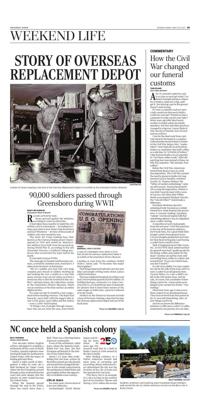
A photo of troops mopping a barracks at the Overseas Replacement Depot is on exhibit at the Greensboro History Museum.
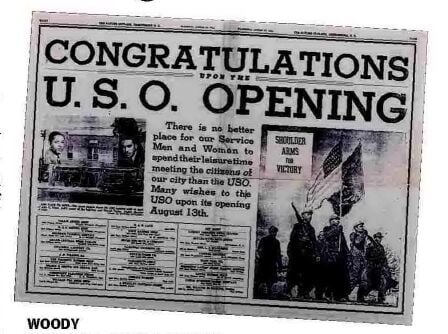
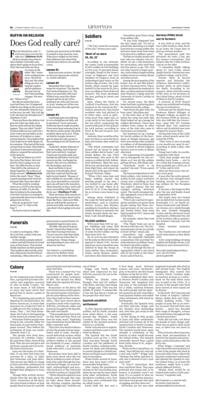
A copy of a newspaper story about a U.S.O. that served the overseas replacement depot is on exhibit at the Greensboro History Museum.
Recruits arrived by train.
Noses pressed against the windows, according to some recollections. It had taken three months to build this city within a city in Greensboro — including locations near what is now Fisher Park downtown and East Wendover — for tens of thousands of soldiers who were headed to war.
The Army Air Corps training base, best known as the Overseas Replacement Depot, opened in 1943 and would be America's last military base built from the ground up during World War II, according to the late Alexander Stoesen, a Guilford College professor who researched the topic before his death.
It even held German POWs. The main gate at Summit and Bessemer avenues, covered by a bamboo arch, stood just 1.3 miles from the heart of downtown.
"All of a sudden you have this very large complex and a bunch of soldiers showing up and making the war a reality in a way that many overseas wars are not unless you have a loved one who is directly involved in the conflict," said Ayla Amon, the collections curator at the Greensboro History Museum, which was in existence at the time and has an online digital archive.
For some recruits it would be a last assignment before heading overseas. The depot had barracks, mess halls with the largest able to seat 3,000, gyms, a post office and fire station — even a 1,000-bed hospital.
"It brings a lot of people through Greensboro who are not from the area, from North Carolina or even from the southern United States," Amon said. "It becomes this major thoroughfare."
That brings improved railroads, but also new ideas and people writing home about a place called Greensboro.
The base employed hundreds of civilians and had a total wartime payroll of $300 million. In building the base, contractor J.A. Jones Construction Co. of Charlotte became so desperate for laborers that it hired black women at the same wages as white men, a practice unheard of in the South.
Artifacts in the historical museum include a map of the basic training camp that became the overseas replacement depot and one of the bunk beds.
"The base saved the economy of the city," Stoesen once said.
'Most of us were 19, 20, 21'
According to one estimate, the center could accommodate 25,000 soldiers in 994 buildings on 652 acres. It sprouted almost overnight, thanks to the Army's Corps of Engineers and local members of Congress, from an undeveloped pine forest on the eastern edge of town. The Cone family, which owned the land, rented it to the Army for $1,200 a year, according to News & Record research. The Army developed the area, putting in streets and utilities.
Here, where the Battle of Guilford Courthouse, that key moment in the American Revolution, played out, they found residents who had pitched in in other ways, such as gathering more than eight tons of scrap metal in two months for the war effort, surpassing the countywide goal of 100 pounds for each person, according to News & Record research over the years.
And now, there would be other ways for them to serve the brave men and women who could see battle.
"The whole community just turned out en masse to make these soldiers feel at home," said Daniel Ballow, the late Triad businessman, who went to the camp as a soldier in 1943. Ballow, from Baltimore, liked the area, fell in love and married a woman from High Point, and stayed. He died in 2015 at the age of 93 while living in Winston-Salem.
"When I first came here and began walking around and meeting people in the area, I was invited to one home after another," he said. "Most of us were 19, 20, 21. It was important for us to have a nice home to go to."
Among those stationed at the camp for brief periods were entertainers, such as Charlton Heston. Actress Jane Wyman, speaking in Greensboro during a celebrity dinner to promote war bonds, boasted about her husband, Capt. Ronald Reagan.
90,000 soldiers
With more than 900 tar-paper buildings and many drill fields, the facility had estimates of some 90,000 soldiers serving there from 1943-46.
No. 10, as it was also referred to for the order in which it was built, opened in March 1943. Service industries such as laundries were enlisted to keep the troops in clean clothes. Bars, restaurants, hotels, movie theaters, dairies and others did a brisk business.
Greensboro gave them refuge from military life.
"It was truly integrated into the city," Amon said. "It's not as potentially alienating as it might have been for a young soldier who had never been away from home to be placed in a military space."
The ban on Sunday movies and beer sales was relaxed. City residents set up a club downtown for servicemen, who until then had few places to go. The club was later moved to larger quarters. And residents began inviting soldiers home for Sunday dinner and other events.
Among the most popular of the homes was Al and Min Klein's on West Greenway Drive. There, soldiers gathered on weekends to dine, socialize and meet students from Woman's College (now the University of North Carolina at Greensboro).
For several years, the Klein home had been a gathering place for women from the college.
"And where the girls were, the boys came," Min Klein said.
In the early days of the war, before the camp was built, Min Klein helped set up a lounge for soldiers downtown. These were soldiers from camps in other areas of the state who came to Greensboro on weekends.
Her husband set up a lounge for Jewish soldiers in the basement of Temple Emanuel, and there were always rides available to soldiers of all denominations who wanted to attend religious services and sit down to dinner afterward.
The outpouring of hospitality was as therapeutic for city residents as it was for the soldiers getting off base, Min Klein said.
"Everybody needs to be needed," she said. "It was a great outlet."
The base included about 6,500 black soldiers, who trained separately in the camp's northeast corner near a building on East Wendover, which in those days was called E Avenue. The war changed nothing, historians noted. The South remained rigidly segregated, even at the wartime military bases.
"This is also a period of segregation and there are quotes from people noting that those German prisoners of war are actually treated better than some black people in GSO," Amon said of the times.
For example, where they rode on the train.
"The 'Black 'train cars are in the back with the coal. The German prisoners of war are actually in front of that," Amon said.
Greensboro had separate USOs, the nonprofit charitable corporations that provided live entertainment on military bases, for Black and white soldiers.
"It was all through the lens of segregation, which is very much alive in the South at this time," Amon said of that era.
German POWs hired out to farmers
It was 1944 or 1945, and the two Coble brothers often drove to an Army Air Corps base to pick up German workers.
The government paid the prisoners 80 cents a day, per the Geneva Conventions. And farmers like the Coble brothers said yes to the offer.
"I remember daddy talking about it," Sam Coble, whose family lived in a farmhouse near Guilford College, said in 2018.
Former News & Record reporter and historian Jim Schlosser interviewed Coble's mother, Ruth, in 2002 before her death. According to his research, about 430,000 enemy POWs were at 510 locations in the United States, about 10,000 of them in North Carolina.
A network of POW branch camps was established including the one in Greensboro.
Schlosser got his details from Professor Robert Billinger of Wingate College, an expert on the German POWs in America, who also told him the Greensboro camp had 397 German enlisted men. One American officer and 18 enlisted men were assigned to oversee them.
During their time at the Coble farm, armed guards never followed the POWs.
"They were as nice of people as you would ever want to see," according to Ruth Coble, who fed them.
Young Sam Coble, in overalls, would play with them.
"They were people who had families back home ... and to see a little kid running around, they probably got a kick out of it," Coble said in 2018.
After just three years, the soldiers were gone.
A year after the center opened, its mission had changed from training recruits to processing soldiers for the European theater.
It became a discharge facility after the war and finally closed in September 1946.
The empty base was turned into an industrial-business park. Eventually, U.S. 29 North (O. Henry Boulevard) and Wendover Avenue cut a swath through the area. Summit Shopping Center and the old Forest Grove apartments obliterated the site of the bachelor officer quarters, the women's barracks and the hospital.
Some wartime remnants survive.
The warehouses and railroad tracks look almost as they did in 1943.
A few camp buildings sit along English and Raleigh streets, East Wendover and Gatewood Drive.
Nancy.McLaughlin@greensboro.com; 336-373-7049; @nmclaughlinnr