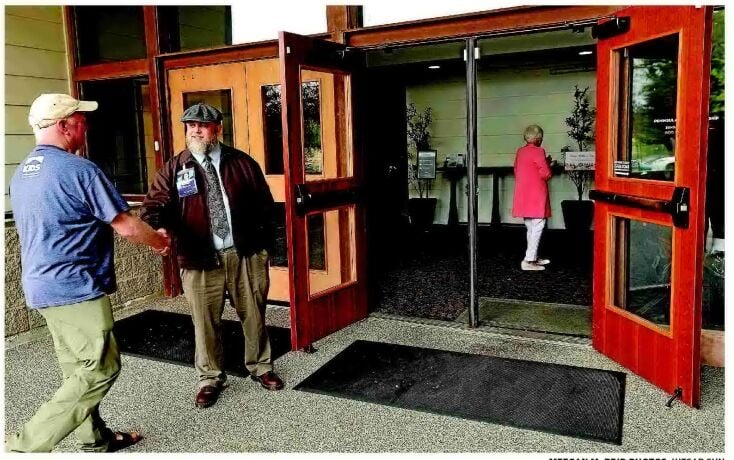
PORT ORCHARD, Wash. — At newlife church's South Kitsap Campus in Port Orchard, attendance has climbed 58% since 2019 — and Pastor Ryan Brewer says the energy in the building reflects it.
"There's a lot of buzz and vibe here," said Brewer, the campus lead pastor. "The purpose has always been clear and consistent, but right now the energy just feels great."
Newlife's story is not universal — but it is no longer unusual. A new national report released earlier this month at the annual Religion News Association conference finds that America's faith communities are showing meaningful signs of recovery now, after the pandemic upended congregational life. The gains are uneven, and the long arc of institutional decline has not reversed. But for the first time in decades, more congregations are stabilizing or growing rather than shrinking.
"What it is not is a story of revival or return to a previous era of sort of congregational glory in the United States," said Allison L. Norton, co-investigator for the Exploring the Pandemic Impact on Congregations study. "The long-term trajectory of gradual decline in American congregational life is still in place."
Attendance up for the first time in decades
Perhaps the report's most striking finding involves worship attendance. Median in-person attendance dropped sharply during the pandemic, reaching a low of 45 in 2021. By 2025, that figure had risen to 70 — surpassing pre-pandemic levels. It marks the first positive gain in median attendance in 25 years. Even so, the current median remains far below the 137 recorded in 2000.
"Directional change and momentum matters for many congregations and churches," said Scott Thumma, principal investigator of the study. "This is the first evidence in a long time for congregations generally that the trajectory and decline narrative might actually be shifting even if it's modest."
The recovery is not uniform. Evangelical Protestant congregations are the only group to show net growth over the past five years, up 2%, while Mainline Protestant churches experienced the steepest decline, at 20%.
Larger congregations — those with more than 250 attenders — are most likely to have grown, while the smallest congregations, those with 50 or fewer, were hit hardest, with 40% reporting declines of 25% or more.
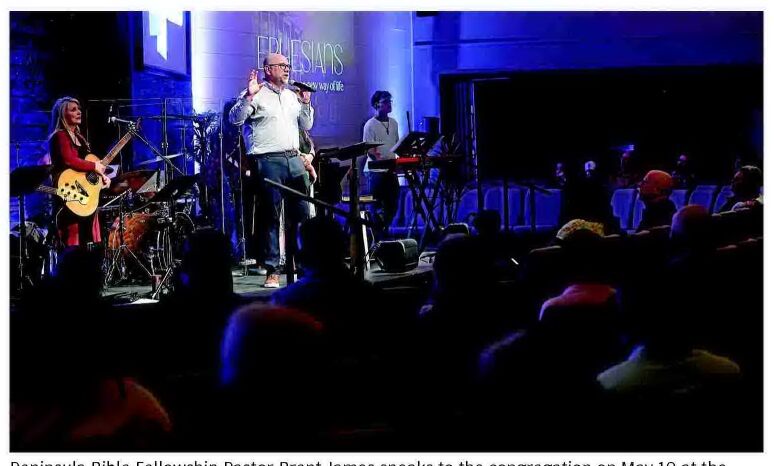
At Peninsula Bible Fellowship in Central Kitsap, lead pastor Brent James estimates his congregation is up about 10% from before the pandemic — and believes it could be growing even faster.
"Our challenge is a lack of space," he said. "I believe we would grow more if we could build."
James credits his congregation's financial resilience in part to a deliberate decision early in the pandemic. The church initially applied for a federal PPP loan but withdrew from the program when it became clear the need wasn't there.
"Our people were faithful," he said.
Recalibration, not revival
Across attendance, finances, volunteering, programming and clergy well-being, the report documents a consistent pattern: an initial surge of adaptation early in the pandemic, a dip in 2023 and a rebound in 2025.
The percentage of congregational leaders who strongly agreed their faith community has a clear mission and purpose went from 39% in 2020, rose to 54% in 2021, fell to 32% in 2023, and has now returned to 40% in 2025. Volunteer participation, which dropped to just 15% during the pandemic, has rebounded to 40% — matching pre-pandemic levels.
The report's authors are careful not to overstate what the data shows. They said the findings are best understood not as a revival, but as a recalibration — a moment of unexpected stabilization marked by resilience, adaptation and cautious hope.
Brewer said he sees something more spiritually significant than the word "recalibration" captures.
"The work of God I always see as spiritual work," he said. "I would maybe use the word awakening."
James pointed to what he sees as a cultural hunger driving people back to physical community. Younger generations raised on social media, he said, are searching for real friendships and a sense of purpose that a screen can't provide — a longing he believes extends well beyond Gen Z and Gen Alpha to just about everyone disillusioned with what pop culture offers.
"There's a longing for something deeper," he said.
The technology dividend
One lasting legacy of the pandemic appears to be a broad technological transformation. Livestreaming services doubled in use between 2020 and 2025, with those using livestreaming "a lot" rising from 32% to 66%.
Peninsula Bible Fellowship was already broadcasting on Facebook before the pandemic hit, which gave the church a running start when in-person services were suspended from mid-March through June 2020.
"We had a wish list of tech we'd been wanting to buy," James said. "We were able to pivot and purchase a lot and became a church experienced through the television — which wasn't easy."
The church also launched an author interview series after recognizing that worship music alone didn't translate well to the home environment. James said that early agility helped the congregation reach people whose own churches were still working out the technology.
"A lot of people discovered us while their home churches were trying to figure out video, and we got a lot of positive word of mouth," he said.
A newer development noted in the 2025 survey: 36% of congregations report having used generative AI in their ministry, primarily to support communications such as newsletters, social media posts and promotional materials, as well as administrative tasks like sermon preparation and meeting minutes.
The gap between large and small
Running through nearly every finding in the report is a divide between larger and smaller congregations that the pandemic appears to have widened. Despite representing only 13% of congregations, the largest churches — those with more than 250 weekly attenders — now account for 78% of all regular weekly service attendees nationwide, up from 70% in 2020.
"Even as the number of small congregations is quite considerable, they are becoming increasingly marginal in terms of where the majority of religious participation happens," Thumma said.
Brewer said the new faces at newlife reflect a broad mix: people brand new to faith, newcomers to the area and military families — a significant presence in Kitsap County, home to Naval Base Kitsap, one of the largest naval installations in the country.
Peninsula Bible Fellowship has made military ministry a dedicated focus as well.
"We're seeing a lot of sailors and their families arriving at our church," James said. "Beyond kids, youth, men's, women's, young adults and second-half-of-life ministries — we see new people come through any one of those avenues week after week."