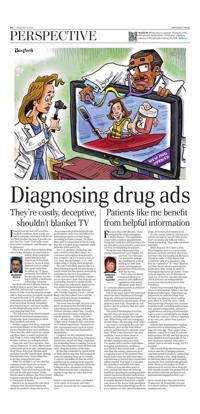


Diagnosing drug ads
They're costly, deceptive, shouldn't blanket TV

BRANDON NOVICK
Imagine you are sick with a serious medical condition. How would you feel if someone constantly told you to buy their product because it would cure you, but this "cure" is actually worse than other treatments, and the price tag is enormous?
This is the reality of prescription drug advertising. Whether on television or online, drug companies spend billions to tell Americans to buy their products. In 2024, giant pharmaceutical companies spent more than $6 billion on TV alone, and nearly $50 billion in the decade prior, according to IQVIA, a healthcare technology company.
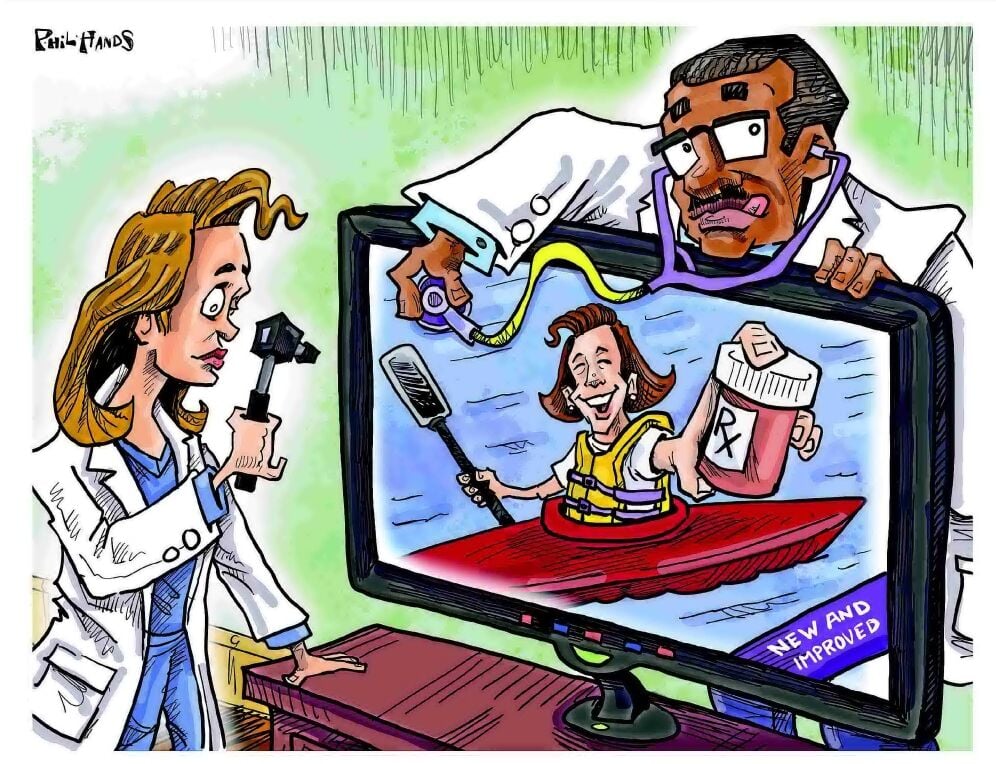
Yet these ads don't include relevant medical facts to prove that a drug is effective, and they fail to provide evidence of risks. Even the long list of side effects that narrators are legally required to read at the end of TV commercials often fails to include all health risks from each drug. Instead, companies play hopeful music and show healthy, active people playing sports or otherwise enjoying their lives.
This is because drug advertisements are tools of emotional manipulation.Companies want consumers to think their products will work.
Studies suggest that drug companies spend more money on treatments that are less beneficial but more profitable. This coincides with Americans spending three times as much on prescription drugs in 2022 compared to other wealthy nations, according to RAND.
These ads aren't just wasteful. They can be dangerous. In 2002, Merck aired a television ad for its anti-inflammatory drug Vioxx, featuring Olympic gold medalist Dorothy Hamill figure skating. She explained how Vioxx helped her overcome osteoarthritis pain.
What the ad didn't say was that the company knew Vioxx was no more effective than another treatment, naproxen. Vioxx also increased the risk of heart attacks and strokes. While Merck raked in billions, the FDA's David Graham estimated the drug contributed to thousands of deaths.
Merck is by no means the only drug company that deceived Americans about its products. From 1991 to 2021, drug companies paid federal and state governments more than $22 billion for unlawful promotion of their drugs, according to Public Citizen. Yet these fines pale in comparison to the $1.9 trillion the 35 largest drug companies made between 2000 and 2018.
The U.S. and New Zealand are the only countries that allow direct-to consumer prescription drug advertising. Congress can try to enact a ban, as U.S. Sens. Bernie Sanders, I-Vt., and Angus King, I-Maine, have proposed.
Yet courts will likely prevent the U.S. from banning drug ads because doing so could violate the free speech protections enshrined in the First Amendment. Under current legal standards, supporters of a ban must show that drug ads are misleading, harmful to public health and cannot be sufficiently improved by less restrictive government policy.
The courts — especially the corporate-friendly Supreme Court — would likely rule that a direct ban is not the least restrictive means of stopping harmful drug advertising.
The court may be right, because Congress can de facto ban deceitful drug advertising on television and online without passing a direct ban. Congress can and should require companies to clearly mention — visibly and audibly — all risks from a drug, rather than today's weak standards that came from 1997 federal regulations. Violations of this requirement must result in significant fines that threaten the product's profitability.
Congress can also eliminate the liability shield protecting drug companies. Americans cannot sue drug companies for misleading them or causing harm, as long as the companies warn doctors and other drug prescribers of the risks.
By forcing companies to spend much of their advertising time mentioning all risks and opening them up to lawsuits, Congress can indirectly ban deceitful, harmful ads by making them unprofitable. Making drug companies liable for failing to warn consumers of all risks also better incentivizes companies to market drugs that are safer and more effective.
Novick is the domestic policy coordinator at the Center for economic and Policy Research. He wrote this for Insidesources.com.
Patients like me benefit from helpful information

DOROTHY LEONE-GLASSER
For more than four decades, I have navigated life while managing a chronic disease.
This experience comes with countless appointments, trying new medicines and learning to be my own advocate in a health system that can feel overwhelming for patients.
Along the way, I discovered that staying informed isn't just helpful. It's survival. Over the years, I've learned to manage my condition by actively seeking out new treatments and engaging in thoughtful conversations with my doctors.
That's why I'm deeply concerned about proposals to add additional regulations that would effectively make direct-to-consumer pharmaceutical advertisements useless for patients.
One of the many ways I stay informed about the latest treatments is through drug ads, which provide information about treatments to me and many of the patients I work with. These ads are not perfect. But for patients, they are a genuine resource.
The push in Washington to further regulate drug ads misses how real patients actually navigate their healthcare. When living with and managing a chronic illness, the learning never stops — you want to constantly discover new treatments, pick up tips from fellow patients and find ways to alleviate symptoms. When a new treatment becomes available, I want to know about it.
I'm not alone. Throughout my decades of patient advocacy work, I've spoken with countless individuals managing autoimmune conditions, rare diseases and chronic pain — people who describe seeing a television ad or a magazine insert as the moment they finally had a name for what they were experiencing or learned that a treatment option existed. That kind of awareness has real effects on health outcomes.
Critics of drug ads often point to cost, arguing that these ads drive up healthcare spending by pushing patients toward expensive branded medications. But research from the National Bureau of Economic Research found that a significant share of the doctor visits prompted by pharmaceutical advertising results in prescriptions for non-advertised generic drugs, or no new prescription at all.
In other words, patients who become curious enough to consult their doctor don't automatically walk out with a brand-name drug. They walk out better informed.
What drug ads do is open a door. What happens next is a conversation between a patient and their physician, and that's the way healthcare decisions should be made. A 2025 Harris Poll found that 70% of respondents said they're "somewhat" or "very" likely to ask their doctor about a prescription medication after seeing an ad for it. Overregulating those ads doesn't lower costs or improve care. It threatens to close one of the few channels through which patients can independently access new information about their conditions.
Patient empowerment depends on access to information. When I was first diagnosed with lupus, I had almost no framework for understanding what my body was doing or what could be done about it. Over the years, I built that knowledge through every resource available to me, including medical journals, patient communities, advocacy organizations and drug advertisements. Each resource contributed to my ability to walk into a doctor's office as a partner in my own care, rather than a passive recipient.
Policies that would further regulate pharmaceutical advertising send the opposite message. They suggest that patients cannot be trusted to evaluate information critically and that we need to be shielded from knowledge of our own treatment options. That paternalistic view is not only wrong, but it's harmful.
The current drug advertising framework is effective at keeping patients safe from harmful products, misleading claims and bad actors, while keeping us informed about new and emerging treatments that could provide genuine relief. Before policymakers in Washington move to restrict these drug ads, they should consider the perspective of the patients who rely on them to stay informed and engaged in their care.
Leone-Glasser is the executive director of advocates for Responsible Care and Rx in Reach Coalition. she wrote this for Insidesources.com.