
Revolutionary Guard has reach
Paramilitary group a powerful force in the country's theocracy

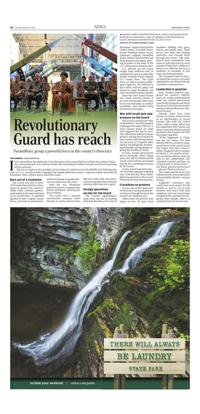
Supreme Leader Ayatollah Ali Khamenei, center, accompanied by the armed forces commanders, visits an exhibition of the Revolutionary Guard's aerospace achievements Nov. 19, 2023, in Iran.
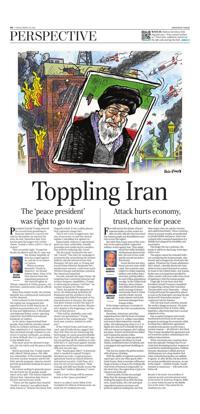
Iran's paramilitary Revolutionary Guard has grown into a powerful force within the country's theocracy, answering only to its supreme leader and overseeing its ballistic missile arsenal and launching attacks overseas.
The force is again in the spotlight as Iran widens its attacks across the Middle East following the start of a U.S.-Israeli airstrike campaign that already killed the country's Supreme Leader Ayatollah Ali Khamenei. Here's what to know about the Guard.
Born out of a revolution
The Guard rose out of Iran's 1979 Islamic Revolution as a force meant to protect the country's Shiite cleric-overseen government and later became enshrined in its constitution. It operated parallel to Iran's regular armed forces, growing in prominence and power during a long and ruinous war with Iraq in the 1980s.
After the war, Khamenei granted it powers to expand into private enterprise, allowing the force to thrive.
The Guard runs a massive construction company called Khatam al-Anbia and has firms that also build roads, man ports, run telecommunication networks and even off er laser eye surgery.
Foreign operations are key for the Guard
The Guard's expeditionary Quds Force was key in creating what Iran describes as its "Axis of Resistance" against Israel and the United States. It backed Syria's former President Bashar Assad, Lebanon's militant Hezbollah group, Yemen's Houthi rebels and other groups in the region, growing in power in the wake of the U.S.-led invasion of Iraq in 2003.
U.S. officials say the Guard taught Iraqi militants how to manufacture and use especially deadly roadside bombs against U.S. troops there. The Quds Force, as well as Iranian intelligence agencies, are believed to have hired criminal gangs and others to target dissidents and Iran's perceived enemies abroad.
Since the latest Israel-Hamas war, Israel arrested citizens it accused of receiving orders from Iran to surveil targets or conduct vandalism. Iran denied being involved in those plots.
War with Israel puts new pressure on the Guard
The Guard's carefully laid "Axis of Resistance" faced its greatest challenge in the wake of the Oct. 7, 2023, Hamas attack on Israel that triggered the war in Gaza. The Palestinian militant Hamas group is among those backed by Iran. Israel is still battling Hamas in Gaza even as it targeted other Iranian-backed groups, decimating Hezbollah and repeatedly targeting the Houthis in Yemen.
In Syria, Assad's government fell in December 2024, taking away a key ally for Tehran and the Guard. Israel and Iran exchanged missile fire, something overseen by the Guard.
In June, Israel launched a massive airstrike campaign targeting Iran. In its first day, those strikes killed top generals in the Guard, throwing the force into disarray.
Crackdown on protests
In Iran, one of the main ways its theocracy can squash demonstrations is through the Basij, the Guard's all-volunteer arm.
Videos from the protests that began on Dec. 28 show Basij members holding long guns, batons and pellet guns. Their forces have been seen beating protesters and chasing them through the streets. One wellknown Basij commander even went on state television to warn parents to keep their children at home as he called for the force's members to assemble to put down the demonstrations.
The European Union in January listed the Guard as a terrorist organization over Tehran's bloody crackdown on the protests.
Leadership in question
Iran's foreign minister suggested his country's military units are acting independently from any central government control after being pressed about attacks on Gulf Arab nations that served as intermediaries for Tehran in the past.
Already, there have been attacks on Oman, which served as an intermediary in recent nuclear talks with the United States, and on Qatar, which also has negotiated with Tehran and shares a massive off shore natural gas field in the Persian Gulf with the Islamic Republic.
"What happened in Oman was not our choice. We have already told our, you know, army, armed forces to be careful about the targets that they choose," Abbas Araghchi told Al Jazeera on March 1. "As a matter of fact, our, you know, military units are now in fact independent and somehow isolated and they are acting based on instructions — you know, general instructions — given to them in advance."
The Guard controls Iran's vast ballistic missile arsenal and much of its stockpile of bomb-carrying drones.
Araghchi's comments also could serve as an excuse for the attacks as well to try to ease tensions with Iran's Gulf Arab neighbors, who are increasingly enraged by the constant fire targeting them despite eff orts at easing tensions in recent years.