

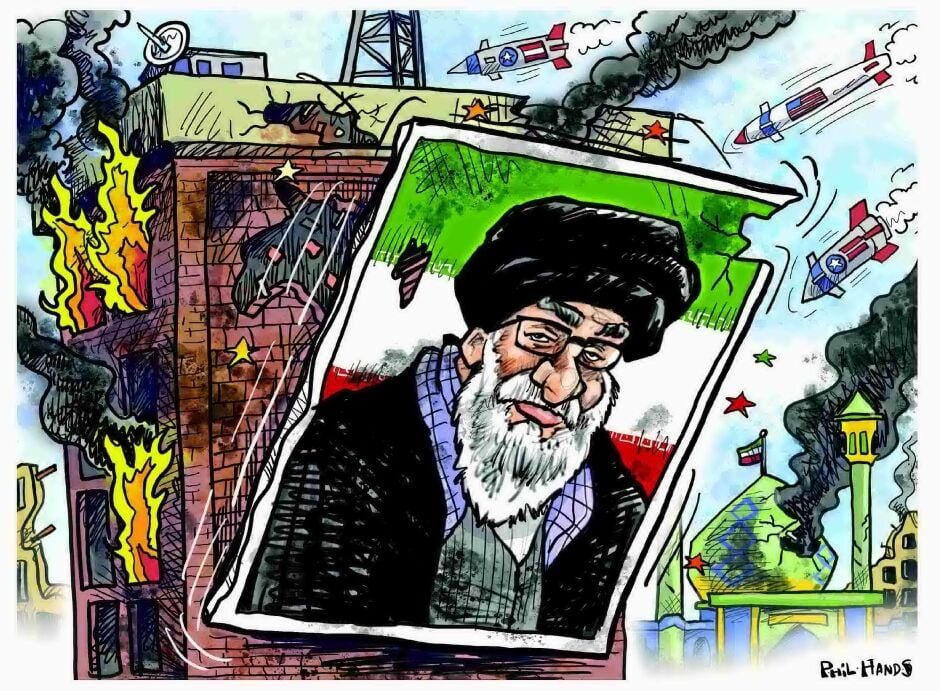
Toppling Iran
The 'peace president' was right to go to war

PETER DORAN
President Donald Trump entered his second term promising to measure America's success not only by the battles we win but the ones we end. Operation Epic Fury has become the largest test of that vision. Trump's critics call it a "war of choice."
They are partly right. Trump has finally decided to end the 47-year war the Islamic Republic of Iran has waged against us, and do so on America's terms.
When an enemy demands "Death to America," we should believe them. Since 1979, that aim has been the organizing purpose of the clerical regime in Tehran, repeated at Friday prayers, celebrations, anniversaries and on official airwaves.
More than empty words, the Islamic Republic has continuously made good on this demand.
From Lebanon to the Persian Gulf, the regime has weaponized and exported terror to kill Americans. It plotted assassinations on U.S. soil. In Iraq and Afghanistan, it developed and deployed lethal, armor-piercing explosives that killed and maimed hundreds of soldiers.
As its clerics impoverished their people, their ballistic missiles rained down on civilians and bases alike. They admitted to U.S. negotiators that they enriched enough uranium to construct 11 nuclear warheads, according to Steve Witkoff , the U.S. special envoy to the Middle East.
This must never be allowed to happen, for our safety and the peace of the world.
Before pursuing war, Trump repeatedly off ered Tehran peace. His off er was unbeatable. If the Islamic Republic forswore nuclear weapons and its ballistic missile program, America would provide guaranteed uranium for peaceful power.
No nation seeking to generate peaceful electricity for its people would reject such a gift. The Islamic Republic did just that. Operation Epic Fury is the just and necessary result.
"Turns out the regime that chanted 'Death to America' was gifted death from America," Defense Secretary Pete Hegseth noted. It was a pithy phrase that captured a larger fact.
This is not a war of aggression, but one of necessity: to end the clerical regime's unending war against us.
Importantly, America's operational goals are clear, achievable, morally grounded and conducted in coordination with its enduring ally: Israel.
The first goal? Dismantle the missile "sword." The joint air campaign is systematically neutralizing the Iranian ballistic missile infrastructure that threatens Tel Aviv and, as Trump and Israeli Prime Minister Benjamin Netanyahu have warned, could soon reach Western Europe and perhaps someday the American homeland.
Second, entomb the larger threat. By targeting Iran's enriched material and nuclear weapons capabilities, Trump is enforcing his primary "red line": no nuclear weapons for Tehran.
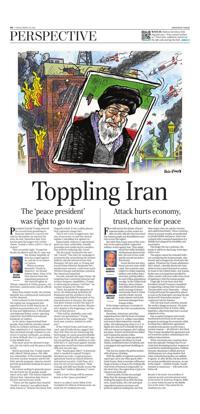
Third, decapitate the apparatus of terror. By eliminating Ayatollah Ali Khamenei and the architects of his campaign that killed thousands of Iranian protesters in January, this operation gives Iranian society the space it needs to seize its own destiny. Khamenei's demise is the beginning, not the end, of that process.
"This will be, probably, your only chance for generations," Trump declared to the Iranian people. "Take back your country. America is with you."
If the United States and Israel succeed, and all indications suggest that they will, then we are witnessing the birth pangs of a more peaceful Middle East. That Saudi Arabia and Gulf capitals are getting off the sidelines to side with the U.S. and Israel against Iranian aggression would have been unthinkable just one year ago.
This "bandwagon eff ect" is precisely what is needed to expand Trump's Abraham Accords: a regional peace agreement based on shared interests and mutual security. Until then, let's pray for our service members. Their courage and skill may finally secure the peace that "endless diplomacy" never could.
That is how Trump will be remembered, as the "peace president."
Doran is an adjunct senior fellow at the Foundation for Defense of Democracies. He wrote this for InsideSources.com.
Attack hurts economy, trust, chance for peace


Few will mourn the demise of Iran's supreme leader or other senior Iranian security officials who terrorized the Iranian people and destabilized countries across the region.
But other than Israel, none of the countries in the region publicly supported military action against Iran. They understood that while Ayatollah Ali Khamenei deserved his fate, the cost of war could quickly exceed any potential returns.
In just the first few days, those concerns were vindicated. Ten countries were subject to strikes targeting military and civilian infrastructure, putting militaries and civilian populations on edge. In the United Arab Emirates, three civilians were killed and 58 injured amid a barrage of drones and missiles fired at Dubai and Abu Dhabi. Several major airports and hotels have been damaged from Iranian strikes.
If this tempo continues, it remains to be seen whether the UAE can maintain its defenses.
Elsewhere, Americans and other regional partners felt the brunt of Iranian retaliation. Four U.S. soldiers were killed and several others injured in a missile strike. The following day, three U.S. F-15 fighter jets were lost to friendly fire that will cost American taxpayers $117 million per plane. At least one Kuwaiti was killed and 32 injured in missile strikes.
Iran also attacked a major gas plant in Qatar, the biggest oil refinery in Saudi Arabia, residential towers in Bahrain and a synagogue and apartment buildings in Israel.
The war has shaken the global market, with oil prices climbing.
With the ability of regional countries to export gas, oil or any other goods eff ectively frozen, their economies will hemorrhage revenues as long as the strategically vital Strait of Hormuz is impassable. In the short term, the region from Cyprus to Oman is not better off .
Unfortunately, it looks increasingly likely that this damage will persist, making the region worse off in the long term. Saudi Arabia, the UAE and Qatar expended enormous resources and political capital in making the case that their major cities are safe for tourism and capital investment. These countries, whose economic models are predicated on predictability and peace, must now contend with a renewed reputation of a Middle East plagued by instability and uncertainty.
The longer the war continues, the harder it will be to shed long-term reputation costs.
The region cannot be evaluated without considering the Iranian people, who bravely and courageously stood up to the regime. Whatever the Trump administration's intent, a durable democratic transition in Iran cannot be based on actions by Israel or the United States. Any Iranian leader seen as having been installed by either country will soon suff er from a lack of legitimacy with the Iranian people.
Tragically, it is far from clear that President Donald Trump is committed to supporting a democratic transition. The precedent set in Venezuela — where Trump jettisoned the opposition almost as soon as the helicopter carrying Nicolas Maduro left Venezuelan airspace — is a cautionary tale for Iranians.
This war may teach countries around the world a dangerous lesson. The Joint Comprehensive Plan of Action, while imperfect, eff ectively kept Iran's nuclear program in a box.
Iran accepted stringent and closely monitored restrictions on its nuclear program in exchange for economic relief, trusting that a diplomatic agreement would provide greater security than a nuclear weapon — all without a shot fired. Then Trump shredded the agreement and set in motion a policy culminating in two military interventions.
What conclusion may countries draw from this episode? Perhaps they'll conclude that developing nuclear weapons is essential for maintaining power. Saddam Hussein, Moammar Gadhafiand now Ali Khamenei cast a long shadow that other authoritarian leaders are unlikely to ignore. If, after all this, the incentives for nuclear proliferation increase, no one in the region — whether Israelis, Saudis, Iranians or Americans — will claim to be better off.
Murphy is the senior vice president of national security and international policy at the Center for American Progress. Miller is a senior fellow focused on the Middle East at the center. They wrote this for InsideSources.com.