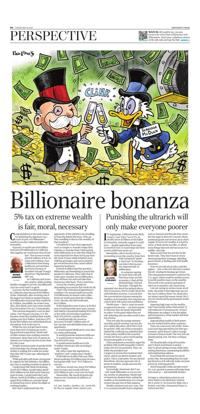


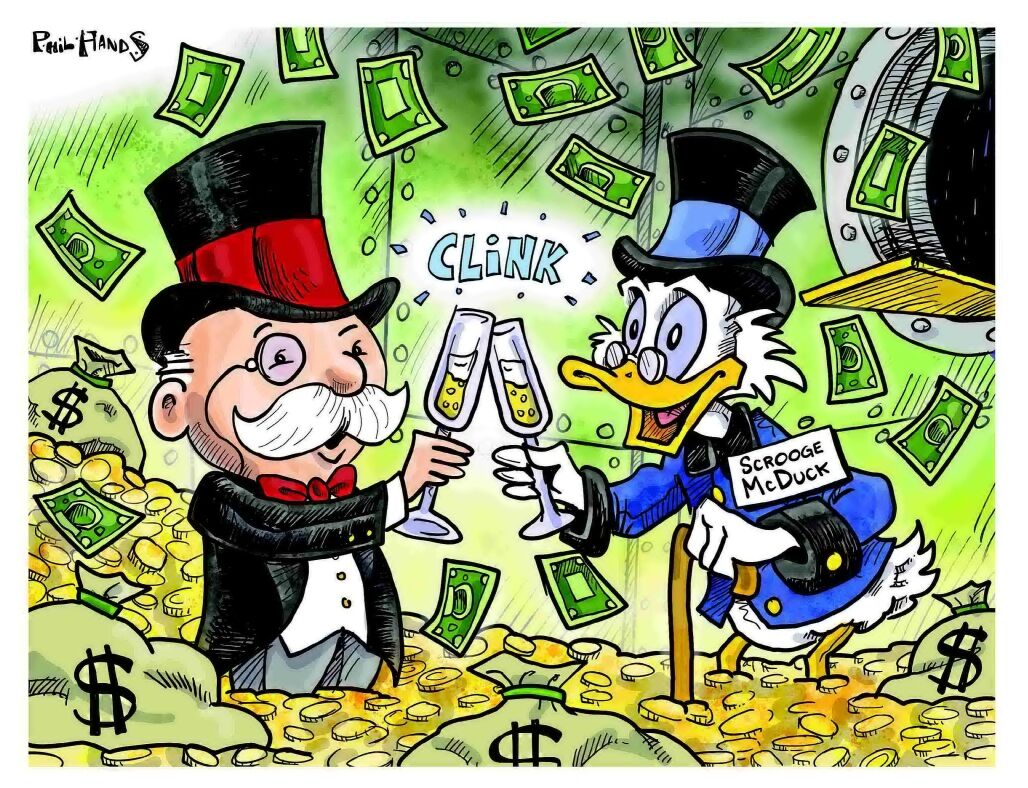
Billionaire bonanza
5% tax on extreme wealth is fair, moral, necessary

BERNIE SANDERS
Congratulations to the trade unions for gathering the signatures necessary to put a 5% billionaires' wealth tax on the California ballot this November.
If passed, it would raise $100 billion from just 200 billionaires in California who together are worth more than $2 trillion. That revenue would prevent millions of low-income and working-class Californians from losing healthcare and nutrition assistance because of President Donald Trump's disastrous "Big Beautiful Bill" law.
In California and across the country, while working families struggle to survive, the billionaire class has never had it so good.
Last year, the five wealthiest people in California alone became $300 billion richer. Nationally, after receiving one of the largest tax breaks in modern history, 938 billionaires increased their wealth by $1.5 trillion. Incredibly, the richest man alive, Elon Musk, now owns more wealth than the bottom 53% of U.S households.
This extreme inequality is not an aberration. Over the past six years, U.S. billionaires more than doubled their wealth, gaining over $4.6 trillion. And since 1975, nearly $80 trillion was redistributed from the bottom 90% to the top 1%.
While the very rich get much richer, more than 60% of Americans are living paycheck to paycheck. Nearly half of older workers have nothing saved for retirement. More than 20% of seniors in America are trying to survive on less than $15,000 a year.
Despite enormous gains in productivity and technology, the average American worker is making $28 a week less today than they did 53 years ago, adjusting for inflation.
While poll after poll shows strong public support for this initiative, the billionaire class is working overtime to defeat it.
I understand why Mark Zuckerberg, worth $237 billion, would rather spend $100 million on his third yacht than pay more in taxes. I understand why Larry Ellison, worth $218 billion, would rather spend $500 million on a private island in Hawaii than worry about the plight of working families.
But I don't understand why the opponents of this initiative are unwilling to honestly debate this issue. Why are they unwilling to discuss the morality of their position?
I would love to hear from opponents such as Google co-founder Sergey Brin, Palantir co-founder Peter Thiel and the other billionaires as to why they think it is more important for them not to pay their fair share of taxes while hospitals close, children go hungry and cancer patients get evicted because they cannot afford expensive treatment.
Instead of addressing that question, billionaires are threatening to punish the people of California. They claim that if voters pass a modest tax on billionaires, they will leave the state and take their businesses with them. That is extortion.
Across the country, people are demanding an economy that works for all.
That's why I introduced legislation to establish a 5% annual wealth tax on the 938 billionaires in America who collectively are worth more than $8.2 trillion. Over a decade, this bill would raise $4.4 trillion.
If this legislation were to pass, in its first year, it would provide every man, woman and child in a household making $150,000 or less with a $3,000 direct payment — that's $12,000 for a family of four.
It would provide the resources necessary to build 7 million units of low-income and affordable homes and apartments.
It would expand Medicare to cover dental, vision and hearing.
It would guarantee universal childcare. It would ensure no teacher earns less than $60,000 a year. It would restore healthcare to the 15 million Americans who are losing it under Trump.
My critics claim this legislation is "punitive" and "confiscatory." Really?
If this bill was in effect this year, Elon Musk would pay $39 billion more in taxes, leaving him with "just" $737 billion to survive.
Jeff Bezos would owe about $14 billion more in taxes and would still have $265 billion to put a roof over his head.
Meanwhile, life would dramatically improve for hundreds of millions of Americans.
U.S. Sen. Sanders, Sanders, I-Vt., wrote this for the Los Angeles Times: latimes.com.
Punishing the ultrarich will only make everyone poorer

ALLISON SCHRAGER
It's happening. California looks likely to put a "one-time" tax of 5% on wealth above $1 billion on the ballot in November, and polls suggest it could pass — despite opposition from some economists (not so surprising) and Democratic politicians (more so).
Meanwhile, calls to tax the rich are resounding across the country, from New York's proposed "piedsa-tierre tax" to Washington State's first income tax, imposed only on millionaires.
As someone arguing for more than a decade that these taxes are bad economics, I find all this disheartening. I missed the point. I thought the argument was about the optimal allocation of resources, but it is really about the redistribution of power. I concede that the concentration of power among the wealthy can be harmful. But using the tax code to fix it will create worse problems.
Wealth taxes — that is, taxes on assets as opposed to income — are bad economics because they are nearly impossible to collect, to the point where they are self-defeating and can often result in less tax revenue.
They not only discourage entrepreneurship and job creation, but also distort capital allocation. All of this is bad for growth. Still, one of the economists behind the California tax admitted that it may reduce wealth in the economy overall, but that is a price worth paying because inequality is so toxic.
Other prominent economists argue the problem with wealth inequality is that it makes the rich too powerful: They can lobby the president and Congress to ensure they maintain their status, which can distort markets and policy. This is a fair point. No one elected Elon Musk, who has amassed a lot of power in markets, media and even the government.
Increasingly, Americans don't see -self-made billionaires as success stories worthy of admiration. Nearly half of Americans despise them, seeing the wealthy as the beneficiaries of a corrupt system who got rich at their expense.
Wealth creation is not zero-sum. The U.S. economy benefits from companies such as Amazon and the jobs they create. But the anger is there for a reason: Many positional goods and services are in short supply. If you're not wealthy, it is hard to move, or find a home you like, or afford many things that now feel necessary to a middle-class life.
Many resent that the rich live by different rules. They don't have to worry about paying their mortgage, affording good schools or finding a job with health insurance.
Now we are told all our jobs could disappear — just as the rich who have created the job-stealing technology get richer. The subsequent resentment could tear the U.S. apart, which could be another reason to justify punitive taxes on the wealthy. The result is the societal equivalent of what we economists call a doom loop.
I am not saying no serious issues are at stake. My point is that high taxes are not the way to address them. No, Musk does not always spend his money wisely. But I am not convinced the government would do better.
Imposing high taxes on the wealthy won't necessarily reduce their power. It will reallocate it to bureaucrats. At least billionaires are subject to the discipline and transparency of the market and their shareholders.
Appropriating wealth to limit power has not worked well in other countries.
Taxes are a necessary fact of life. Americans have big expectations for their government, and it doesn't collect enough revenue to finance itself. The very rich are already paying a lot, but they could pay more.
Yet the principles of good tax policy aren't about resentment or power — they're about raising revenue while minimizing distortions, maximizing feasibility and emphasizing salience.
If you think the rich have too much power, fine. But punishing them by making them less rich will only make everyone poorer by reducing growth.
And if inequality makes people resentful, a no-growth economy will make them even more so — and miserable besides.
Schrager is a Bloomberg columnist and senior fellow at the Manhattan Institute. She is author of "An Economist Walks Into a Brothel: And Other Unexpected Places to Understand Risk."