

CHIMPANZEE TO BE HONORED
NC plans historical marker
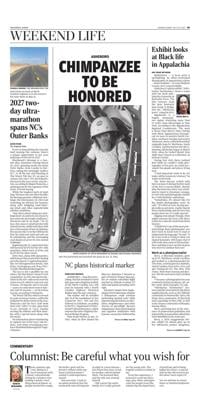
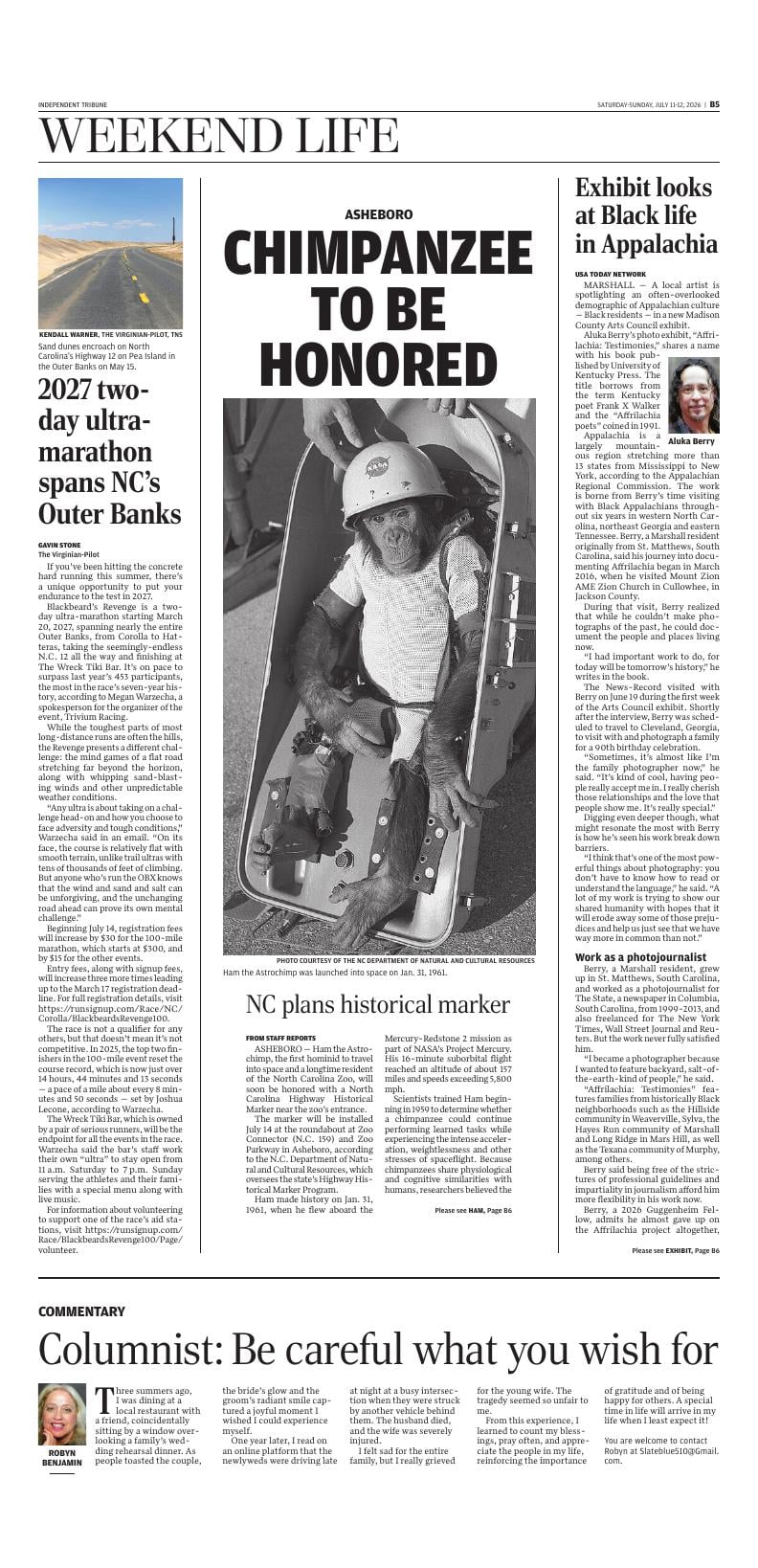
Ham the Astrochimp was launched into space on Jan. 31, 1961.
ASHEBORO
ASHEBORO — Ham the Astrochimp, the first hominid to travel into space and a longtime resident of the North Carolina Zoo, will soon be honored with a North Carolina Highway Historical Marker near the zoo's entrance.
The marker will be installed July 14 at the roundabout at Zoo Connector (N.C. 159) and Zoo Parkway in Asheboro, according to the N.C. Department of Natural and Cultural Resources, which oversees the state's Highway Historical Marker Program.
Ham made history on Jan. 31, 1961, when he flew aboard the Mercury-Redstone 2 mission as part of NASA's Project Mercury. His 16-minute suborbital flight reached an altitude of about 157 miles and speeds exceeding 5,800 mph.
Scientists trained Ham beginning in 1959 to determine whether a chimpanzee could continue performing learned tasks while experiencing the intense acceleration, weightlessness and other stresses of spaceflight. Because chimpanzees share physiological and cognitive similarities with humans, researchers believed the species could help answer questions critical to sending astronauts into space.
The mission
Despite stronger-than-expected g-forces and a flight path that differed from the original plan, Ham successfully completed his assigned tasks during the mission. The results demonstrated that cognitive and motor functions could be maintained in space and helped pave the way for astronaut Alan Shepard's historic flight less than four months later.
Researchers also collected data on Ham's heart rate, breathing and stress responses, providing NASA with valuable information about the biological effects of space travel.
Ham's mission came during the height of the Cold War space race between the United States and the Soviet Union. The Soviet Union had launched the dog Laika into orbit in 1957, and Soviet cosmonaut Yuri Gagarin would become the first human in space just months after Ham's flight. U.S. officials viewed Ham's successful mission as an important step toward human spaceflight.
The chimpanzee's name was derived from the Holloman Aerospace Medical Center at Holloman Air Force Base in New Mexico, where he was trained.
Homes after space
After his flight, Ham lived at the National Zoo in Washington, D.C., before retiring to the North Carolina Zoo in Asheboro. He remained there until his death in 1983. His remains were later interred at the International Space Hall of Fame in Alamogordo, New Mexico.
The Highway Historical Marker Program is a partnership between the N.C. departments of Natural and Cultural Resources and Transportation that recognizes people, places and events significant to the state's history.