
WATER RUSH
Data centers' massive energy, cooling needs are driving up demand
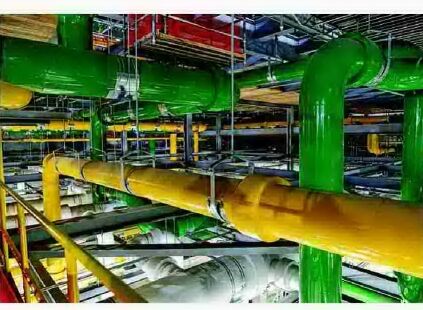
Piping that is part of a closed-loop chiller plant is seen Sept. 18 at the Microsoft data center in Mount Pleasant, Wis.

Part of a Microsoft data center is seen Sept. 18 in Mount Pleasant, Wis.
The massive water and energy demands needed to power and cool data centers are reshaping how communities think about shared water resources.
In the Great Lakes region, data centers typically buy water from local utilities, so they don't appear as major individual users in public databases, making their true demand hard to see. The lack of visibility fueled transparency concerns and left communities unsure how new data centers will affect water supplies and watersheds.
How much water is needed?
The more energy a data center uses, the more cooling and water it needs. Research from Lawrence Berkeley National Laboratory shows about 90% to 93% of a data center's water footprint comes from electricity generation alone.
Most of the water needed comes from electricity generated offsite, especially if that power comes from fossil fuels or nuclear power, which use massive amounts of water.
Wisconsin emerged as a hub for data center development because of access to fresh water, cooler climate and affordable land. The state is part of the Midcontinent Independent System Operator, or MISO, grid where about 70% of electricity comes from fossil fuels, 14% from nuclear power and the remainder from wind and solar.
Coal plants withdraw about 19,000 gallons per megawatt hour, while natural gas uses about 2,800 gallons per megawatt hour. Nuclear plants also require great amounts of water. Wind and solar energies use negligible amounts of water.
Because many data centers generate electricity offsite, the water effects may be in another watershed or even another state.
Will this reshape infrastructure?
Water utilities must plan water systems decades ahead, but data centers can arrive and change their needs much faster.
If a utility builds extra pipes and treatment capacity for a big user that later closes or scales back earlier than anticipated, the community can be left paying to maintain an oversized, aging system.
Past examples in Michigan cities such as Flint and Benton Harbor show how, after industry and population decline, overbuilt systems saddled residents with high costs, debt and ongoing maintenance that can lead to public safety challenges.
Do sources face threats?
Big industrial water users, like data centers, may compete with farms, towns and private wells for limited groundwater, lowering aquifer levels and increasing tensions during droughts or heat waves.
Water demand studies can help identify infrastructure gaps and potential water shortfalls, which can be especially helpful in areas like southeastern Wisconsin and northern Illinois, which face dwindling groundwater supplies and don't have access to Great Lakes water.
Because of these risks, experts urge stronger regulations and more thorough reviews before approving new data centers.
Are PFAS used?
Environmental groups raised concerns about the use of PFAS, or forever chemicals. PFAS are linked to health risks, such as certain cancers, as well as reproductive, liver and thyroid problems.
Data centers must report chemicals that could interfere with treatment, but many consider cooling fluids proprietary. Smaller facilities may not have to disclose them, and municipalities aren't required to make that information public.
To date, conventional wastewater treatment plants are not designed to remove PFAS, which allows them to enter rivers, lakes and drinking water supplies.
Is there a way to reduce water use?
Many hyperscale data centers use closed-loop systems to cool their servers. These systems work like a car radiator, in which water circulates through pipes to absorb heat. The water is then cooled and sent back through the system again. Closed-loop systems reuse most of that water, but they still need occasional flushing and refills.
The systems use less water for cooling than other methods used in the past. However, the water needed for cooling is only a fraction of the water needed to keep a data center up and running.
What about clean energy?
Experts warn that the race to build artificial intelligence data centers outpaces clean-energy development and undermines climate efforts.
The centers' growing power demand slowed the shift to clean energy because new loads are often met with fossil fuel plants. While companies like Microsoft say they can meet clean-energy goals and added renewables, data center electricity use is projected to soar nationally and in the Great Lakes.
An analysis this year by the Union of Concerned Scientists showed that replacing fossil fuel plants with wind, solar and batteries could avoid billions in health costs in Wisconsin by 2050.