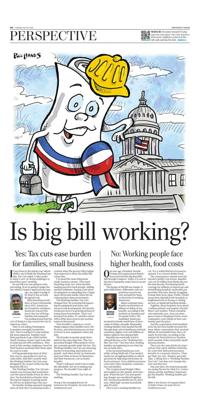


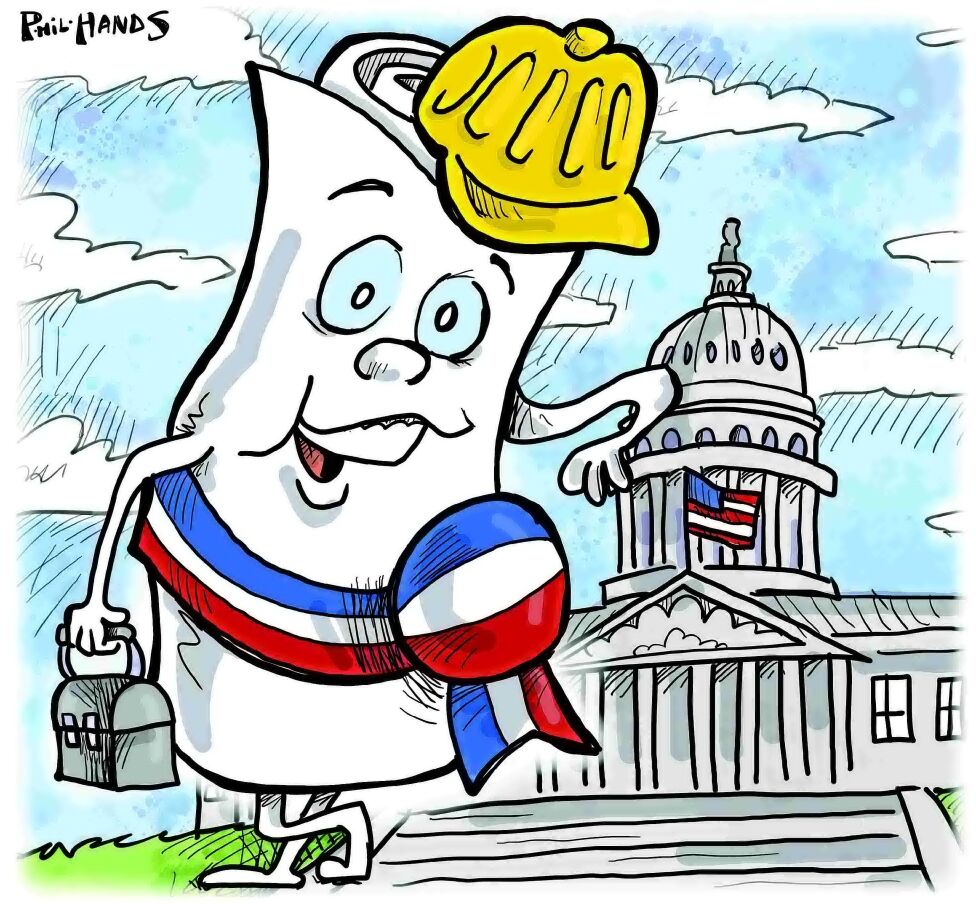
Is big bill working?
Yes: Tax cuts ease burden for families, small business

KENT STRANG
If you listen to the debate over affordability, you'd think the Working Families Tax Cuts failed. Critics point to today's cost-of-living challenges as proof they aren't working.
No one bill was ever going to solve everything. If we're going to judge this law, which Congress approved one year ago, we ought to judge it by what it was actually designed to do.
After knocking on millions of doors nationwide since 2022, Americans for Prosperity volunteers heard one concern the most: the cost of living. Families feel squeezed. Our polling found that the cost of living is a top concern for 4 in 10 American voters.
They're not asking Washington to promise overnight transformation. They're asking it to stop making life more expensive. Families want their paychecks to go a little further. Small-business owners want to be able to make payroll with confidence. They want to hire another employee, invest in their business and keep their doors open for years to come.
Letting people keep more of what they earn is a good place to start on some relief. And that's exactly what the Working Families Tax Cuts were designed to do, as part of the One Big Beautiful Bill Act.
The Working Families Tax Cuts prevented a tax increase that would have cost the typical family of four $1,500 a year. Tax Foundation estimates show the typical taxpayer is paying nearly $2,300 less in federal taxes this year.
For families feeling squeezed, keeping more of what they've earned provides a cushion when the grocery bill is higher than expected or when the utility bill comes due.
I've heard the same thing from small-business owners. They need breathing room, too. Some months, making payroll is hard enough. Adding another employee, buying a new piece of equipment or expanding into a larger space all become harder when the tax code penalizes those investments.
The Working Families Tax Cuts changed that. By restoring full expensing for equipment purchases and research and development, the law lets businesses invest in growing instead of taxing those investments. That's not just good tax policy. It's another owner with a little more room to put another name on the payroll.
That shouldn't surprise us. Good things happen when families have a little more, and when businesses are free to invest in new equipment, ideas and jobs.
The broader economic projections point in the same direction. The Congressional Budget Office projects stronger economic growth under the law. The Working Families Tax Cuts are removing barriers to investing, innovation and growth. And when we bet on Americans and trust them to invest in themselves and their businesses, our economy benefits.
There's still more work to do to make life affordable. But we're making real progress. We shouldn't lose sight of that.
The Working Families Tax Cuts are working.
Strang is the managing director for Americans for Prosperity. He wrote this for InsideSources.com.
No: Working people face higher health, food costs

JOSHUA MILLER
One year ago, President Donald Trump and congressional Republicans forced their Big Beautiful Bill through Congress. Today, it is one of the most unpopular major laws in recent history.
The design of the bill was simple. It gave millionaires, billionaires and corporations massive tax cuts and paid for them on the backs of working Americans.
Major corporate beneficiaries received tens of billions of dollars in tax benefits, according to the Institute on Taxation and Economic Policy. The wealthiest Americans received tax breaks worth tens of thousands of dollars annually. Meanwhile, working families were handed the bill through deep cuts to healthcare and food assistance, higher costs and trillions of dollars added to the national debt.
Republicans eventually tried to rebrand the law as the "Working Families Tax Cuts." One year later, working families are beginning to see what the law actually does.
It has increased healthcare costs while cutting Medicaid. It has made it harder for struggling families to afford groceries by imposing restrictions on food assistance. It has shifted enormous costs onto states, hospitals, communities and families.
The Congressional Budget Office put numbers to this upside-down bargain. When the law's tax and spending changes are considered together, low-income households lose $1,200 a year, while high-income households gain $13,600.
That is not a working families tax cut. It is a redistribution of resources upward. It is a reverse Robin Hood.
The consequences already reach far beyond a family's tax return. Republicans cut $1 trillion from Medicaid over the next decade, threatening health coverage for millions of Americans and destabilizing hospitals and healthcare providers that were already struggling to keep their doors open. Public Citizen researchers identified 446 hospitals at heightened risk of closing or cutting services as Medicaid funding shrinks.
Together, those hospitals serve about 7 million patients and employ 250,000 direct care workers. When a hospital cuts maternity care, closes an emergency room or disappears from a rural community, every family in that community pays the price.
And the corporations that benefited from the law have hardly returned the favor. Major corporations that received billions in tax benefits have since cut nearly 45,000 jobs, according to the analysis by the Institute on Taxation and Economic Policy and public layoff announcements.
These are the same kinds of corporations that spent millions lobbying for a law that delivered enormous benefits to corporate America. They got their tax cuts. Workers got pink slips. Calling that a "Working Families Tax Cuts" law does not change who won and who lost.
One year later, the American people are seeing the law for what it is. Corporations and the wealthiest Americans got the benefits. Working families got the bill.
Miller is the director of Congress Watch at Public Citizen. He wrote this for InsideSources.com.