
Pedal to the metal
Boot camps aim to forge a worker pipeline for defense manufacturing

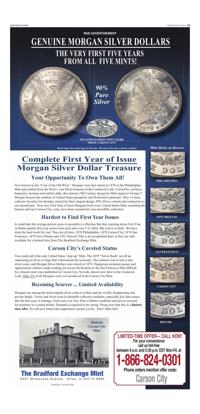
Molten brass is poured from the crucible into molds.
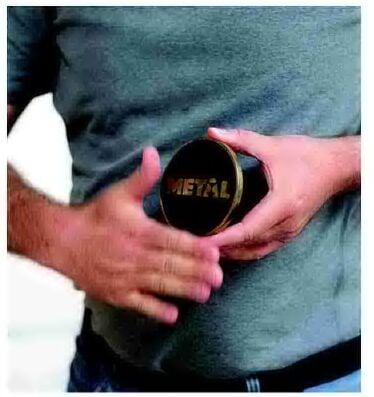
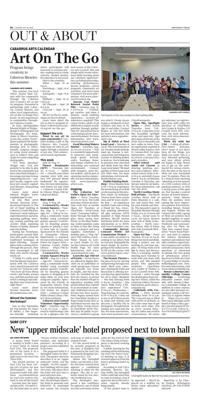
UW-Madison mechanical engineering Professor Frank Pfefferkorn shows off the brass medallion that students make as a souvenir at the boot camp.
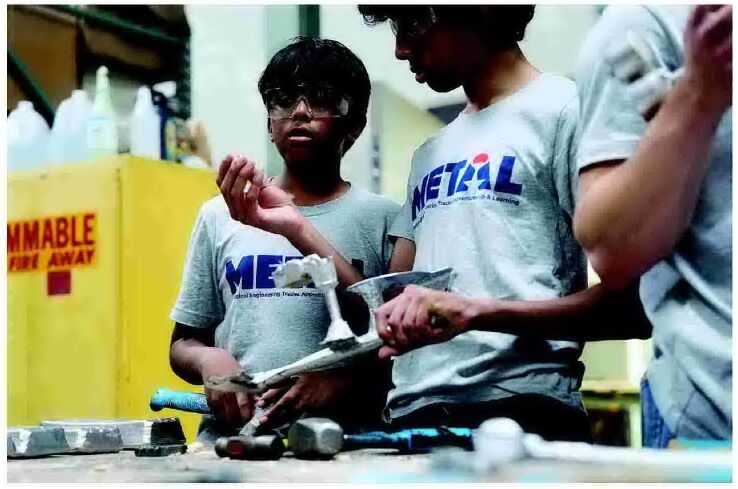
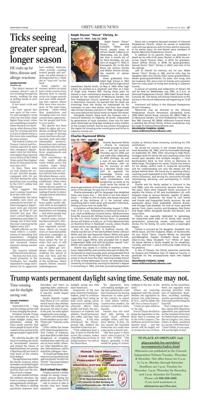
Brothers Awaan Hamid, 13, and Ehan Hamid, 15, a metal manufacturing boot camp July 16 at University of Wisconsin-Madison.

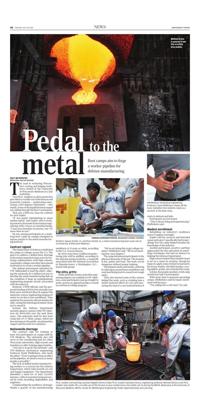
Ph.D. student and teaching assistant Rogelio Herrera helps Ph.D. student Salvatore Russo, engineering professor Michael DeCicco and Ph.D. student Jack Zupfer lift a crucible out of the furnace to pour molten brass into molds July 16 during the METAL Bootcamp at the University of Wisconsin-Madison. METAL stands for Metallurgical Engineering Trades Apprenticeships and Learning.
The road to reshoring Wisconsin's casting and forging work-force started at the University of Wisconsin-Madison in a July workshop.
Two Ph.D. students in silver protective gear lifted a crucible out of the furnace and poured its contents — molten brass measuring 1,900 degrees Fahrenheit — into molds. Some of the liquified metal seeped out, falling through the floor's metal grate.
That was a little too close for comfort for Jack Zupfer.
"It was pretty intimidating to move molten metal," said Zupfer, who is working toward a doctorate in mechanical engineering with a focus on manufacturing. "I had seen foundries in movies, but I've never been in one."
He was among participants in a weeklong boot camp on campus designed to expose people to the metal manufacturing industry.
Contract signed
The Department of Defense established the camps at colleges across the U.S. The goal is to address a skilled labor shortage in the metals manufacturing sector by fostering collaborations with high schools, community colleges and other educational institutions to create a worker pipeline.
The federal government intended for UW-Milwaukee to lead the effort, offering the university $1.5 million last year to develop the metal manufacturing hub on the condition it keep an undergraduate engineering program closely associated with the industry.
However, UWM officials said the proposed funding of $500,000 annually over three years would not directly support the materials science engineering program it wants to cut due to low enrollment. They maintain the university did not decline the offer, saying the federal government chose not to award it.
Instead, the Defense Department recently signed a contract with UW-Madison for $600,000 over the next three years. The university held its first boot camp July 14-17. More camps, which are free and open to the public, are planned for August and the next two summers.
Nationwide shortage
The contract calls for training at least 160 participants in camps held by UW-Madison. The university also will serve as the coordinating hub for other Wisconsin universities, high schools and foundries to offer training opportunities.
"Our job is to grow the network," said UW-Madison mechanical engineering Professor Frank Pfefferkorn, who leads the effort. "If we're going to have an effect on the pipeline, we need to reach as many people as possible."
The lack of skilled metals manufacturing workers is a concern for the Defense Department, which relies heavily on cast and forged equipment. The department identified a need for at least 122,000 mission-critical manufacturing personnel by 2028, including shipbuilders and engineers.
Compounding the workforce shortage: Nearly a quarter of the manufacturing workforce is 55 years or older, according to the U.S. Census Bureau.
By 2030, more than 2 million manufacturing jobs will be unfilled, according to the Manufacturing Institute, a nonprofit associated with the National Association of Manufacturers, a Washington, D.C.-based trade group.
The nitty, gritty
While materials science and other engineering degrees are available at UW-Madison, some participants may go straight to work, pursue an apprenticeship or enroll in a technical college program.
"We're not doing this to get college students," Pfefferkorn said. "We're not pushing four-year degrees."
The camp introduced participants to the physical demands of the job. The foundry is hot, grimy and loud. The work can be dangerous without proper training.
Participants made sand molds, suited up in safety gear, poured brass medallions and used machining tools to smooth out rough spots.
They also learned some of the science behind the work, such as studying how a mold's material affects its cast and measuring the load of a cast material before it starts to deform and fails.
Participants are not tested.
"This is about doing and experiencing," Pfefferkorn said.
Modest enrollment
Rebuilding an industry's workforce doesn't happen overnight.
Zupfer said his research and intended career path aren't specifically tied to metallurgy but the camp helped broaden his knowledge of the industry.
Another participant, an artist, said they appreciated the free education in metallurgy techniques but had no interest in helping the Defense Department.
High school student Ehan Hamid's heart is set on a career in aviation, though he hopes to apply some of what he learned to his future studies. His little brother, a rising eighth-grader, also attended the camp.
In total, five people enrolled. A full camp would have had 15 participants.
With more time to promote upcoming camps, Pfefferkorn said he hopes enrollment will increase.
"I'm calling this a soft start," he said.