
Adapting for autism
Police trained to slow down, adjust tactics for safer outcomes

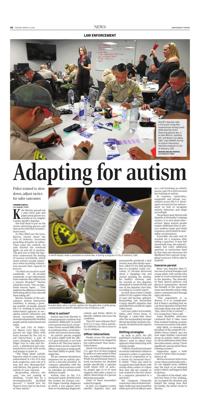
Sheriff’s deputies take a trivia quiz using their nondominant writing hands while wearing vision-distorting glasses Nov. 4 as Kate Movius, standing left, and Mayor Cory Moss, right, ring cowbells during an Autism Interaction Solutions program in City of Industry, Calif.

A sheriff deputy reads a pamphlet on autism Nov. 4 during a program in City of Industry, Calif.
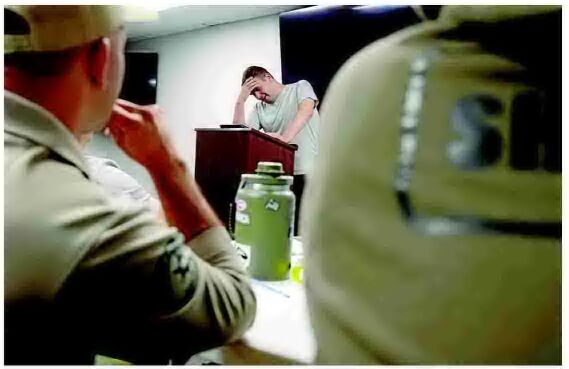
Brayden Moss, who is autistic, gathers his thoughts Nov. 4 while giving a presentation to sheriff’s deputies in City of Industry, Calif.
LAW ENFORCEMENT
Kate Movius passed out a pop trivia quiz and paper prism glasses to a roomful of Los Angeles County sheriff's deputies.
She told them to put on the vision-distorting glasses and then write with their nondominant hand.
As they filled out the tests, Movius moved about the City of Industry classroom pounding abruptly on tables. Then came the cowbell. An aide flashed the overhead lights on and off at random. The goal was to help the deputies understand the feeling of sensory overwhelm, which many autistic people experience when incoming stimulation exceeds their capacity to process.
"So what can you do to assist somebody, or de-escalate somebody, or get information from someone who suffers from a sensory disorder?" Movius asked the crowd. "We can minimize sensory input. … That might be the difference between them being able to stay calm and them taking off."
Movius, founder of the consultancy Autism Interaction Solutions, is among a growing number of people around the U.S. working to teach law enforcement agencies to recognize autistic behaviors and ensure encounters between neurodevelopmentally disabled people and law enforcement end safely.
She and City of Industry Mayor Cory Moss later passed out bags filled with tools donated by the city to aid interactions: a pair of noise-damping headphones, fidget toys to calm and distract, a whiteboard and communication cards with words and images to point to.
"The thing about autistic behavior when it comes to law enforcement is a lot of it may look suspicious, and a lot of it may feel very disrespectful," said Movius, the parent of an autistic 25-year-old man.
Responding officers, she said, "are not coming in thinking, 'Could this be a developmentally disabled person?' I would love for them to have that in the back of their minds."
What is autism?
Autism spectrum disorder is a developmental condition that manifests differently in nearly every person who has it. Symptoms cluster around difficulties in communication, social interaction and sensory processing.
An autistic person stopped by police might hold the officer's gaze intensely or not look at them at all. They may repeat a phrase from a movie, repeat the officer's question or temporarily lose their ability to speak. They might flee.
All are common involuntary responses for an autistic person in a stressful situation. To someone unfamiliar with the condition, these reactions could be mistaken for intoxication, defiance or guilt.
Autism rates in the U.S. increased nearly fivefold since the Centers for Disease Control began tracking diagnoses in 2000, a rise experts attribute to broadening diagnostic criteria and better efforts to identify children who have the condition.
The CDC now estimates that 1 in 31 U.S. 8-year-olds is autistic. In California, the rate is closer to 1 in 22 children.
Officer interactions
People across the spectrum are more likely to be stopped by law enforcement than neurotypical peers.
About 15% of all people in the U.S. ages 18 to 24 were stopped by police at some point in their lives, according to federal data. While the government doesn't track encounters for disabled people specifically, a separate study found 20% of autistic people ages 21 to 25 were stopped, often after a report or officer observation of a person behaving unusually.
Some of these encounters ended in tragedy.
In 2021, Los Angeles County sheriff's deputies shot and permanently paralyzed a deaf autistic man after family members called 911 for help getting him to a hospital. Isaias Cervantes, 25, became distressed about a shopping trip and started pushing his mother, his family's attorney said. He resisted as two deputies attempted to handcuff him and one of the deputies shot him, according to a county report.
In 2024, Ryan Gainer's family called 911 for support when the 15-year-old became agitated. Responding San Bernardino County sheriff's deputies shot and killed him outside his Apple Valley home.
Last year, police in Pocatello, Idaho, shot Victor Perez, 17, through a chain-link fence after the nonspeaking teenager did not heed their shouted commands. He died from his injuries in April.
Shifting strategies
As early as 2001, the FBI published a bulletin on police officers' need to adjust their approach when interacting with autistic people.
"Officers should not interpret an autistic individual's failure to respond to orders or questions as a lack of cooperation or as a reason for increased force," it stated. "They also need to recognize that individuals with autism often confess to crimes that they did not commit or may respond to the last choice in a sequence presented in a question."
But Chapman University researchers who reviewed multiple studies last year found that while up to 60% of officers were on a call involving an autistic person, only 5% to 40% received any training on autism.
In response, universities, nonprofits and private consultants across the U.S. developed curricula for law enforcement on how to recognize autistic behaviors and adapt accordingly.
The primary goal, Movius told deputies at November's training session, is to slow down interactions. Many autistic people require additional time to process auditory input and verbal responses, particularly in unfamiliar circumstances.
If possible, she said, wait 20 seconds for a response after asking a question. It may feel unnaturally long, she acknowledged, but every additional question or instruction fired in that time just decreases the likelihood that a person struggling to process will be able to respond.
Concerns persist
Moss' son, Brayden, then 17, was one of several teenagers and young adults with autism who spoke or wrote statements read to the deputies. The diversity of their speech patterns and physical mannerisms showed the breadth of the spectrum. Some were fluently verbal, while others communicated through signs and notes.
"This population is so diverse. It is so complicated. But if there's anything that we can show (deputies) in here that will make them stop and think, 'Hey, what if this is autism?' … it is saving lives," Moss said.
Some disability advocates cautioned that it takes more than isolated training sessions to ensure encounters end safely.
Judy Mark, co-founder and president of the nonprofit Disability Voices United, says she now urges families concerned about an autistic child's safety to call an ambulance rather than law enforcement, noting "I have significant concern about these training sessions."
Supporters argue a brief course is better than no preparation at all.
Movius received a letter from a man whose profoundly autistic son slipped away, climbed into the back of an unlocked police vehicle and began to flail in distress.
The officer at the wheel, who had just been to her training, de-escalated the situation and helped the young man find his family, the father wrote to Movius.