

Miracle medication
Drugs can lower obesity rates, health care costs

ALISON SEXTON WARD
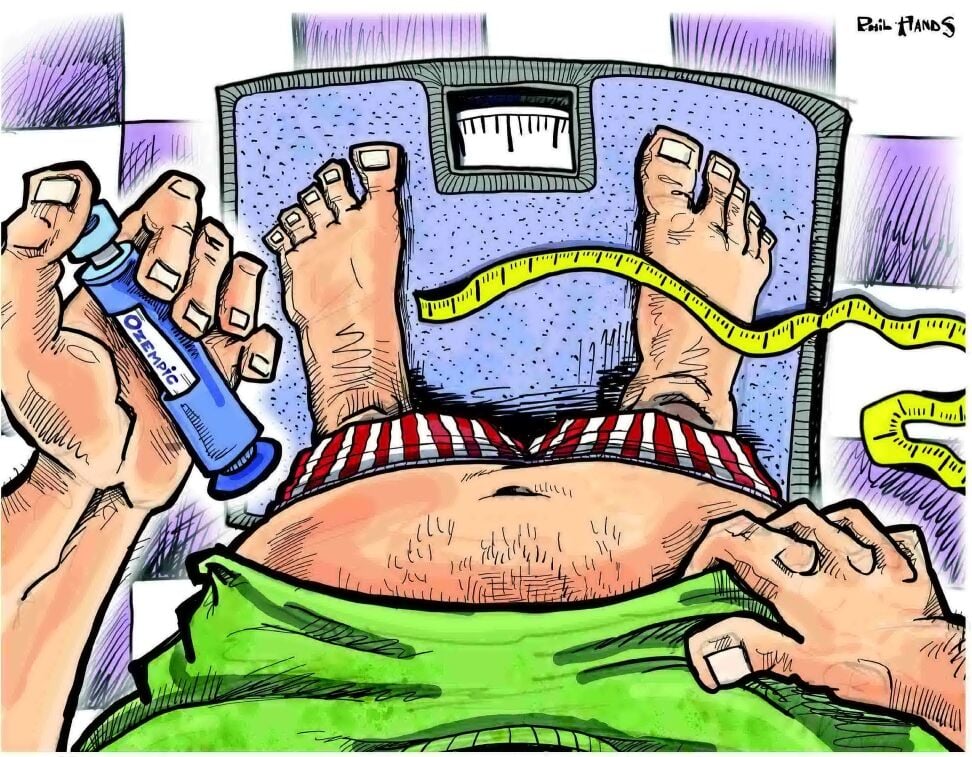
Alarmed by rising rates of obesity, public health off cials have urged Americans for decades to eat better, move more and make healthier choices. Yet obesity rates kept rising, peaking at 40% of Americans in 2022. The decline since then is linked to something else: a new class of medications known as GLP-1.
The arrival of these drugs has historic implications for Americans' health. Obesity and its related conditions — including diabetes, heart disease, stroke and cancer — are responsible for a large percentage of deaths annually and account for a significant part of the nation's $5.3 trillion in health care costs.
GLP-1 medications like semaglutide and tirzepatide help patients lose 15% to 20% of their body weight, outcomes that behavioral interventions have never achieved at scale.
Yet insurance coverage for GLP-1s prescribed for weight loss remains limited. Millions of Americans lack access to treatments that could lengthen and improve their lives, while bending the curve of U.S. health care spending.
Research at the University of Southern California's Schaeffer Center for Health Policy & Economics finds that widespread access to GLP-1 therapies could generate significant benefits to society. Young adults starting treatment between ages 25 and 34 could gain nearly two years of life expectancy, spend nearly six fewer years with diabetes, and reduce their risk of hypertension, heart disease, stroke and cancer. Even Medicare beneficiaries who start treatment between ages 65 and 74 can expect to live about six months longer and experience reduced time living with diabetes.
Research also shows that Medicare coverage alone would generate nearly $1 trillion in cumulative social benefits over the next decade. Medicare itself would save between $175 billion and $245 billion in the first 10 years, with 60% of savings from reduced hospitalizations and nursing home care. Investment in broad access could generate real returns exceeding 13% yearly even after accounting for treatment costs, performing better than the U.S. stock market over this century. While the value of GLP-1 treatment varies by age and underlying health risk, all groups would see positive lifetime gains.
Broad access could also dramatically reduce health disparities. Obesity disproportionately affects Black and Hispanic Americans, with 43% and 37% of each population affected, respectively. Black adults experience significantly less weight loss from behavioral interventions compared with white adults, and lower-income individuals have less access to these programs.
The status quo — relying on lifestyle modifications — has expanded existing health disparities.
Like beta blockers for hypertension, GLP-1s simplify treatment. After beta blockers' approval in 1967, reductions in hypertension and cardiac disease were more equal across income levels — the medication bridged the gap that behavioral interventions couldn't. GLP-1s can do the same for obesity.
Critics argue that GLP-1s cost too much to broaden access. That case is fading quickly. Injectable prices as high as $1,300 per month have fallen 50% or more. A new, once-a-day GLP-1 pill, which could significantly increase the number of patients who would consider treatment, has a starter price of $149 a month.
Unfortunately, fewer than one-third of insurers cover GLP-1 medications for weight loss, and Americans who pay cash for the drugs can't count those costs toward their insurance deductibles. Medicare has covered the drugs only for the treatment of diabetes or, in some cases, for obesity-related heart disease.
The history of diabetes off ers an important parallel. Just as diabetes came to be recognized as a biological disease — rather than a lifestyle one — treatable with insulin, it is time to extend the same understanding to obesity treatment.
Ward is a research scientist at the USC Schaeffer Center for Health Policy & Economics. She wrote this for InsideSources.com.
Weight loss aids don't help with body image

CHARLOTTE MARKEY
The rapid adoption of GLP-1 weight loss medications such as Ozempic, Wegovy and Zepbound represents one of the most striking cultural shifts in weight management I've witnessed in nearly 30 years of studying and writing about body image.
These medications were developed to treat diabetes and, more recently, approved for weight management for people who meet specific medical criteria. However, their use has expanded far beyond those original purposes, becoming not just a medical intervention but a new social norm.
As a body image scientist, I'm intellectually curious and deeply concerned about what this shift signals, especially for young people developing a sense of self in a world already saturated with appearance-based expectations.
In a 2025 study I published with colleagues, we found that higher body shame, body surveillance, weight concerns and anti-fat bias were associated with greater interest in trying GLP-1s and greater willingness to tolerate side effects. In other words, our cultural enthusiasm for these drugs may land hardest on those already struggling, and we have no evidence that taking a GLP-1 improves body image. Changing the body is not the same as changing body image.
Another concern is how quickly these medications have helped recenter weight loss as a primary "health" goal. For years, many clinicians, researchers and advocates have emphasized that weight alone is not a reliable proxy for health. Healthy behaviors such as adequate nutrition, enjoyable movement, sleep, stress management and social connection are far more predictive of long-term well-being than body size itself.
Yet, the excitement around GLP-1s risks reinforcing an old idea in a new form: that smaller bodies are inherently healthier bodies and higher-weight bodies are medical problems in need of correction. That framing doesn't just shape medical practice; it encourages stigma. And weight stigma is not benign. It's associated with worse mental and physical health outcomes and with avoidance of health care.
Speaking of mental health, many people are not screened for eating disorder history or symptoms before being prescribed these medications. Eating disorder specialists and advocacy organizations raised concerns about what happens when appetite suppression becomes culturally celebrated. For some, medicated appetite suppression may feel like relief at first, especially if they've spent years in diet-and-shame cycles. Relief can slide into rigid control.
Which brings a deeper worry: Weight loss drugs are reshaping the body image conversation. For years, we've tried to move away from "thinness equals virtue" and "fatness equals failure." Now the message increasingly sounds compassionate: It's not your fault; your body is a medical condition that needs treatment.
This is also why I disagree when people declare that body diversity was a myth or that body positivity is no longer needed. Body positivity, at least as body image scientists define it, was never about celebrating every body. It was about decoupling appearance from worth and helping people treat their bodies with respect and compassion.
Finally, I worry about what this discourse teaches young people. When the loudest cultural message is that hunger can be pharmaceutically muted, we risk sending a confusing lesson: that a "good" body is a controlled body, possibly even a medicated one. When did hunger become a problem? Why give up on enjoying food? Do we really want adolescents growing up believing that only small, controlled bodies are acceptable?
We are conducting a massive, realtime social experiment, and scientists have barely considered the psychological consequences. Weight loss medications may treat diabetes and other health conditions with remarkable success, but I am doubtful they can treat body dissatisfaction.
If the next generation learns that the "best" body is the one that needs the least food, we shouldn't be surprised when body dissatisfaction and life-threatening eating disorders increase.
Markey is a professor of psychology at Rutgers University, a body image scientist, clinician and author of "The Body Image Book" series. She wrote this for InsideSources.com.