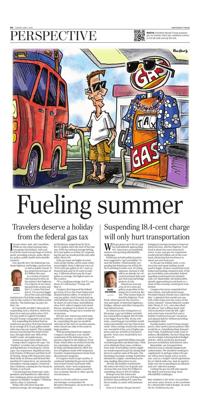


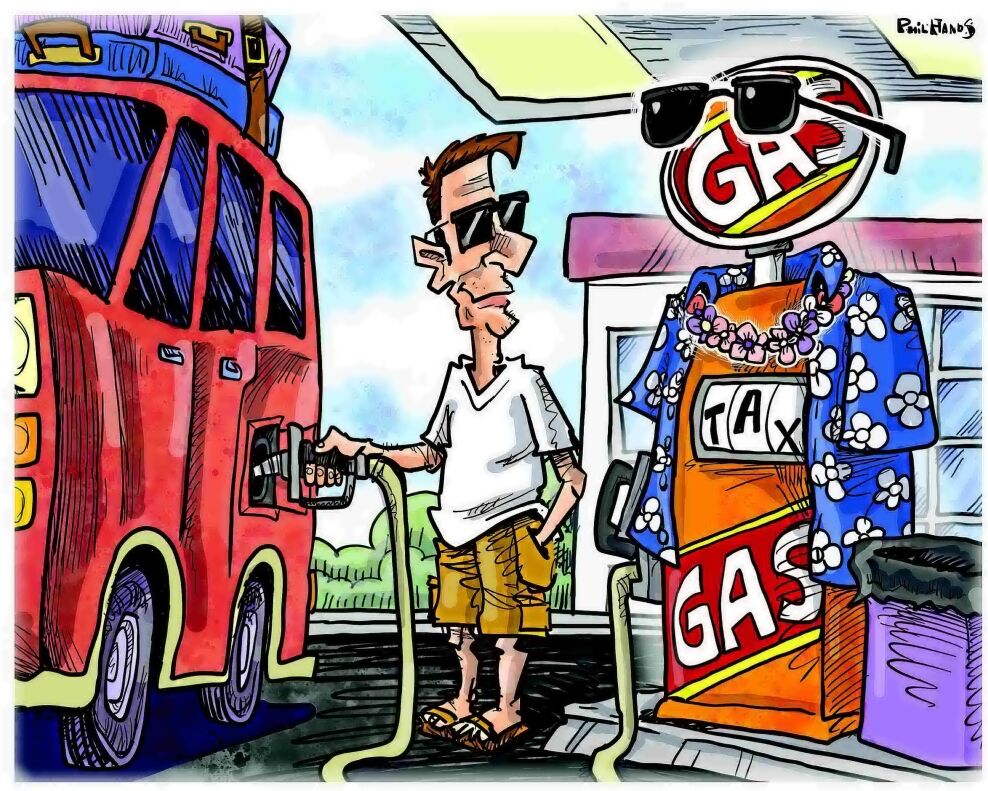
Fueling summer
Travelers deserve a holiday from the federal gas tax

JAMES ROSEN
I'm not a knee-jerk, anti-tax fellow.
While no one enjoys paying taxes, I recognize that federal, state and local levies fund a broad range of critical needs, including schools, parks, libraries, police, public health and scientific research.
One specific levy, the federal gas tax, funds highway and bridge construction as well as public transit. It has projected revenues of $37 billion this year.
As a native of Detroit who learned to drive on the nation's first highway, I'm a big fan of our amazing interstate system and the U.S. routes that feed into it. I'm an even bigger fan of the road and bridge maintenance that helps make driving safe for the country's 280 million motor vehicles. The federal gas tax pays for that, too.
So I normally wouldn't advocate for suspending such a vital levy, which has been 18.4 cents per gallon since 1993. I'm also loath to support President Donald Trump's misguided war in Iran.
But suspending the federal fuel tax would ease gas prices that have increased by an average of $1.52 per gallon nationwide since the war started. This is largely because Iran blocked the Strait of Hormuz, through which one-fifth of the world's crude-oil supply passes.
Americans need some relief. Now. Trump asked Congress for a gas-tax
"holiday." A motley mix of Democrats and Republicans is backing his call for a gas-tax suspension. Republican Sens. Josh Hawley of Missouri and Rick Scott of Florida, along with Democratic Sens. Mark Kelly of Arizona and Richard Blumenthal of Connecticut, are among the lawmakers voicing support. Democrat Alex Vindman, running for the Senate in Florida, is on board.
"I'm hearing from Democrats, independents and Republicans alike about how surging gas prices are putting the squeeze on families' budgets," Vindman said in a May 12 statement.
While still a bit lower than the national average, the average gas price in Florida has surged from $2.88 to $4.34 a gallon since the start of the Iran war. With the national average hitting $4.53 per gallon as of May 20, suspending the gas tax would provide only mild relief, about 4%.
State gas taxes are higher in every state except Alaska, and in some states much higher, from California's levy of 70.92 cents per gallon to 58.7 cents in Pennsylvania and 54.50 cents in Indiana. California drivers pay $6.16 per gallon on average, the highest price in the country.
"It's a small percentage, but it's, you know, it's still money," Trump said May 11.
Congress first imposed the federal gas tax in 1932 as the Great Depression drained federal coffers. It started at 1 cent per gallon. Had it merely kept up with inflation since then, the tax would be about 24 cents today. And inflation since 1993, when Congress last raised the tax, would put it at about 42 cents. So if anything, the gas tax is overdue for an increase.
But not now. Americans need some relief this summer. As mild as it might be, suspending the gas tax would be welcome at the start of vacation season, when Americans take to the roads in large numbers.
With growing bipartisan support, Congress should pass a six-month suspension of the federal gas tax. To prevent a big hit to the Highway Trust Fund, which relies on revenue from the tax, lawmakers should adopt a plan by Kelly and Blumenthal to offset the loss of highway funds with temporary transfers of general purpose funds from discretionary programs.
If Congress wants to get creative, it could pair indexing the gas tax to inflation to meet future road needs with automatic, short-term suspensions in the event of price spikes caused by war, economic shocks or other special circumstances.
Rosen is a former political reporter and Pentagon correspondent for McClatchy Newspapers. He wrote this for InsideSources.com.
Suspending 18.4-cent charge will only hurt transportation

MARC GOLDWEIN
With gas prices up to $4.50 a gallon and inflation approaching 4%, Americans are justifiably anxious over growing affordability challenges.
Politicians in both political parties have suggested a "gas tax holiday" to ease the burden. Unfortunately, suspending the federal gas tax will do little if anything to lower cost-of-living expenses. Instead, it will add to an already out-ofcontrol national debt and put vital road and bridge projects at risk.
Americans now pay a tax of 18.4 cents per gallon on gasoline at the pump (24.4 cents for diesel). That money helps to fund the Highway Trust Fund, which pays for the construction and repair of interstate highways, bridges, railways and other transportation infrastructure.
As Americans face rising prices at the pump, a gas tax holiday certainly has some political appeal. But its bark is far bigger than its bite. By my estimate, a yearlong gas tax holiday would reduce household costs less than $1 per week. These savings would only reverse one-twentieth of the cost of higher gas prices and one-fortieth of total price growth. Total costs would fall by less than 0.1%.
Americans spend $40 billion annually on federal gasoline and diesel taxes. Were we to eliminate those taxes, evidence from state-level holidays shows suppliers would respond in part by raising their prices to capture some of the gain. The remaining consumer savings would juice demand in a supply-constrained economy, leading other prices to rise.
All told, the holiday would probably reduce the total cost of goods and services this year from $32 trillion to something closer to $31.99 trillion.
Perhaps even this minuscule improvement in the cost of living would be better than nothing if it came free. But in reality, it comes with immense costs.
Even as it stands, the gas tax isn't bringing in enough revenue to fund our infrastructure, and the Highway Trust Fund is about two years from insolvency. A one-year gas tax suspension would pull $40 billion out of the trust fund, advancing that insolvency to about one year from now.
As the gas tax holiday ends, a construction and repair holiday would need to begin. Projects would have to be halted and funding slashed in half. If the gas tax holiday were extended, federal spending would need to be dramatically cut. Meanwhile, the federal debt, already approaching record levels as a share of the economy, would grow even further.
Congress has never suspended fuel taxes before, and with good reason. President Barack Obama once called the idea "a gimmick that would save you half a tank of gas over the course of the entire summer." Senate Majority Leader John Thune, R-S.D., once described the idea as "just a flimsy Band-Aid." And economists from the left, right and center have warned that such a holiday would increase pre-tax prices and expand deficits without providing meaningful relief.
If policymakers want to lower energy prices, they need to pursue policies that would do so. Subsidizing their demand won't help. If politicians really want to address affordability, the best thing they can do is begin reducing federal budget deficits, which would put downward pressure on inflation and interest rates.
Meanwhile, our transportation infrastructure is already dangerously underfunded. We should be working to supplement or perhaps replace the gas tax with a more steady source of revenue, such as a weight-based registration fee or vehicle miles tax. And we need to make sure we're spending in an efficient and cost-effective manner.
Cutting the gas tax will only expand the deficit and worsen long-term affordability challenges.
Marc Goldwein is the senior vice president and senior policy director at the Committee for a Responsible Federal Budget. He wrote this for InsideSources.com.