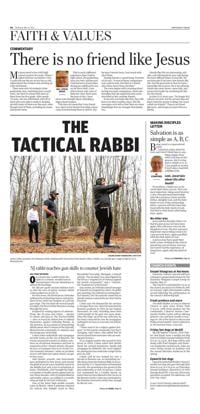
On a recent day, a rabbi led his disciples to a remote, wooded area in Pennsylvania's Pocono Mountains to deliver his teachings.
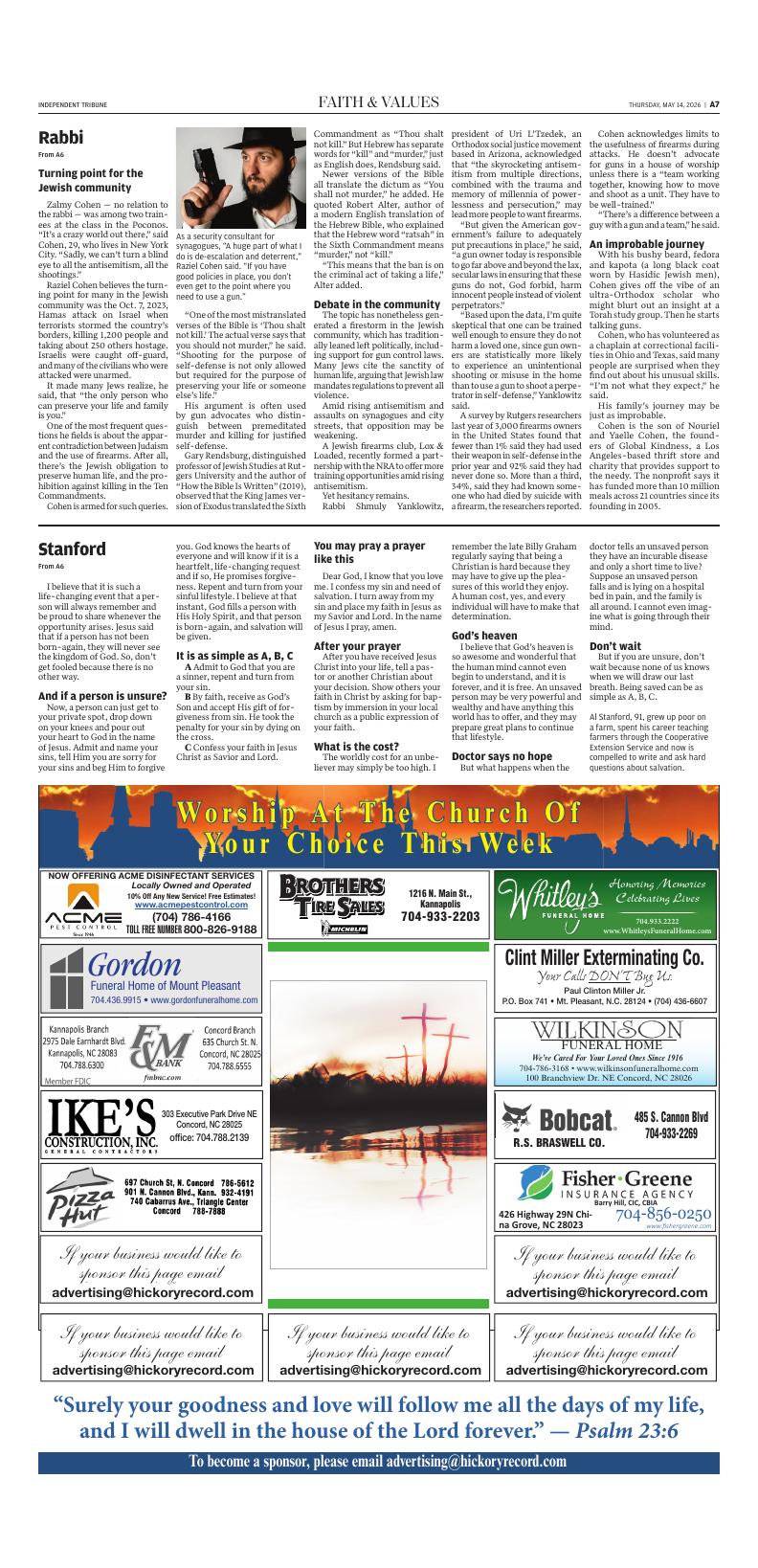
He did not quote ancient Hebrew texts or raise his voice in prayer. Instead, Raziel Cohen pulled out an AR-15.
For four hours, the North Jersey Orthodox rabbi practiced shooting stances and quickdraw tactics with two students at a private gun range. The trio fired off several rounds at targets, the blast of their firearms echoing through the trees.
Inspired by soaring reports of antisemitism, the 29-year-old Cohen — known to clients and fans as The Tactical Rabbi — aims to teach his fellow Jews to defend themselves against widening threats. In the practice, he has joined an intensifying debate about what it means in the typically liberal Jewish community to embrace and encourage gun ownership.
Cohen trains individuals and synagogue security teams on the use of firearms. He travels around the country to deliver seminars on situational awareness and how to respond to active-shooter attacks. His goal, he says, is to prepare Jews to act in the crucial moments between "when an incident occurs and when law enforcement can get to the scene."
Anti-Jewish assaults and harassment have multiplied in New Jersey and around the globe in recent years, fueled by unrest in the Middle East and a rise in extremism at home. Worldwide, 2025 brought the highest number of deadly attacks against Jews in over three decades, with 20 people killed in antisemitic sprees, according to a recently released tally by Tel Aviv University.
One of the latest high-profile assaults came in March, when a gunman rammed his vehicle into Temple Israel in West Bloomfield Township, Michigan, a Detroit suburb. The incident was investigated by the FBI as a "targeted act of violence against the Jewish community" and a "Hezbollah-inspired act of terrorism."
Days earlier, an Orthodox Jewish teenager in Teaneck was targeted in a drive-by pellet gun shooting. He suffered no lasting physical injuries, but the episode unnerved an already anxious community just days before Passover.
Cohen says the demand for his services is stronger than ever. Since he launched his firearms academy in 2019, he has trained thousands, he said, including more than 5,000 people in the past two years alone. Since the ramp-up of the war with Iran, he has been contacted by over 40 synagogues seeking his services as a security consultant, he said.
"There used to be a stigma against firearms" in the Jewish community, but that's changing, said Cohen, who added that he also has heard from more Jews who are seeking gun licenses.
A Los Angeles native who moved to New Jersey in 2020, Cohen asked that details about his current hometown, family and synagogue be withheld. His vocal support for arming Jews has made him a target in the past, he said.
Cohen said he has trained for over a decade in firearms use, accumulating certifications from the National Rifle Association and the U.S. Department of Homeland Security. His prominence has grown in the gun community as well. In January, Cohen was nominated for a Gundie Award, an honor that has been likened to the Oscars of the firearms world. Cohen was nominated as the Firearms Instructor of the Year, though he did not win.
Turning point for the Jewish community
Zalmy Cohen — no relation to the rabbi — was among two trainees at the class in the Poconos. "It's a crazy world out there," said Cohen, 29, who lives in New York City. "Sadly, we can't turn a blind eye to all the antisemitism, all the shootings."
Raziel Cohen believes the turning point for many in the Jewish community was the Oct. 7, 2023, Hamas attack on Israel when terrorists stormed the country's borders, killing 1,200 people and taking about 250 others hostage. Israelis were caught off-guard, and many of the civilians who were attacked were unarmed.
It made many Jews realize, he said, that "the only person who can preserve your life and family is you."
One of the most frequent questions he fields is about the apparent contradiction between Judaism and the use of firearms. After all, there's the Jewish obligation to preserve human life, and the prohibition against killing in the Ten Commandments.
Cohen is armed for such queries.
"One of the most mistranslated verses of the Bible is 'Thou shalt not kill.' The actual verse says that you should not murder," he said. "Shooting for the purpose of self-defense is not only allowed but required for the purpose of preserving your life or someone else's life."
His argument is often used by gun advocates who distinguish between premeditated murder and killing for justified self-defense.
Gary Rendsburg, distinguished professor of Jewish Studies at Rutgers University and the author of "How the Bible Is Written" (2019), observed that the King James version of Exodus translated the Sixth Commandment as "Thou shalt not kill." But Hebrew has separate words for "kill" and "murder," just as English does, Rendsburg said.
Newer versions of the Bible all translate the dictum as "You shall not murder," he added. He quoted Robert Alter, author of a modern English translation of the Hebrew Bible, who explained that the Hebrew word "ratsah" in the Sixth Commandment means "murder," not "kill."
"This means that the ban is on the criminal act of taking a life," Alter added.
Debate in the community
The topic has nonetheless generated a firestorm in the Jewish community, which has traditionally leaned left politically, including support for gun control laws. Many Jews cite the sanctity of human life, arguing that Jewish law mandates regulations to prevent all violence.
Amid rising antisemitism and assaults on synagogues and city streets, that opposition may be weakening.
A Jewish firearms club, Lox & Loaded, recently formed a partnership with the NRA to offer more training opportunities amid rising antisemitism.
Yet hesitancy remains. Rabbi Shmuly Yanklowitz, president of Uri L'Tzedek, an Orthodox social justice movement based in Arizona, acknowledged that "the skyrocketing antisemitism from multiple directions, combined with the trauma and memory of millennia of powerlessness and persecution," may lead more people to want firearms.
"But given the American government's failure to adequately put precautions in place," he said, "a gun owner today is responsible to go far above and beyond the lax, secular laws in ensuring that these guns do not, God forbid, harm innocent people instead of violent perpetrators."
"Based upon the data, I'm quite skeptical that one can be trained well enough to ensure they do not harm a loved one, since gun owners are statistically more likely to experience an unintentional shooting or misuse in the home than to use a gun to shoot a perpetrator in self-defense," Yanklowitz said.
A survey by Rutgers researchers last year of 3,000 firearms owners in the United States found that fewer than 1% said they had used their weapon in self-defense in the prior year and 92% said they had never done so. More than a third, 34%, said they had known someone who had died by suicide with a firearm, the researchers reported.
Cohen acknowledges limits to the usefulness of firearms during attacks. He doesn't advocate for guns in a house of worship unless there is a "team working together, knowing how to move and shoot as a unit. They have to be well-trained."
"There's a difference between a guy with a gun and a team," he said.
An improbable journey
With his bushy beard, fedora and kapota (a long black coat worn by Hasidic Jewish men), Cohen gives off the vibe of an ultra-Orthodox scholar who might blurt out an insight at a Torah study group. Then he starts talking guns.
Cohen, who has volunteered as a chaplain at correctional facilities in Ohio and Texas, said many people are surprised when they find out about his unusual skills. "I'm not what they expect," he said.
His family's journey may be just as improbable.
Cohen is the son of Nouriel and Yaelle Cohen, the founders of Global Kindness, a Los Angeles-based thrift store and charity that provides support to the needy. The nonprofit says it has funded more than 10 million meals across 21 countries since its founding in 2005.