
New study finds 'alarming' flood risk for millions in US
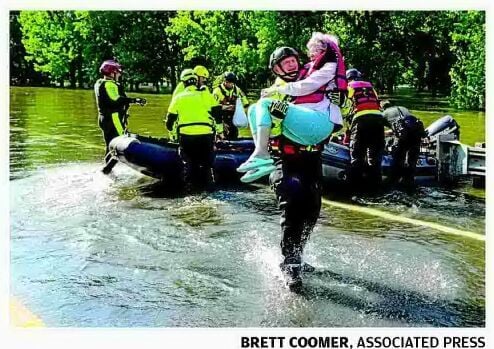
Firefighter Cody Leroy carries a resident evacuated in a boat from her flooded home in the aftermath of a severe storm May 2, 2024, in Conroe, Texas.
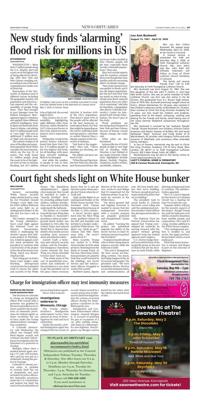
WASHINGTON — More than 17 million people along the U.S. Atlantic and Gulf coasts are at the highest risk of being affected by flooding, with New York and New Orleans standing out, according to one of the most comprehensive studies ever of flood risk.
Researchers at the University of Alabama used 16 different factors including the geographic hazards, the population and infrastructure exposed and the vulnerability of people living there. They then brought in past damages from the Federal Emergency Management Agency's database and applied three different artificial intelligence tools to figure out flood risks from Texas to Maine, calculating that 17.5 million people were at "very high" risk and an additional 17 million were at "high" risk, the next level.
The authors looked at all sizes of flooding and examined separately what FEMA considers the most extreme, which are the top 1% of events. The study found 4.3 million people along the coasts to be at the highest level of risk of extreme flooding, but 20.5 million to be at high risk, the second highest level.
They found a lot of vulnerability, highlighting eight different cities from Houston, which flooded in 2017's Hurricane Harvey, to New York, which was inundated in 2012's Superstorm Sandy.
Wednesday's study in the journal Science Advances found that New York City has 4.75 million people at the two highest risk levels for all flooding, with more than 200,000 buildings likely to be damaged.
And while the number of people at risk in New Orleans is far lower, about 380,000, it involves 99% of the city's population. That doesn't mean 99% of the people will be affected in the next hurricane or nontropical flood, but that they might be depending on the storm's individual path and rain pattern, said study co-author Wanyun Shao, a climate scientist at the University of Alabama.
"Just look at the magnitude," Shao said. "Those numbers are shocking, are alarming."
The elderly and poor are most at risk.
"When the next big storm hits New York City, when the next Hurricane Katrina-like hurricane makes landfall in New Orleans, people will get hurt, especially those socially vulnerable populations," Shao said.
Shao and outside experts said the numbers stunned them even though they were familiar with the worsening effects of climate change.
"New York is known to be susceptible to floods and it has the largest population. But the fact that New York has nearly an order of magnitude more flood-exposed population than any other city is surprising," said Alex de Sherbinin, a geographer who directs Columbia University's Center for Integrated Earth System Information. He wasn't part of the study.
Flood problems are becoming more frequent in New York and New Orleans because of human-caused climate change, the study said.
Other cities are also threatened.
Jacksonville has 679,000 people at high or very high risk of flooding, while Houston is just behind at just under 600,000. Other cities highlighted include Miami, Norfolk, Virginia, Charleston, South Carolina, and Mobile, Alabama.