

READY TO RIDE
Tips for keeping your child safe on two wheels

Bicycle riding not only promotes physical fitness but also provides an enjoyable way for children to explore their environment.
Spring offers an ideal opportunity for families to refresh their routines and develop healthier, more active habits beyond the confines of indoor spaces. The season's warmer temperatures and longer daylight hours create perfect conditions for children to spend meaningful time outdoors.
One of the most beneficial activities is bicycle riding, which not only promotes physical fitness but also provides an enjoyable way for children to explore their environment. Ensuring that children receive basic safety instruction and proper training helps make every ride safe and positive.
Having the right equipment, including a properly fitted bicycle and appropriate safety gear, is the first step toward a successful riding experience.
Selecting a bicycle
When choosing a bicycle, parents should focus on selecting a bike that fits their child now rather than one they can "grow into" for the future. When standing over the bicycle, a child should have 1 to 2 inches of clearance above the top bar of a road bike and 3 to 4 inches for a mountain bike. The seat height should be adjusted so the child's knees have a slight bend when the legs are extended.
Tricycles, training wheels and balance bikes also are excellent options for helping children learn to steer, pedal and balance before transitioning to a standard bicycle. Before each ride, the bike should be checked to make sure it is in good working condition. Tires should be inflated and brakes should function properly.
Protective gear
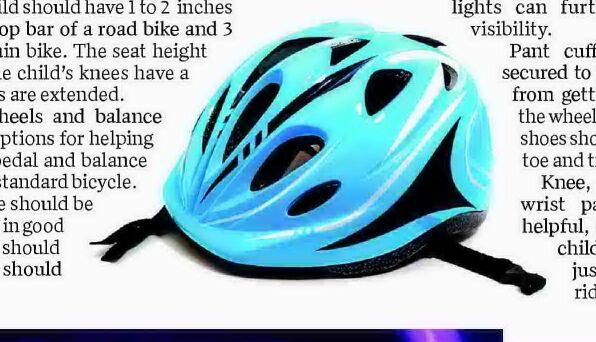
A helmet is the most important piece of protective gear a cyclist can wear. Studies show that helmets can reduce the risk of head injury by about 85%. Children should wear a helmet every time they ride, regardless of the distance or how close they are to home.
Helmets come in various sizes and should be fitted correctly. They should sit level and low on the child's forehead. The center and side straps must be adjusted so the helmet fits snugly, allowing no more than two fingers between the strap and the chin.
Appropriate attire also plays a key role in preventing crashes and increasing visibility.
In all weather and lighting conditions, it is essential that riders can be easily seen. Children should wear neon, fluorescent or bright colors in low-light conditions. Reflective tape, markings or flashing lights can further enhance visibility.
Pant cuffs should be secured to prevent them from getting caught in the wheels or chain, and shoes should be closedtoe and tied securely.
Knee, elbow and wrist pads also are helpful, especially for children who are just learning to ride.
Where to ride
Designated riding areas should be chosen based on a child's age and maturity. Young children should ride only under adult supervision and avoid streets entirely. Select areas free of traffic and distractions and ideally without gravel, leaves, puddles, dogs or potholes. These hazards can cause crashes, so the lead rider should call out and point to any danger to alert others. Bike paths are always a safe and reliable option.
Children should not ride at night, as reduced visibility increases the risk of a crash. Plan ahead to ensure rides end before dark or be sure to equip bikes with proper lighting when visibility will be limited.
For advanced riders
Older cyclists who are ready to ride on streets must follow all rules of the road. This includes obeying stop signs and traffic lights, stopping at all intersections — whether marked or unmarked — and riding on the right side of the street. Riding against traffic can confuse and surprise drivers.
Children also should learn proper hand signals before riding on the street. At least one hand must remain on the handlebars at all times and any items being carried should be placed in a bicycle carrier or backpack. If a child cannot maintain control of the bike with one hand, they should not ride in the street.
For additional safety tips, visit the national Highway traffic Safety administration website at nhtsa.gov.