This is a collection of historical photos and stories that have been published recently in the Independent Tribune.
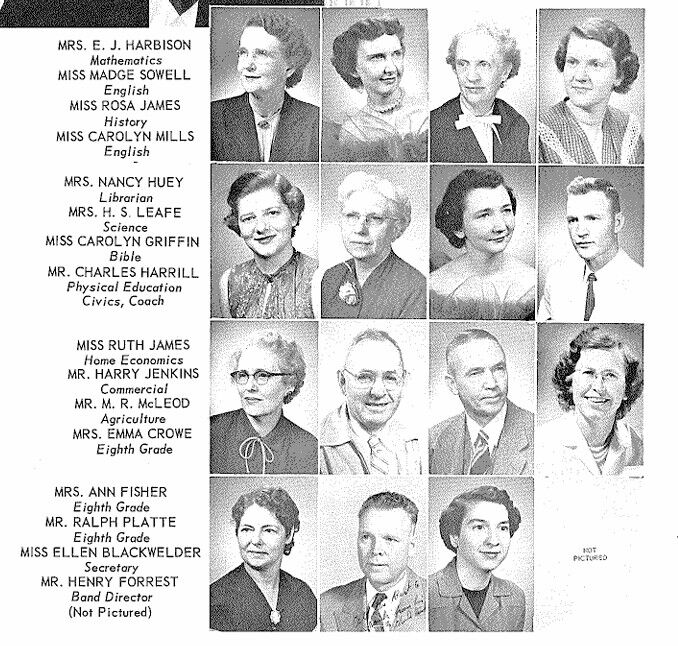
1955 faculty at Mount Pleasant High School
Mount Pleasant High School celebrates its 100th anniversary in 2026. Here are faculty members from the 1955 yearbook, the oldest one in the collection at Eastern Cabarrus Historical Society Museum.
From Eastern Cabarrus Historical Society
John Hood: Do sternly worded letters win wars?
RALEIGH — It was 250 years ago this week that a displaced governor issued a proclamation intended to restore him to power in North Carolina. Instead, it led to the first major engagement of the Revolutionary War in the Southern colonies — and a decisive defeat for his cause.
The governor in question was Josiah Martin, a Dublin native and British army officer appointed in 1771 to replace William Tryon as the king’s top magistrate in the future Tar Heel State. As resistance to illegal British taxes and sympathy with the residents of Boston spread across North Carolina, Martin catastrophically mishandled his relationship with the provincial legislature and was essentially chased out of the capital, New Bern, in April 1775.
Taking refuge in a British sloop anchored off shore, Martin spent the early months of the Revolutionary War concocting various schemes to regain power. All came to naught. Then he received word the British government wanted to pursue a Southern strategy to win the war, beginning with the capture of Charleston, South Carolina, in early 1776.
An emboldened Governor Martin instructed his emissary Alexander Shaw to propose an alternative: first capturing Wilmington. Taking the smaller but strategic valuable city, then reasserting royal control over the rest of North Carolina, would weaken Patriot manpower, supplies and resolve, Shaw argued, making it easier to seize Charleston and Savannah. With the Carolinas and Georgia back in the fold, British regulars and Tory militia could then move north against the largest province in revolt, Virginia, in late 1776 or 1777.
Shaw proved persuasive. British leaders agreed to converge on Wilmington — Gen. Henry Clinton sailing south from New York with one army, Gen. Charles Cornwallis west from Ireland with another. As for Governor Martin, he promised to raise many thousands of Loyalists, most either Scottish Highlanders from the Sandhills or ex-Regulators from the Piedmont with longstanding grievances against the coastal elites now running North Carolina’s revolutionary government.
Another part of the plan, at least in the minds of some British agents, was to draw Carolina militiamen away from coastal defense by inciting and arming the Cherokees to open a second front in the backcountry.
Martin threw himself wholeheartedly into the plan. On Jan. 10, 1776, he issued a proclamation calling for Loyalists to muster into militia companies for the impending conflict. He also promised “every aid, encouragement, and support to all such as shall come to vindicate and support the violated laws and Constitution of their country,” while fuming that “a most daring, horrid and unnatural Rebellion has been exerted in the Province against His Majesty's Government, by the base and insidious artifice of certain traitorous, wicked and designing men.”
This was his public proclamation. Also on Jan. 10, Governor Martin dispatched messengers to Loyalist militia commanders in Anson, Cumberland, Chatham, Guilford, Mecklenburg, Rowan, Surry and Bute counties to march their forces to a central location by Feb. 15. They soon settled on Cross Creek, now Fayetteville, as their initial destination, with the intention of then heading down the Cape Fear River to Wilmington to meet up with the incoming British regulars.
Because you know how the Revolutionary War turned out, I won’t worry about spoilers here. Britain’s first Southern strategy had too many moving pieces and was based on the faulty intelligence — much of it from Josiah Martin himself — that most Carolinians sided with the king. Nothing went according to plan. General Clinton showed up late. General Cornwallis was even later. The Cherokee attacks came too late, as well, and converted more than a few previously neutral frontiersmen into passionate Patriots.
As for the Loyalists, many fewer took arms than Martin predicted. And they never made it to Wilmington. To learn more about the resulting battle of Moore’s Creek Bridge (Feb. 27, 1776), please consider attending North Carolina’s First in Freedom Festival. It will be held on and around the Pender County battlefield this coming Feb. 21 to Feb. 28. Visit NCFirstInFreedomFestival.com for more details.
John Hood
A Tom Thumb wedding? The view from the balcony at the old Mount Pleasant High
This old photo appears to be a Tom Thumb wedding being held at the old Mount Pleasant High School. The view is from the auditorium balcony.
A Tom Thumb wedding is a children's mock marriage ceremony popular in the late 19th/early 20th century, in which kids dress as wedding participants for a fundraiser or social event, named after P.T. Barnum's famous little person, General Tom Thumb, and his real-life wedding. AI was used to define a Tom Thumb wedding.
Mount Pleasant brick building came after 1911 fire
After a fire on Thanksgiving night in 1911 burned Mont Amoena Female Seminary to the ground, this impressive brick replacement opened in 1913. Thankfully, the fire started when most of the students and staff were attending a play at the town auditorium over Cook and Foil's store and no serious injuries were reported.
ECHS, MPHS PTSO celebrate Mount Pleasant High's centennial
A special program on the history of Mt. Pleasant High School with Betty Honeycutt, Ben Callahan, Doug Drye, and Richard Miller. Get ready to celebrate the school's 100th anniversary next year with a look back at the past. The Eastern Cabarrus Historical Society will hold the program on Thursday, Nov. 13, at 7 p.m. at the Mount Pleasant High School auditorium.
Battleship North Carolina searches for schoolchildren who saved her
WILMINGTON — More than 60 years ago, an extraordinary thing happened: schoolchildren across North Carolina saved a battleship.
Armed with nothing but determination and their lunch money, students from every corner of the state launched a grassroots campaign that would make history. In 1961, these young North Carolinians collected nickels, dimes and spare change to “Save Our Ship” — raising more than $300,000 and rescuing the U.S.S. North Carolina from the scrap heap.
Their effort brought the ship home to Wilmington and transformed her into a living memorial to the 11,000 North Carolinians who gave their lives in World War II and to her 9,000 crew members who served aboard.
Today, those children are grandparents and great-grandparents scattered across North Carolina and throughout the country. Now, the Battleship North Carolina, a division of the North Carolina Department of Natural and Cultural Resources, is searching for these original “North Carolina Navy” members — the kids, families and community leaders whose small donations made the impossible possible.
“Think about it: Children across North Carolina emptied their piggy banks and saved a battleship,” said Dr. Jay Martin, executive director of the Battleship North Carolina. “These donors are now in their 70s and 80s, living all across our state and beyond. We want to find them, hear their stories, and ensure their extraordinary contributions are never forgotten.”
The memories already shared tell a powerful story of determination and pride:
“There was very little extra money, but my parents managed to send many dimes with us to school to help save the USS North Carolina.”
“All of my brothers and sister and I sold drink bottles, raked yards, knocked on doors — most anything we could to raise money.”
“It was exciting to know I had helped bring the Battleship home.”
Whether you’re a former student “crew member” who donated a dime, a teacher who organized your class, or a community leader who helped rally your town — no matter where you live now — the Battleship wants to hear your story. Anyone who contributed, or whose parents or grandparents did, can share written memories, photographs or videos at www.battleshipnc.com/dimes. Submissions will become part of a digital archive and may be featured in upcoming exhibits and educational programming celebrating the people who accomplished what seemed impossible: a generation of kids who saved a battleship.
A spooky tale from Mount Pleasant about angels and a little boy
A picture of Grady McAllister (born 1916) can be found at the Eastern Cabarrus Historical Society Museum. It reminds us of one of Mount Pleasant’s haunted tales, as collected by Vickey Cline and Robin McAllister.
As the story goes, one day in 1920, Grady and his little sister Betty Kate were at the family home on the corner of Main and Walnut Streets, looking out the window into the leafy branches of a large tree outside. Grady told his sister that, “Angels stay in the tops of trees so that they can watch over us.”
Five years later, Grady was coming home from Mount Pleasant Graded School for lunch, playing tag with friends, when he ran into Main Street, directly into the path of an oncoming truck. He was killed instantly.
Some time later, Betty Kate came home from school one day to see that workmen had left a ladder leaning up against the tree and she began to climb it.
But when she looked up into the treetop, she saw Grady, who told her, “Go back down! You will get hurt! It is not your time! See, I told you angels live in trees!”
The McAllister home still stands, as does Grady’s tree. Perhaps Grady is still there, too.
Hotel from 1875 now a hair salon
The Bangle Hotel was located on Main Street in Mount Pleasant, where Miracle Hair Salon is today. It was built around 1875, damaged by fire in 1901, reopened in 1902, and continued to be operated by the Bangle family until 1906.
Reed Gold Mine is closing in November
MIDLAND — Reed Gold Mine State Historic Site will temporarily close to the public to complete a major parking lot resurfacing project. The site is expected to be closed for a month, from Nov. 17 to Dec. 17. North Carolina Historic Sites, a division of the N.C. Department of Natural and Cultural Resources, administers Reed Gold Mine.
Full closure of the site (including the visitor center, historic mine, panning area, and trails) is necessary to ensure public safety while work is underway.
“This upgrade to the driveway and parking area will make for a much more pleasant visitor experience,” said Site Manager Amanda Brantley. “We look forward to completing this project quickly so that the public can return in December to enjoy all that Reed Gold Mine has to offer.”
Updates to the site’s operating schedule will be posted on Reed Gold Mine’s social media accounts and website
Reed Gold Mine is the site of the first documented gold discovery in the United States. North Carolina led the nation in gold production until 1848, when it was eclipsed by the great rush to California.
Today, the site interprets the history of gold mining and features exhibits on geology and mining technology. Visitors can experience the site through guided and self-guided tours of the historic underground mine, panning for gold, three miles of hiking trails, and a working reconstructed 19th century stamp mill.
The Chapel, a classroom at the Mt. Pleasant Collegiate Institute
This is the chapel (left) and a classroom from Mt. Pleasant Collegiate Institute (MPCI). It is now the Eastern Cabarrus Historical Society Museum. MPCI opened in 1903 with a "two-fold mission: (1) To prepare thoroughly for entrance into the Junior Class of our best colleges those students who will take the full college course; and (2) to give to those who will not take the full college course the training that will best equip them for their special work in life."
Mount Pleasant's Class of 1934 on the steps of the school
This is the Mount Pleasant High School Class of 1934. It is one of the many photos in the files of the Eastern Cabarrus Historical Society.
These names are written on the back of the photo, given to ECHS by the late Edith Walker who also graduated in 1934: Sylvia Louise Wilson, Mary Ellen Hatley, Ida Mae Drye, Majell Miller, Muriel Heglar, Melvin E. Barringer, Loyd Nesbit, Edith A. Honeycutt, Beulah M. Lowder, Daphne Rose Bunn, Willene Fisher, Mary Kluttz, Mary Pearl Troutman, Edith Penninger, Archie Moose, Elizabeth M. Link, and John Kimray.
Mount Pleasant High's first football team in 1948
In 1948, Mt. Pleasant High School fielded its first football team, which was nicknamed the "Aces." Local historians and former players have been unable to determine when the school's nickname changed to "Tigers."
Historian Ben Callahan said the first reference to Mt. Pleasant "Tigers" he could find in old newspapers is from 1952. Earlier years only refer to them as Mt. Pleasant.
The players pictured here are: front row, Ray "Cotton" Page, Douglas Caston, Bobby Casper, Earl "Dude" Clark, Paul Petrea, Eugene Parrom, Bill Watts and Lloyd Ritchie; second row, Gilbert "Gib" Heilig, Charles Fortune, Omeldo de Diego, Eugene "Lefty" Sides, Vance Goodman, Van Tarlton, Bob Richards, Bob McMahan, J.C. Rinehardt and Bob McAllister; and third row, Ray Hill, John Williams, Hoy Moose Jr., Alva "Jake" Walters, John Suther, Carl Hill, Ray Fisher, Flake Mills, Paul D. Fisher, Dink Earnhardt, and Coach Earl Hinson. Not pictured were: Buss James, John Eury, Ray Huffstickler and Clyde Brooks.
Historic Cabarrus Association elects news officers
The Historic Cabarrus Association Board of Directors held its annual election of officers earlier this month. The board members were elected to serve were Chairman Jack Lambert, top left, clockwise, Vice Chairman Jody Taylor, Secretary Ashley Sedlak-Propst, and treasurer John Misenheimer.
MPHS Class of 1965 photo added to ECHS collection
This photo of the Class of 1965 at Mount Pleasant High School was recently added to the collection of the Eastern Cabarrus Historical Society. Who you recognize anyone?
The ECHS museum is open on Saturdays from 10 a.m. to 3 p.m. and the library is open for genealogical and other research on Mondays from 10 a.m. to 2 p.m. The Society also sponsors special exhibits, open houses, community events, and programs on a wide variety of topics.
Mecklenburg Resolves and Capt. James Jack display at ECHS Museum
Captain James Jack was a Revolutionary War officer, famously known for his ride from Charlotte to the Second Continental Congress in Philadelphia, where he delivered a copy of the Mecklenburg Resolves, which predates the Declaration of Independence.
He was also appointed a local tax collector and “overseer of the poor”.
Now, thanks to a generous loan, you can see one such original document, completed and signed by Captain Jack at the Eastern Cabarrus Historical Society Museum.
It is part of the Meck Dec Signers exhibit at the ECHS Museum. Check out this display of 18th-century signatures and cast your vote on the authenticity of the Mecklenburg Declaration of Independence. The museum is open on Saturdays from 10 a.m. to 3 p.m.
FLASHBACK: A petition to name R. Brown McAllister Elementary School
Back when the school was a new school the first time in the late 1950s, a petition was circulated to name the school. The Eastern Cabarrus Historical Society has this petition to name the new school in honor of R. Brown McAllister, "the grand old man of education in Cabarrus County."
R. Brown McAllister Elementary School opened as new school the first time in 1958. A new building was constructed behind the first facility.
Coltrane-Webb Elementary School is in the 1958 building, while a new Coltrane-Webb is built on the corner of Spring Street and Grove Avenue.
A couple of pages of signatures.
Here are more pages of signatures.
ECHS recreating 1925 war and Christianity debate
On Sunday, Aug. 24, the Eastern Cabarrus Historical Society will be re-creating a debate given by students at Mt. Pleasant Collegiate Institute in 1925.
Local pastors will read the speeches those students wrote 100 years ago on the topic "War is Inconsistent with Christianity."
The program begins at 2:30 p.m. at the ECHS Museum in Mount Pleasant. The program is free and open to the public.
FLASHBACK - Kindley Mill on Dutch Buffalo Creek in early 1900s
Kindley Mill was located on Dutch Buffalo Creek approximately where it crosses Highway 73, east of Mt. Pleasant (near where Southern Grace Distilleries is today). The Eastern Cabarrus Historical Society estimates this picture dates from 1905-1910.
FLASHBACK 1896: the North Carolina College baseball team
This old photo of the 1896 baseball team at North Carolina College comes from the files of the Eastern Cabarrus Historical Society. The players' names and positions are: Will Corzine (3B); Oscar Simpson (2B); William Petrea (SS); Harry Foil (sub); Fred Foil (CF); Hugh Barrier (P); Howard Barrier (3B); Ed Crowell (sub); Myron Linn (LF); Gurley Moose (1B); Walter Moser (C), and an unnamed manager.
FLASHBACK 40 Years - Do you recognize anyone in this winning poster?
Kristel Dalton Swayze was going through some old things and found this clipping from The Daily Independent April 9, 1986. The photo was taken by Karen Cobb. Extension agent David Goff is showing with a young Kristol and her winning poster.
App State researchers uncover hidden history at Fort Defiance
BOONE — In a newly discovered graveyard at Fort Defiance in Caldwell County, an interdisciplinary effort led by Appalachian State University is establishing “a place where science can meet humanity,” as App State researcher Dr. Ellen Cowan describes it. The confirmation of the previously undocumented resting place of enslaved people follows the discovery in 2023–24 of the fort’s buried footprint by the same researchers on a separate project, deepening the history of the Lenoir-area landmark.
Using ground-penetrating radar over several months, Tucker Terrell, of Burlington, a recent graduate of App State’s geology-environmental geology program, confirmed the existence of 105 graves this spring, using multiple scans of a half-acre area previously buried in brush behind the historic home that bears the fort’s name. The subsurface study revealed the graves by bouncing radar waves off their sides and floors to contrast the density of the sites with the untouched soil around them.
Some grave sites could be identified by faint depressions in the ground, visible to those with a trained eye. Researchers also found a single headstone fragment under an old log. Beyond these markers, there was little surface detail to guide the search.
The discovery highlights the role of the enslaved in the fort’s history and their contributions to the plantation established by Revolutionary War figure Gen. William Lenoir in 1792. It also confirms generations of family stories and holds deep significance for their descendants.
William LeNoir, who today bears the name of the original plantation owner but with a slightly different spelling, had four generations of ancestors enslaved at Fort Defiance. As he walked the cemetery on a recent Saturday afternoon, his gaze fell on a giant beech tree carved with faint initials and other traces of vanished histories. The massive trunk, descendants have said, seems to anchor the area in the manner of a witness tree, and there is something in its size, age and strength that is reassuring.
For descendants of those enslaved at Fort Defiance in Caldwell County, the research work at the fort represents important steps toward acknowledging the roles in plantation life of people who were not free.
“Whenever I come up, I feel like I’m drawn to come look at the tree and see how it’s doing,” LeNoir said.
The work of discovering and quantifying the graves and attaching them to an ancestral story “brings about some reflection,” he said.
“It connects the dots for me,” LeNoir said. “It gives me a reference for where a portion of my history started. It grounds you to know you had family who were an integral part of helping make Fort Defiance what it was. I think of them as the hidden faces of Fort Defiance.”
Revealing something of these faces has been detective work involving local historians, descendants and interdisciplinary researchers at App State led by Cowan, a professor in the Department of Geological and Environmental Sciences (GES).
Central to the effort is Dr. Leslie McKesson, a descendant of the enslaved who is an affiliate faculty member in App State’s Honors College. Her study of historic Lenoir family papers gave credence to rumors that a cemetery for the enslaved existed somewhere on the property — including a decades-old report from one descendant that he had stumbled across what looked like a grave in the forest. Ike Forester, the fourth great-grandson of William Lenoir, has done extensive work summarizing history related to enslaved people at the fort, and that documentation became the starting point for the search, McKesson said.
“The story that is here at Fort Defiance is unique because of the amount of information that we have about enslaved people and because of the fact that we can tell a fuller story,” McKesson said. “What happened with the Revolutionary War, what happened here on Fort Defiance property, would not have happened without the labor of a lot of people who were not free. So it’s a broader story, and it’s beginning to get a broader audience.”
Science beneath the surface
To show what’s under the sod without disturbing the ground, Terrell wrangled massive datasets.
“With a project like this, we have to collect gridded data,” he explained. “So we run lines from south to north to hit burials laid east to west — hopefully multiple times — and there is 1 foot of space between each of our lines. Then we use software to make those cross sections into animation that will show a reflection map of the entire subsurface in 3D.”
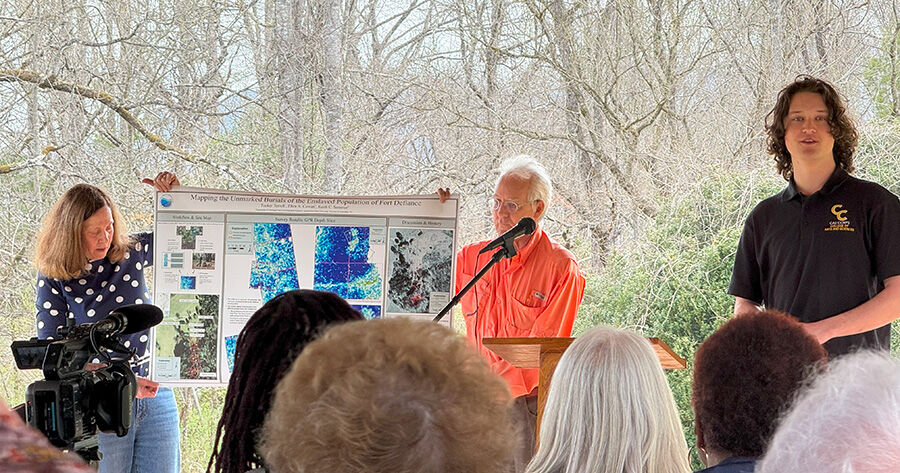
App State alumnus Tucker Terrell, right, explains to a group how he used ground-penetrating radar to locate more than 100 graves of enslaved people at Fort Defiance in Caldwell County. Holding the poster displaying Terrell’s findings are project leader Dr. Ellen Cowan, professor in the Department of Geological and Environmental Sciences (GES), far left, and Keith Seramur, adjunct research and teaching professor in the GES department.
Photo by Mary Beth McKee
Finding and interpreting changes in the density of the ground is far more subtle than work surrounding other burials, which may have a coffin or other hard material to serve as a target for the radar.
“There’s no casket and no biological material left here,” said Terrell.
The data, gleaned from a radar machine that had to be pushed like a lawnmower, forms the basis of Terrell’s senior honors thesis. He worked closely with Cowan and Keith Seramur, an adjunct research and teaching professor in the GES department who owns a geological consulting company and provided equipment and expertise. The work and mentorship gave Terrell research experience that would be tough to gain elsewhere as an undergraduate.
“This is a master’s thesis or Ph.D.-level project I get to work on here,” he said. “The Department of Geological and Environmental Sciences focuses on undergraduate education, which is really special.”
A cross-disciplinary, collaborative effort
Many hands are helping reveal and celebrate the hidden history of Fort Defiance, whose original structure was built to defend against Native Americans well before Lenoir acquired the land. Eagle Scouts and student volunteers pitched in to clear brush so surveys could be done, and the fort’s board of directors, staff and volunteers have supported efforts and provided space for an art exhibit revealed to the public in late March. During an emotional unveiling of the mural, Israel Solomon, an Indianapolis-based artist who is descended from the enslaved at the fort, imagined a world of imagery and color where his ancestors moved.
App State affiliate faculty member Dr. Leslie McKesson, left, and Indianapolis-based artist Israel Solomon stand in front of his art exhibit honoring the role of enslaved people at Fort Defiance, the Lenoir-area historical plantation site founded by American Revolutionary War figure Gen. William Lenoir. The mural series was unveiled March 29 in the summer kitchen at Fort Defiance.
Photo by Mary Beth McKee
“As an artist, I want to work on projects that are meaningful and can stand the test of time,” he reflected. “Definitely, there is a lot of love that lies throughout the work.”
The artistry, historical detective work and supporting efforts help close a circle in a way that the fort’s governing board finds important to its mission.
“We come together to share the other side of the story of Fort Defiance, to pay respect and honor those other faces that lived and worked here,” said Sandra Watts, president of the board, as the mural was unveiled in the fort’s summer kitchen. “It’s our responsibility to educate people about the country’s history so it’s not forgotten or repeated.”
The broad framework of the effort involves collaboration across university departments — an approach that has become central to many of the research missions at App State.
App State alumnus Tucker Terrell, in foreground, explains how faint engravings on a stone indicate it was a headstone for enslaved people at Fort Defiance in Caldwell County. The marker was retrieved from beneath a log by researchers working the site in recent months.
Photo by Bret Yager
Dr. Andrea Burns, associate professor in the Department of History and director of App State’s applied and public history graduate program, led a graduate class in fall 2024 that used the products of McKesson’s spring 2024 class, “Antebellum Slavery in Appalachia,” as a foundation to create curriculum for public school educators, fort staff and volunteers. The inspiration for the exhibit also sprang from McKesson’s class, offered through the Department of Interdisciplinary Studies. Dr. Beth Davison, a professor of sociology in the department, assisted with the class and planning for the exhibit and spearheaded fundraising and promotion efforts.
“The idea for Israel’s paintings came out of the class when I realized that I had ancestors who were enslaved there,” McKesson recalled. “Israel is my first cousin once removed, and I’ve always followed his work. The idea of having him interpret the experiences of our ancestors and others who were enslaved there came up one day as I was talking to Beth Davison about the overall class project and what we could do with the summer kitchen as a permanent exhibit space. I mentioned that I’d love to see his talent incorporated there to honor our ancestors and demonstrate how much they and their descendants continue to contribute to history and society.”
Cowan plans to work in cooperation with the Fort Defiance directors to have the cemetery recorded by the state of North Carolina as an official burial ground. The boundaries will be delineated and the site commemorated in some fashion, depending on what the board decides. More attention will go to the fort site, buried in the sod, its location undetermined until recently. Cowan intends to seek funding to bring in an archeologist from App State to excavate the area.
“As soon as we get funding, we’d like to dig the fort up,” she said.
The grave sites are located away from the fort’s footprint and will be left untouched.
“I think it’s important to tell the whole story,” Cowan reflected. “When groups come here, they will not be able to overlook the accomplishments of the enslaved in making this a successful plantation.”
A look back at the Mount Pleasant 4th of July Celebration in 1955
70 years ago, the Mt. Pleasant 4th of July Celebration was sponsored by the Mt. Pleasant Lions Club and featured a concert by the Mt. Pleasant High School band. The program was a 36-page booklet with the schedule, advertisements and information about the Lions Club and the band. Here are some excerpts.(tncms-asset)cc460cc0-be93-481c-a856-c0aa9df53549[0](/tncms-asset)(tncms-asset)65014b1d-948d-49ab-82fc-4fcc6a7319fa[1](/tncms-asset)
70 years ago, the Mt. Pleasant 4th of July Celebration was sponsored by the Mt. Pleasant Lions Club and featured a concert by the Mt. Pleasant High School band. The program was a 36-page booklet with the schedule, advertisements and information about the Lions Club and the band. This page shows the Lions' Club leaders from 1955.
From the files of Eastern Cabarrus Historical Society
A Tom Thumb wedding? The view from the balcony at the old Mount Pleasant High
This old photo appears to be a Tom Thumb wedding being held at the old Mount Pleasant High School. The view is from the auditorium balcony.
A Tom Thumb wedding is a children's mock marriage ceremony popular in the late 19th/early 20th century, in which kids dress as wedding participants for a fundraiser or social event, named after P.T. Barnum's famous little person, General Tom Thumb, and his real-life wedding. AI was used to define a Tom Thumb wedding.
From the files of Eastern Cabarrus Historical Society