


Tall fescue lawns
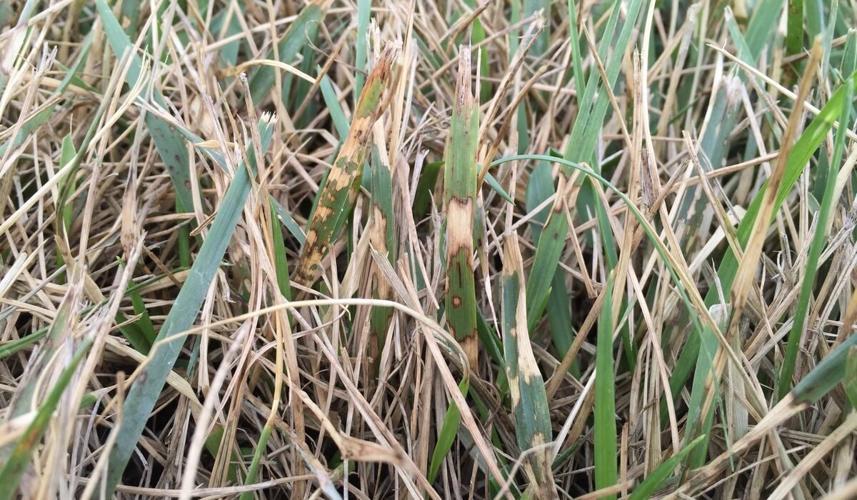
Rain has finally returned to NC, yet most tall fescue samples submitted to our lab (48% of all submissions since 2008) are not diseased. Most issues stem from poor growing conditions, including shade, compaction, drought, heat and traffic. Of the three major diseases of tall fescue, we observe brown patch in 28% of samples, gray leaf spot in 10% and Pythium blight in 6%. Although Pythium blight receives a lot of discussion, it is a relatively rare disease of tall fescue. For it to develop, significant standing water in the lawn is required. We suspect most people confuse gray leaf spot with Pythium blight in tall fescue swards. The remaining 7% of samples we have received since 2008 were diagnosed as red thread, fairy ring, Ascochyta blight and white patch combined.
Because most disease pressure in tall fescue stems from brown patch and gray leaf spot, it is imperative to use a pre-mixed fungicide or a tank mixture to suppress both diseases. The only pre-mixed products that are excellent against both brown patch and gray leaf spot are Headway and Compendium. However, tank mixtures of a DMI fungicide such as propiconazole or triadimefon with a QoI like azoxystrobin, pyraclostrobin or fluoxastrobin would be adequate as well. Thiophanate methyl is another excellent addition to one of the QoIs above, and we suggest starting the summer season in tall fescue with a mixture, as gray leaf spot can develop quickly once conditions are favorable. If Pythium blight is an actual issue (meaning we have diagnosed it), then the most effective options for home lawns are Segway, Union and Subdue MAXX. Those treatments can be applied curatively if needed.
People are also reading…
Golf course putting greens
Bermudagrass putting greens
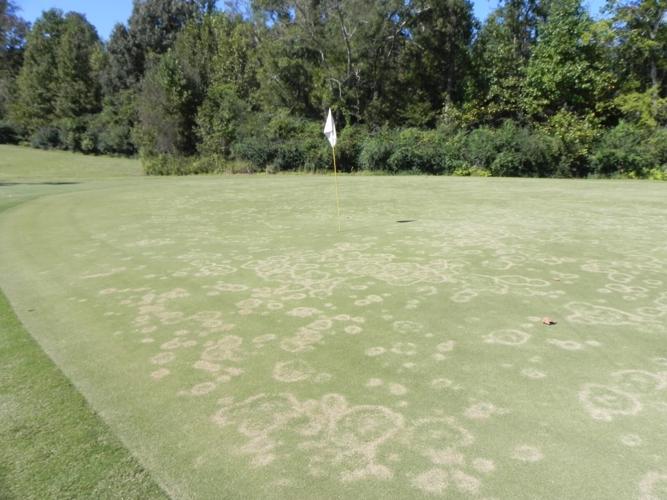
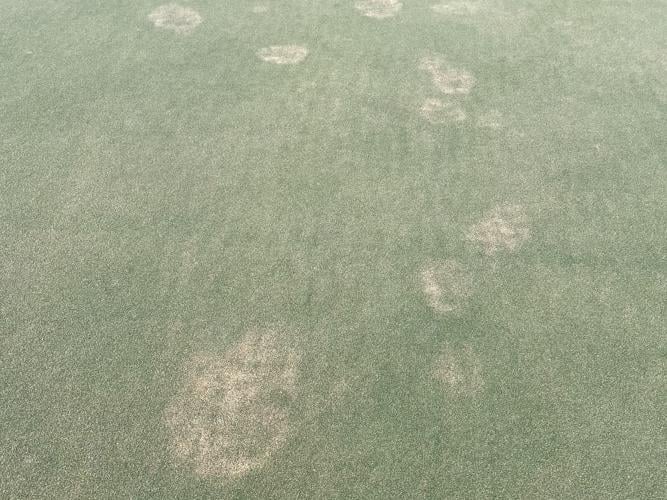
This is the ideal time to start preventive fungicide applications for take-all root rot and mini-ring if you have not already done so. We typically target August 1 for our take-all root rot trial work, and that has been quite successful for us. The key is to have “heavy hitters” go out at least monthly from now until dormancy. In between “heavy hitter” applications, use products rated well for take-all root rot (click here) to ensure protection throughout the fall months. Be sure to irrigate these fungicides in immediately after application and stay on a consistent wetting agent program.
For mini-ring control, we have found that starting between June 15 and July 15 is sufficient for prevention. In our studies, we have used a rotation of Densicor and Ascernity (three applications of each at 14-day intervals), which provided exceptional suppression of mini-ring. Other considerations include the nitrogen source; work conducted at Clemson University clearly shows that potassium nitrate, calcium nitrate and urea help suppress mini-ring. Soil pH seems to influence mini-ring, as many sites with mini-ring pressure have a soil pH below 6. Other fungicides that have performed well for mini-ring are here.
I am sure someone will read this and say, “I just cannot control my take-all root rot or mini-ring.” And yes, that may be the case because nematodes are key to both diseases. Including a strong nematode management program will dramatically reduce the severity of these two diseases. Thus, it is imperative to incorporate products such as Resilia, Indemnify, Trefinti and Divanem to be most successful in managing TARR and mini-ring. Do not fall into the trap of “Well, I do not have a nematode problem.” If you deal with these two diseases consistently, you have an underlying nematode issue!
Cool-season putting greens
This is the time of year to remain vigilant with rotations of Serata and Segway, along with foliar applications of Signature or Appear, tank-mixed with a contact such as chlorothalonil, mancozeb or fluazinam. For cool-season putting greens, simplicity is best this time of year. Protect them against disease, spoon-feed them, alternate mowing and rolling, or do anything that helps limit stress. Regular venting will help regulate soil temperature and limit black layer development. Of the cool-season putting green samples received this year, 48% of diagnoses are abiotic. Twelve percent are black layer. Anything that helps get oxygen into the root zone is key this time of year. For more information about black layer, click here.


