

How to win in Iran
Air power can shatter mullahs, trigger uprising

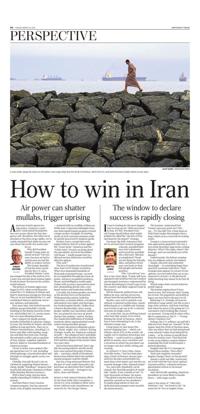
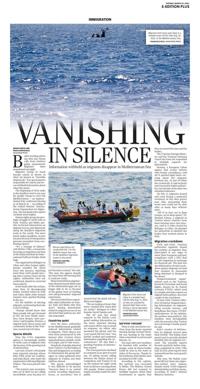
A man walks along the shore as oil tankers and cargo ships line the Strait of Hormuz, which the U.S. and world economy badly needs to stay open.

CHUCK DEVORE
Americans tend to ignore foreign policy. Living in a continent-sized nation bounded by two vast oceans allows for that dangerous self-deception. But when we're attacked or the price of gas spikes, we're rudely reminded that while we may not care about the world, the world cares for us.
Why did President Donald Trump order an attack on Iran? Two reasons: because we had to and because we had the ability to achieve victory.
The Islamic Republic of Iran has been a problem for the U.S. since President Jimmy Carter encouraged the fall of the shah in 1979. Carter was worried about human rights. If only he knew the horrors his actions would unleash.
The pattern of Iranian aggression began in 1979, when revolutionaries seized the U.S. Embassy in Tehran and held 52 Americans hostage for 444 days. This act of war humiliated the U.S. and established Tehran's playbook: terrorism, defiance and impunity.
Four years later, Iran backed nascent militant group Hezbollah's suicide bombing of the Marine barracks in Beirut, which killed 241 U.S. service members on a peacekeeping mission .
Iran's support for deadly proxies includes Hezbollah in Lebanon, Hamas in Gaza, the Houthis in Yemen, and Shia militias in Iraq and Syria. They act as Tehran's forward bases, attacking U.S. forces and allies with funding, weapons and direction from Iran. During the extended conflict and occupation of Iraq, Iranian-supplied explosive devices killed or wounded hundreds of American troops .
Closer to home, Iran conducts illegal operations on U.S. soil, including cyberespionage, assassination plots and attempts to smuggle agents across our borders.
Globally, Iran aids Russia's war on Ukraine by supplying Shahed drones — cheap, deadly "kamikaze" weapons that mostly kill and maim Ukrainian civilians while draining Western resources.
With China's help, Iran has been rapidly expanding its ballistic missile arsenal .
And then there's Iran's nuclear weapons program. Iran has amassed about a ton of highly enriched uranium — material with no credible civilian use. While June's Operation Midnight Hammer interrupted Iranian progress toward a larger nuclear stockpile, its existing stocks of 60% enriched uranium could be quickly processed to weapons grade.
Further, Iran's corrupt theocratic regime believes that its actions against the "Great Satan" (America) and the "Little Satan" (Israel) can bring about the apocalyptic arrival of the hidden 12th Imam — hardly people that traditional nuclear deterrence would be eff ective against.
Why now?
The face of warfare has transformed since Iran's 1979 Islamic revolution. What once demanded hundreds of thousands of ground troops can now be accomplished through precision air power. Advances in guided munitions, drones and intelligence enable rapid strikes with accuracy measured in mere feet, dismantling missile sites, command centers and leadership swiftly.
Crucially, the Iranian people can serve as the decisive force on the ground. Widespread discontent, fueled by repression, economic failure, corruption and protests over rights and shortages, has eroded regime loyalty. Unlike more cohesive dictatorships, Iran's young people, middle class and ethnic minorities are primed to rise once air power shatters the mullahs' control. Further, the clandestine infiltration of Starlink terminals allows unprecedented coordination among dissident groups.
Trump's decision to eliminate a growing threat might also achieve lasting strategic results for American national security — the collapse of Iran's ayatollahs will rank with the fall of the Berlin Wall in 1989 and the collapse of the Soviet Union two years later.
Had action been deferred, Iran's rapidly increasing ballistic missile would have soon reached the point of immunity — erecting a shield of threatened destruction behind which the mullah's nuclear program could be rebuilt.
Iran has a long and proud history. But the past 47 years under theocratic rule have been an aberration that's held the region — and world — hostage to violence, chaos and threats.
DeVore is chief national initiatives officer for the Texas Public Policy Foundation, a retired U.S. Army intelligence officer and a former California state assemblyman. He wrote this for The Chicago Tribune.