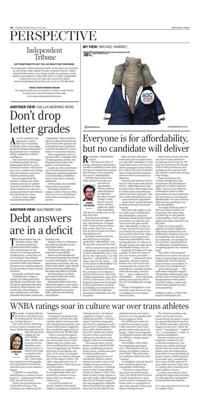

Shaky financial footing
Why middle-class life feels increasingly out of reach for some Americans
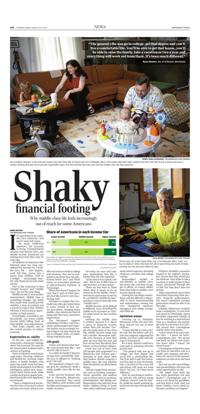
Jen and Ryan Stewart, a dual-income couple, play with their kids at home June 26 in Stillwater, Minn. the couple, who both work, waited until their late 30s to buy a house and start a family, thinking that was the financially responsible move, but they still feel like they can't live the middle-class life they expected.
Tasha Coats sits in her home office July 17 in Plymouth, Minn. Coats, 66, has no plans to retire. She loves her job in advertising and wants to keep working, but she also can't afford to stop.
It's a good time to be a middle-class American. And yet it's never felt worse. By many traditional measures, the economy is strong. Unemployment remains near historic lows, and middle-income Americans are making more than they were 50 years ago.
Yet millions of Americans who followed what was long considered the formula for a middle-class life — earn degrees, work full time, marry, buy a home, raise children, stick to a budget — increasingly wonder why financial security feels elusive.
Part of the confusion is that "middle income" and "middle class" are not the same thing.
Middle income is an economic measurement. Middle class is something broader: the belief that steady work should provide stability, a dose of comfort and a reason to expect that children will have at least as many opportunities as their parents.
Increasingly, economists say, households can reach middle income while falling short of their middle-class expectations.
That helps explain one of the central puzzles of today's economy.
Expectation vs. reality
At the lowand middle-in-come levels, Americans' feelings about the economy this year hit the lowest point in almost half a century of tracking.
Years of inflation erased many wage gains. Housing, childcare and healthcare consume larger shares of family budgets even when two adults work full time. Rapid advancements in artificial intelligence added new uncertainty about future work, while soaring stock prices largely benefited households with significant investments.
"There's a belief that if you follow the rules, if you go to school and pay your taxes and pay your bills and send your kids to college and whatever, that you're supposed to do better than the generation before you," said David Autor, an economics professor at Massachusetts Institute of Technology.
When that doesn't happen, he said, that's "part of when (people) feel like society's not functioning well."
Attempts to explain this contradiction often get boiled down to some version of fact versus perception, enraging many middle-class Americans tired of being told they have unrealistic expectations.
The disconnect suggests something is broken, and economists, policymakers and corporate leaders are increasingly trying to figure out why Americans are so unhappy when, on paper, things look pretty good.
Life goals
Tasha Coats knows what middle-class security feels like — and what it's like to lose it.
As a child, her family's finances swung from comfortably middle class to affluent to "working poor," she said.
The experience shaped a simple goal for adulthood: Build a stable middle-class life for her family.
Coats and her husband, who live in Plymouth, Minnesota, largely succeeded. They raised two children, both worked, paid the bills and managed occasional family vacations.
Yet today, 66-year-old Coats says, maintaining that life is harder than she ever expected.
"At the time it was a pinch," she said. "But to me, it didn't feel as pinched then as it does today."
There are two ways to think about what it means to be an American in the middle: There's how much a person has to earn to be considered "middle income," and there's what it feels like to be "middle class."
Middle income can be defined in different ways, including the middle 60% of earners or a dollar range based on area median income.
Defining the middle class is trickier, because it is about a sense of financial security rather than just income. People who make more or less than the middle-income range may still consider themselves middle class because of how they grew up, how they live now and how secure they feel about their future, or those of their children.
Coats was one of more than 200 people who responded to a Minnesota Star Tribune questionnaire in June about what they believe should comprise a middle-class life and whether their household can afford those things.
Options ranged from necessities such as housing, transportation, groceries and medical care to extras such as vacations, entertainment and dining out. Respondents who said they have minor children living at home were asked additional questions about related expenses, including childcare, activities and college savings.
Respondents tended to self-identify as middle class, but many also said they struggle to afford, or cannot afford, items they believe a middle-class income should cover.
Among the top things respondents said feel difficult or impossible to reach: homeownership and maintenance; owning two cars; unexpected expenses; emergency and college savings; and childcare.
Optimism wanes
Growing up in Stillwater, Minnesota, in the '80s and '90s, Ryan Stewart was one of three children.
"I never felt like we were rich," he said, but his father's job at a telecom company supported the family, and they could still take trips to Disneyland.
For a time, Stewart could see a clear path to achieving what his parents had.
"The general vibe was go to college, get that degree and you'll live a comfortable life. You'll be able to get that house, you'll be able to raise the family, take a vacation or two a year and everything will work out from there," he said. "It's been much different."
Now 40 and living in Stillwater with his wife and two young children, Stewart said his family, unlike his family growing up, needs two incomes to make ends meet.
Without disability payments related to his military service, he's unsure how they would pay for childcare. They'd like to take a vacation or make repairs to their house, purchased through the GI Bill, but they don't have the money.
Older respondents more often described surpassing their parents' financial achievements, but weren't optimistic younger generations would be able to do the same.
Oakdale, Minnesota, resident Dave Cunningham, 72, was born and raised in Pittsburgh, where his father supported a family of four by working in a steel mill and then as a chauffeur. His mother got a job as a secretary at a Catholic school after Cunningham and his sister were grown.
"I don't know if we were middle class — I guess we were," Cunningham said. "We always had food, we always had shoes, you know what I mean? We weren't poor."
Cunningham retired five years ago from an executive role at a credit card company, and attributes his success to his parents' emphasis on education and hard work.
He's not sure his own children and grandchildren will have the same opportunities he did.
"We might have been the last lucky generation, but who knows?" Cunningham said. "I worry a lot about my grandkids, and that kind of stuff. And, you know, frankly, I worry about us. Because anything can happen."