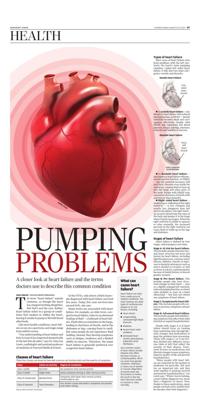


PUMPING PROBLEMS
A closer look at heart failure and the terms doctors use to describe this common condition
The term "heart failure" sounds ominous, as though the heart has stopped working altogether. But that's not the case. Rather, heart failure refers to a group of conditions that weaken or stiffen the heart, leaving it unable to pump or fill with blood effectively.
Like most health conditions, heart failure occurs on a spectrum, and stages range from mild to severe.
"Our understanding of heart failure and how to treat it has improved dramatically in the last few decades," says Dr. Dara Lee Lewis, cardiologist and assistant professor of medicine at Harvard Medical School.
In the 1970s, only about a third of people diagnosed with heart failure survived five years. Today, five-year survival rates exceed 60%, she says.
Many terms are associated with heart failure. For example, an older term, congestive heart failure, refers to an abnormal buildup of fluid — a hallmark of heart failure. Fluid often accumulates in the lungs, leading to shortness of breath, and in the abdomen or legs, causing them to swell. But some people do not experience fluid buildup. Instead, they develop symptoms such as fatigue, weakness and a limited ability to exercise. Therefore, the name heart failure is generally preferred over congestive heart failure.
Types of heart failure
Most cases of heart failure arise from problems with the left ventricle, the heart's main pumping chamber. Called left-sided heart failure, it falls into two main categories: systolic and diastolic.
■ In systolic heart failure — also known as heart failure with reduced ejection fraction, or HFrEF — the left ventricle becomes weak and can't squeeze effectively. People with HFrEF may experience low blood pressure, fatigue, fainting, shortness of breath and inability to exercise.
■ In diastolic heart failure — also known as heart failure with preserved ejection fraction, or HFpEF — the left ventricle becomes stiff and thick. Pressure rises inside the ventricles, causing fluid to back up into the lungs and other parts of the body. People with HFpEF may experience shortness of breath with exertion or when lying flat.
■ Right-sided heart failure — weakening or stiffening of the right ventricle — is less common and usually less dangerous than left ventricular failure. The right ventricle receives blood from the veins of the body and pumps it to the lungs where it picks up oxygen. When the right ventricle is unable to squeeze or relax normally, the increased pressure in the right ventricle can cause fluid to build up in the legs and abdomen.
Stages of heart failure
Heart failure is defined by four stages, which progress over time.
Stage A: At risk for heart failure. This includes people who have normal heart structure but have risk factors for heart failure, including high blood pressure, coronary artery disease, diabetes, obesity or exposure to harmful substances (such as excess alcohol or cocaine), as well as those at risk for cardiomyopathy because of family history or known genetic variants.
Stage B: Pre-heart failure. This includes people who have structural changes in their heart — such as a slightly enlarged left ventricle, reduced pumping function, or a heart valve problem as seen on a heart ultrasound — but have not shown any symptoms of heart failure.
Stage C: Symptomatic heart failure. This includes people with current or previous symptoms of heart failure.
Stage D: Advanced heart failure. This includes people with debilitating symptoms that affect their daily function or require hospitalization.
People with stages A or B heart failure should focus on treating their underlying risks through lifestyle changes and medications to keep the problem from worsening. Those with stages C or D are further divided into different classes (see table at left) that reflect the severity of their disease. Treatment focuses on medications and lifestyle changes to ease symptoms, improve quality of life and prevent hospitalization.
"Many people with heart failure are surprised by the number of medicines we prescribe. But each has an important job, and they work together to prolong survival and prevent hospitalizations," Lee Lewis says. "When I was in training, a heart failure diagnosis was worse than a diagnosis of cancer. Now, thanks to these medications, many people can lead active, healthy lives for decades after their diagnosis."
What can cause heart failure?
Heart failure can stem from a wide array of medical conditions. the most common are other types of cardiovascular disease or its risk factors, including:
■ Heart attack.
■ Longstanding, untreated high blood pressure.
■ Diabetes.
■ Severe heart valve problems.
■ Untreated heart rhythm disturbances, especially atrial fibrillation.
Less common causes of heart failure include diseases that affect the heart muscle, or cardiomyopathy, which can arise from genetic variations, infections or heavy use of alcohol or cocaine. regardless of exactly what sets the process in motion, the result is that the heart becomes unable to contract or relax normally.