

Don't drop letter grades
ANOTHER VIEW | DALLAS MORNING NEWS
As a new academic year approaches, universities face a daunting challenge: How to encourage genuine learning while preparing graduates for a workforce being reshaped by artificial intelligence.
The University of Michigan is thinking outside the box. Beginning in fall 2027, some freshman students will receive pass or no-credit marks during their first semester instead of traditional letter grades.
We can understand the impulse. Colleges are under immense pressure to uphold academic standards at a time when students are using AI to produce polished work without ever showing up to class.
In Texas, some colleges are experimenting with "ungrading," where students agree to contractual terms for a particular letter grade or are evaluated in more qualitative ways like through self-assessments or course benchmarks.
These experiments show a genuine effort to grapple with a broken grading system, but dropping letter grades altogether is not the answer.
Grades are still a useful measure of student performance. Employers, graduate programs and scholarship committees need a clear way to compare applicants.
Letter grades also establish that distinctions matter.
The larger problem is a campus culture that too often treats an A as an entitlement rather than something to be earned.
Debt answers are in a deficit
ANOTHER VIEW | BALTIMORE SUN
The federal deficit has continued to widen, while the national debt has climbed beyond $40 trillion. The consequences are not abstract accounting exercises. As debt grows, so does the cost of servicing it. More federal revenue must go toward interest payments rather than defense, infrastructure, health programs, Social Security or other national priorities.
Eventually, arithmetic wins. Candidates for Congress ought to be talking about this specifically and seriously. They should be explaining what they would cut, what revenues they would raise, what programs they would protect and what tradeoffs they believe Americans should accept.
Instead, voters too often hear the political equivalent of dessert before dinner.
That leaves voters with an important responsibility.
Americans should demand more from the people they intend to send to Washington. At candidate forums, town halls and, yes, letters to the editor, voters should insist on hearing credible plans for addressing deficits and debt.
And those plans should be grounded in arithmetic rather than political fantasy. ...
Meaningful deficit reduction ultimately requires some combination of greater revenue, slower spending growth and, potentially, reductions in existing expenditures.
Everyone is for affordability, but no candidate will deliver
JONAH GOLDBERG
Remember "affordability" mania?The time was 2025. A young, charismatic democratic socialist candidate for New York City mayor named Zohran Mamdani became a viral sensation. His secret? "Affordability."
Ask him about almost anything and he'd turn the conversation to affordability. When a reporter asked Mamdani to respond to President Donald Trump's claim that he was the better-looking politician, Mamdani responded, "My focus is on the cost-of-living crisis, bro."
Queried about whether Hamas, the terrorist organization, should disarm, he began with "I believe that any future here in New York City is one that we have to make sure that's affordable for all."
Mamdani won the election, and pretty much everyone agreed that "affordability" was the key that unlocked City Hall.
All this annoyed Trump, who'd campaigned on lowering prices in 2024. Affordability was a "con job by the Democrats," he told reporters. "Affordability is a lie when used by the Dems. ... We are the party of affordability!" he declared on Truth Social.
One of Mamdani's first priorities as mayor was to impose a partial rent freeze on more than 1 million apartments, about 40% of NYC's rental stock. That was temporary good news for people in those apartments, but good luck finding an economist who doesn't think this will make housing less affordable over the long term.
More recently, Mamdani endorsed a plan to require Amazon and other companies to stop using third-party contractors to deliver packages to New Yorkers. It's a naked sop to the Teamsters, who've long wanted unionized drivers to have a monopoly on deliveries.
If passed, the Delivery Protection Act will create some jobs for drivers, while killing more jobs for gig workers. More important, it would surely make deliveries slower and more expensive. The only study estimating the costs — sponsored by its opponents — found that it would add $664 in delivery fees per household annually.
Take that with a grain of salt if you like, but it's telling that the affordability-obsessed Mamdani administration didn't even bother to study the question of how this plan would affect affordability. If they're so laser-focused on the issue, you'd think this would be the first question they'd ask. Mamdani hasn't even mentioned improving affordability when touting the plan. It's almost as though Trump was right about affordability being a con job.
Speaking of Trump, let's take a gander at what he's done of late. For starters, his tariffs — by design — make goods more expensive. We don't need to belabor that, but to pick just one example, his recent 50% tariff hike on Canadian lumber, will make housing construction — a key component of affordability — more expensive, adding more than $10,000 to the cost of building the average home.
Trump's immigration crackdown has made food costs rise, according to his own Department of Labor.
And of course there's the Iran war. Even Trump admits it's causing gas prices to go up. We hear less about how the closure of the Strait of Hormuz is also pushing up the costs for fertilizer, plastics and jet fuel, among other things.
There are defenses for Trump's immigration and Iran policies (his blunderbuss approach to tariffs is indefensible). There are also defenses of Mamdani's plan to make home deliveries more expensive (his rent freeze is economically indefensible). But none of those defenses have anything to do with affordability.
You might think my point is that our political leaders are lying hypocrites when they say their top or only priority is affordability. I won't argue against the claim, but that's not my point.
Rather, it's that populist appeals are always simplistic. They blame sinister forces for deliberately standing in the way of simple fixes that are good for everybody, save perhaps for the evil elites, special interests or millionaires and billionaires conspiring against the common good.
The reality is that populist promises of easy fixes are easy to make, but governing is hard and complicated. Elected officials have to balance any number of priorities and considerations — good, bad and ugly — that undermine simplistic slogans. The problem with populist pandering is that it always leads to disappointment with leaders who fail to deliver, which only invites more populist ire and more pandering.
Goldberg is editor-in-chief of The Dispatch: thedispatch.com.
WNBA ratings soar in culture war over trans athletes
LORRAINE ALI
File under "stupid publicity stunt that I shouldn't even be writing about, but here I am, writing about it."
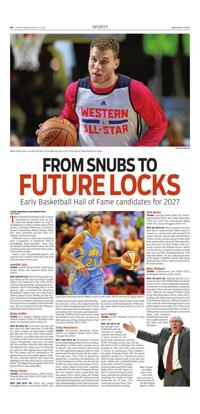
Last week, former NBA players Enes Kanter Freedom and Royce White demanded they be officially declared eligible for the 2027 WNBA draft. White, who recently lost the Republican primary for the U.S. Senate seat being vacated by retiring Minnesota Sen. Tina Smith, has claimed to be transgender and argued that he should be allowed to play in the women's league.
"I identify as sometimes identifying as a woman for purposes of … professional basketball," he told Fox News.
White also posted pictures of himself wearing a wig, stating he was embracing his "feminine era."
Designed to mock the trans community and troll the organization and its inclusion and self-identification policies, the former NBA players suggested they would take legal action if blocked from the WNBA draft.
They're among the legions of attention seekers, influencers, news media and activists taking sides in a culture war over something that's not even close to happening: the WNBA's inclusion of transgender athletes. To be clear, no transgender players are slated to become part of the league's roster. The right-wing uproared over an imagined threat. Where have we seen this before?
The debate was sparked not by an impending reality but instead by comments from a player who's no stranger to controversy.
In an ESPN profile last month, Indiana Fever guard Sophie Cunningham stated that "biological men" should not compete in women's sports, calling the position "common sense" to protect young girls and Title IX. Agitation is nothing new for Cunningham. She's been called "MAGA Barbie" since her college days, partly because of the conservative influencers she follows and engages with on social media.
The remarks drew activist groups to rally outside WNBA games, heightening tensions inside arenas, and became grist for MAGA influencers.
Capitalizing on the fear of transgender athletes participating in women's sports and stoking outrage among conservatives has been a winning move for the Trump administration. In February 2025, President Donald Trump signed an executive order called "Keeping Men Out of Women's Sports" that was designed to withhold federal funding from organizations that do not abide by the administration's view that a person's sex is the gender they were assigned at birth.
The WNBA last week criticized those trying to create a false narrative about transgender women playing in the league. "There are no immediate eligibility matters affecting the WNBA," a league spokesperson said.
The WNBA's 2026 collective bargaining agreement says, "Only players who are women are eligible to play in the WNBA." The policy does not explicitly define the term "woman."
Cunningham said she doesn't have anything against the transgender community.
"I am here to extend love," she said in the ESPN article. "But I also think with that love is truth, being honest. And I want to protect young girls in a locker room, or young girls in sport who shouldn't have to go against biological men."
The vitriol around her comments has become so pronounced that the player's name has reportedly been banned on the WNBA subreddit, where the league's forum won't allow the words "Cunningham," "Sophie," "sc," "scunningham," "soph" or "sophiacunningham."
But the attention on Cunningham's comments, the contrived outrage over a fictional trans athlete draft and dumb stunts by former NBA players may have helped drive more folks toward watching the league's games. ESPN reported its second-most-watched regular season WNBA game in 30 years when the New York Liberty-Indiana Fever matchup averaged 2 million viewers.
A culture war aimed at denigrating the league may be doing just the opposite, creating fans no matter how they identify.
Ali is news and culture critic for the Los Angeles Times.