
Recent rainfall has improved drought conditions across the region, but the town of Mooresville remains under Stage 2 Water Conservation Measures.
Since going into Stage 2 drought conditions in May, reservoir storage has increased, and overall drought conditions are better. Streamflow, however, remains below the level needed to reduce the town’s current conservation measures.
How drought conditions are measured
The town follows the Catawba-Wateree Drought Management Advisory Group’s Low Inflow Protocol, or LIP, which uses three key indicators to determine drought stages:
- Reservoir storage – how much water is currently stored in reservoirs
- Streamflow – how much water is moving through rivers and streams
- Drought conditions – how dry the region has been over time
People are also reading…
Before the town can reduce its water conservation measures from Stage 2 to Stage 1, all three indicators must support the lower drought stage.
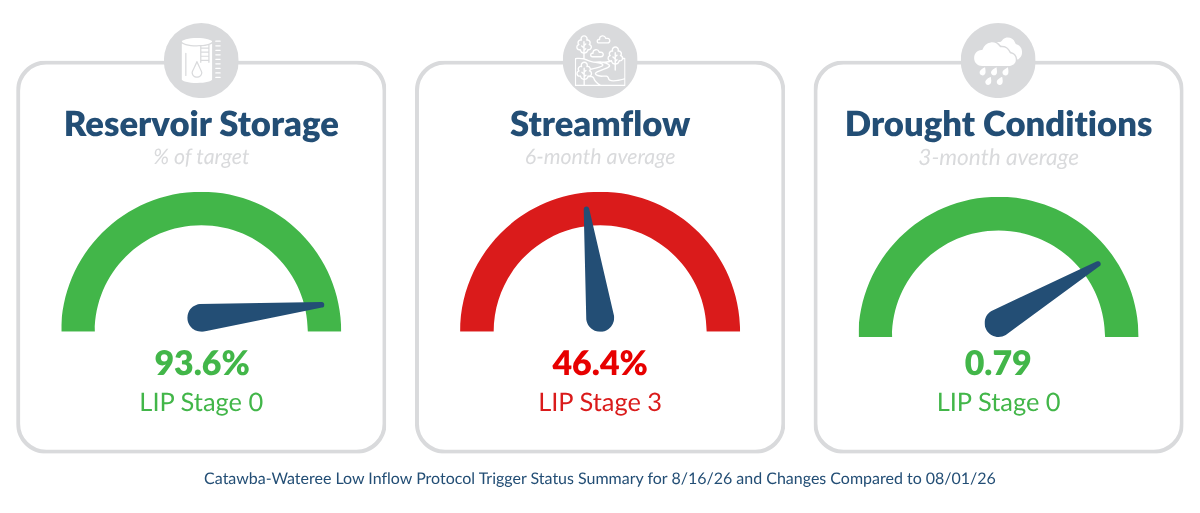
Currently, reservoir storage is at 93.6% of its target, and the drought monitor indicator has improved to 0.79. Both are now within the range associated with LIP Stage 0 conditions.
Streamflow, however, remains the limiting factor because it is measured using a six-month average. Currently, streamflow is 46.4% of normal, which remains within the LIP Stage 3 range. For streamflow, LIP Stage 3 means the six-month average is at or below 55% of normal. To be at LIP Stage 1, the six-month average needs to be at or above 65%.
Why streamflow is still low
Even with the recent rain, the average still includes the very dry conditions experienced during the spring, so it takes longer for this indicator to respond even when rainfall begins to improve.
Think of it like a six-month report card. A few strong weeks can help raise the average, but they do not immediately erase several months of very dry conditions.
The type of rain matters
The heavy, isolated downpours the area has experienced recently are helpful. They have added water to streams and reservoirs and provided short-term relief.
However, when a large amount of rain falls in a short period of time, much of it runs off the ground before soaking into the soil.
Steady rainfall over several days is more beneficial for long-term recovery because it allows more water to soak into the ground. That helps improve soil moisture and recharge groundwater, which in turn helps support streams between rainfall events.
What happens next
For now, it is a matter of time and continued rainfall.
As the driest spring months begin to drop out of the six-month streamflow average, more recent conditions will impact the calculation. Additional rainfall, particularly steady rainfall that improves soil moisture and groundwater levels, can also help streamflow continue to recover.
Until all three drought indicators support a move to LIP Stage 1, the town’s Stage 2 Water Conservation Measures will remain in place.
Residents and businesses are asked to continue following the current conservation measures and using water wisely. The town will continue monitoring conditions and provide updates as they change.