




What is the ACT WorkKeys?
A core priority of North Carolina’s K-12 system is to ensure that students graduate both college- and career-ready. Yet the typical assessments that states use to measure preparedness, such as the SAT and ACT exams, are designed to gauge readiness for college entry, not the workforce. As a result, some states, including North Carolina, have begun requiring some students to take the ACT WorkKeys exam, a career readiness assessment that measures foundational workplace skills across three domains:
- Applied Math (e.g., calculating perimeters, areas, volumes, sales tax, and averages);
- Workplace Documents (e.g., understanding memos, policies, manuals, and contracts);
- Graphic Literacy (e.g., reading and analyzing charts and figures).
Based on their performance, students can receive a National Career Readiness Certificate at a level of Bronze, Silver, Gold, or Platinum.1 Receiving a distinction of Silver or above is generally considered “career-ready.” Currently, North Carolina requires all Career and Technical Education (CTE) concentrators—about 40% of students in each graduating class—to take the WorkKeys in the 12th grade.2
People are also reading…
What’s relatively unknown is how well performance on the WorkKeys exam relates to students’ college and early-career outcomes, as compared to other traditional academic measures. Over the past year, the Labor & Economic Analysis Division (LEAD), in partnership with the Education Policy Initiative at Carolina (EPIC)3, has examined this question using K-12 administrative data on students in the 2018 and 2019 graduation classes, linked to postsecondary enrollment records and state unemployment insurance wage records. The remainder of this article presents three takeaways from this research. (See the Technical Appendix for more information on the data and methodology).
Takeaway #1: Most college-ready students are also career-ready
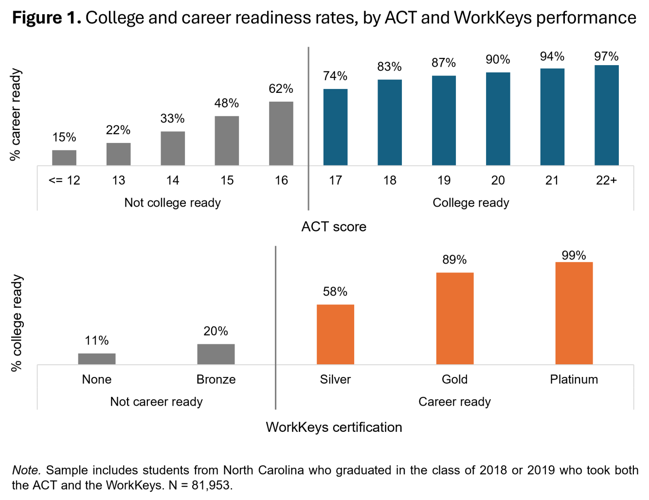
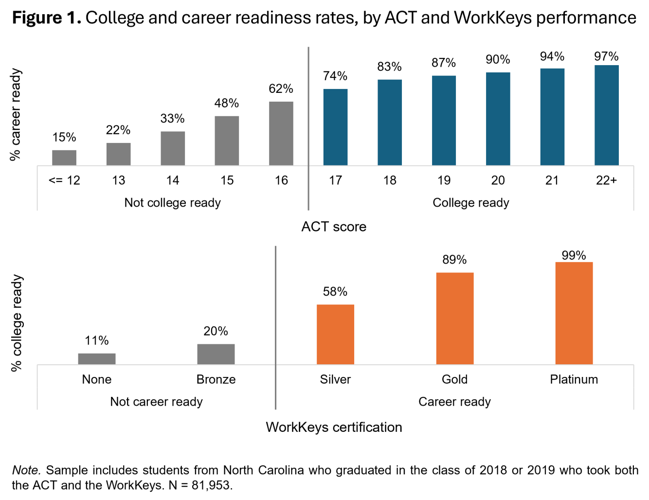
We first compared student performance on the ACT in 11th grade and the WorkKeys in 12th grade to better understand whether these exams measure distinct skill sets. We found that student performance on the ACT and the WorkKeys is highly correlated.4 In other words, students who received a high score on the ACT tended to do well on the WorkKeys, too. Roughly 89% of students who earned a college-ready ACT score (defined as a score of 17 or higher on the 1-36 scale) also earned a career-ready WorkKeys score (Silver or above). Similarly, students’ likelihood of having earned a college-ready ACT score increased sharply from a rate of 11% of students who earned no WorkKeys certification to 99% of those who earned a Platinum designation.
The large overlap in performance across both exams, despite being administered a year apart, suggests that the skills needed to succeed on the ACT and the WorkKeys may be highly similar or complementary. In general, the more college-ready a student is, the more career-ready they appear to be as well, and vice versa.
Takeaway #2: Math skills appear positively associated with college completion and early-career wage earnings
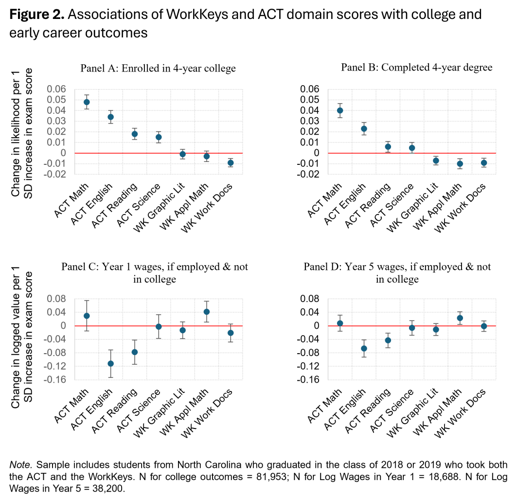
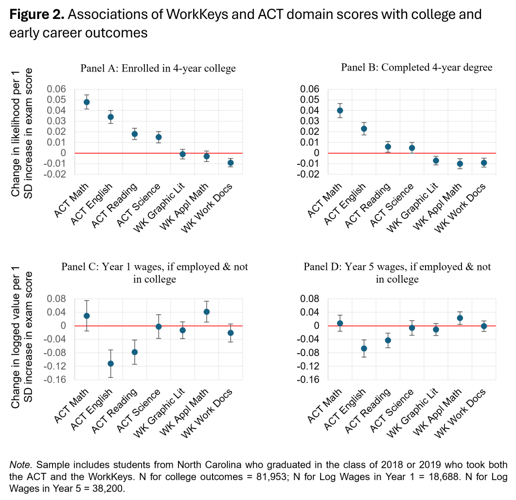
We also leveraged students’ scores on the individual ACT sections (English, Math, Reading, and Science) and the different WorkKeys domains (Applied Math, Workplace Documents, and Graphic Literacy) to identify which skills tested by these exams may be most associated with student success across both college and career pathways.
For example, we examined whether students who earn a higher score on the WorkKeys Applied Math domain have better college and early-career outcomes than peers with otherwise similar characteristics—including demographics, ACT scores, high school GPAs, and course-taking patterns—but who earn a lower Applied Math score.
Students’ ACT scores, especially in Math and English, are positively associated with enrolling in and completing a four-year degree. When comparing two observably similar students, whose ACT Math scores differ by one standard deviation (about 4-5 points on the 1-36 scale), the student with the higher score is expected to be four percentage points more likely to earn a bachelor’s degree within five years of high school graduation.
In terms of workforce outcomes, WorkKeys Applied Math scores stand out as the strongest positive predictor of early-career wage earnings. Among otherwise similar students whose Applied Math scores differ by one standard deviation (about one point on the 3-7 scale), the student with the higher score earns about 4% more in the first year after high school and about 2% more in the fifth year after high school.5
In total, strong math skills appear to be associated with postsecondary success regardless of whether a student pursues a college or career pathway. Students may benefit from developing both applied and more academic math skills during high school.
Takeaway #3: High school GPA is a strong predictor of later outcomes
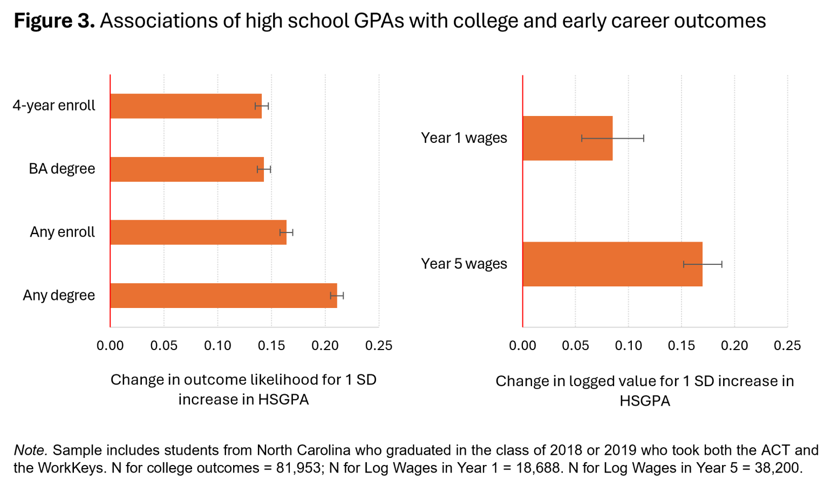
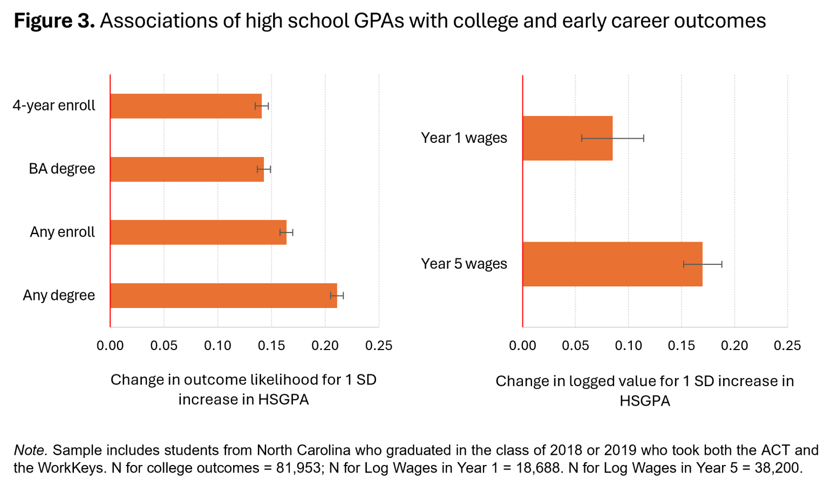
Finally, using the same approach as above, we explored whether students’ GPAs provide meaningful information about their college and career readiness above and beyond their test scores. Overall, students’ high school GPAs are strong predictors of later outcomes. Among students whose GPAs differ by one standard deviation (about 0.7 points on a 4.0 scale) but who otherwise have similar characteristics, the student with the higher GPA is 16 percentage points more likely to enroll in college and 21 percentage points more likely to earn a college degree.
A higher GPA is also associated with higher wage earnings. Among those who were employed and not enrolled in college at the time, those with higher GPAs had about 7% higher earnings in the first year after high school and 17% higher earnings in the fifth year relative to comparable peers with lower GPAs.
What makes these findings notable is that GPA remains a strong predictor of later outcomes even after accounting for student performance on the ACT and the WorkKeys. Unlike test scores, which tend to measure subject-specific knowledge and general reasoning at a single point in time, grades are built up over years of academic coursework and can also reflect the “soft” or “durable” skills (e.g., communication, organization, and grit) that are valuable for success in both college and the workforce.
Conclusion
Considered together, these findings offer several insights for education and workforce practitioners in North Carolina. First, performance on the ACT and the WorkKeys appears to reflect largely overlapping skill sets. Students who are college-ready are also generally career-ready, and vice versa, suggesting that strong performance on one exam is a good indicator of strong performance on the other. Second, math skills, as measured by both the ACT and the WorkKeys, are associated with positive outcomes across both college and students’ early careers, suggesting there is value in developing a broad range of math skills during high school. Third, students’ GPAs are strong predictors of both college and early career outcomes even after accounting for test scores, perhaps pointing to the importance of durable skills alongside academic content mastery.
Technical appendix
This study uses K-12 administrative data from the NC Department of Public Instruction (DPI) on approximately 82,000 CTE concentrators in the 2018 and 2019 graduating classes who took both the ACT and the WorkKeys exams. These data are linked to postsecondary enrollment and completion records from the National Student Clearinghouse (NSC) and state unemployment insurance wage records from the North Carolina Department of Commerce. Wage outcomes do not capture earnings of those who work out of state or in employment types not covered by North Carolina’s unemployment insurance law (e.g., federal or self-employment). We observe outcomes for up to five years after high school graduation. Descriptive statistics can be found in Table A1 in the linked report.
To examine associations between specific skills and students' outcomes, we estimated linear regression models using ordinary least squares (OLS), controlling for demographic characteristics, CTE concentration areas, test scores, unweighted GPAs, and course-taking patterns, in order to isolate the association between each subject-specific ACT score or WorkKeys domain score and students' later outcomes.
The results describe associations and do not establish causal relationships. Students who score differently on these exams may also differ in other ways not fully captured in our data, such as their postsecondary intentions or underlying motivation, and these findings should be interpreted accordingly.
- 1
WorkKeys test takers can receive a score ranging from 3-7 on each domain. The certification level is determined by the test taker’s minimum score across all three domains. For example, those who score at least a 3 on all domains earn a Bronze; those who score at least a 4 on all domains earn a Silver; and so on.
- 2
All public high school students in North Carolina, regardless of CTE status, are required to take the ACT in the 11th grade.
- 3
This joint project was done as part of the Urban Institute’s Student Upward Mobility Initiative (SUMI), a sponsored project of Rockefeller Philanthropy Advisors. Project funders include the Walton Family Foundation, Bill & Melinda Gates Foundation, Joyce Foundation, and Overdeck Family Foundation.
- 4
Student scores on the ACT and the WorkKeys had an overall correlation of r = 0.77.
- 5
For the analysis on wage earning outcomes, we only include students who were observed as employed and not enrolled in college in the focal year.


