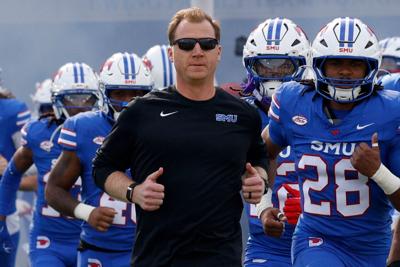






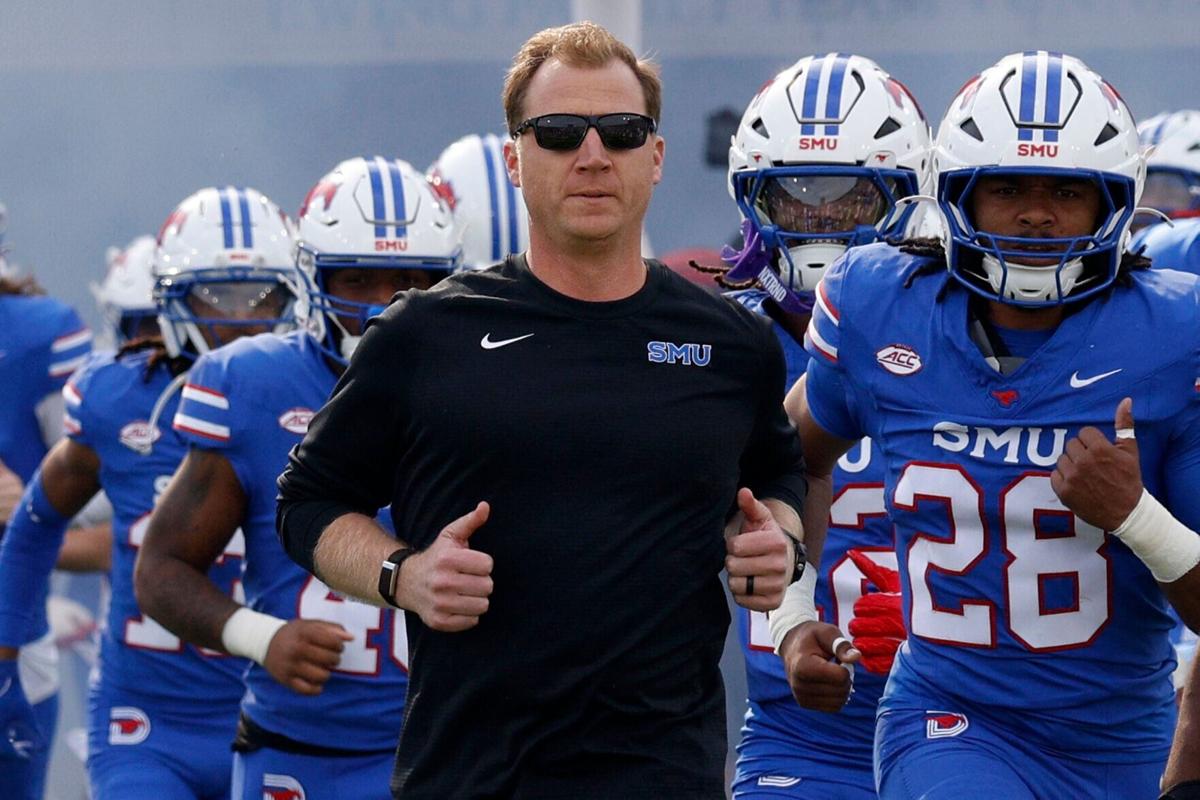
UNIVERSITY PARK, Texas — After approximately 30 years of mediocrity, Bill Armstrong had enough.
The oil and gas billionaire knew SMU football's 1987 death penalty from the NCAA for illegally paying players was the catalyst for the program's generation-long downward spiral. But he believed the length of his alma mater's purgatory was somewhat self-imposed.
"The first thing I had to do, to be very frank, was get SMU to pull its own head out of its ass," Armstrong said. "We were paying some guys a little bit of dough, and we literally allowed ourselves to stay in the penalty box for 40 years. That was on us. That was SMU being so embarrassed by what happened that we literally let the inmates run the asylum."
The Mustangs had no choice but to change. It just so happened that the desire for a drastically different approach coincided with monumental shifts in the college sports landscape. SMU's plans were already in motion when NIL, the transfer portal and conference realignment took shape.
People are also reading…
The results of the Mustangs' formula for change have been remarkable. As SMU enters its third season in the ACC, the program finds itself commanding a level of respect it hasn't received since before the death penalty. The Mustangs were picked to finish second in the ACC preseason poll, their highest preseason ranking since joining the conference. They enter the season ranked No. 19 in the nation in the AP poll — their second straight preseason top-20 ranking.
And they are set to play their season opener Monday night on the road against blue blood Florida State on national television, yet they enter as 3.5-point favorites.
"We're not a blue blood, but we are a new blood," head coach Rhett Lashlee said at ACC media days in Charlotte, N.C., in July. "When you start thinking of it along those lines, new blood is what we're currently doing. We're present. Blue blood means it's what you've done in the past. We're living on what we're doing now."
Indiana won the national championship last season. Programs like Texas Tech have joined SMU in an unexpected rapid ascent through big spending and competitive recruiting. As those programs compete with traditional powers — and SMU enters with higher expectations than teams like Florida State and Clemson — new bloods are showing their approaches can be just as impactful as another program's rich history.
"New bloods just don't come out of thin air. They're built," SMU athletic director Damon Evans said. "They're build through investment. They're built through laying a foundation. They're built through a belief that a leader like Rhett has in his program. But they're also built because in today's game of football, in particular, there's more parity than ever before."
How SMU became a new blood
Not every school has the potential to be a new blood. But SMU general manager J.R. Sandlin knew the Mustangs were a sleeping giant when he left Oklahoma and joined the program in 2024.
"I thought it was a gold mine because we're in a new era of college sports, and when you look at businesses across America, location is key," Sandlin said. "You always have to be inside-out. Every college roster is built from basically a five-hour radius."
SMU had a gift in its backyard with the high school football talent pool in Dallas-Fort Worth and across the state.
Armstrong thought back to the program's down years and how it didn't capitalize on the talent in its backyard.
"In order to win, you have to be able to recruit, and there is no better recruiting hotbed in the country than Dallas-Fort Worth," he said. "While we were sitting there with our feet in the sand, Baylor and TCU were just basically running circles around us, and it really affected us in a way that affected the entire university. That was just not tolerable for me."
Just over 50% of SMU's roster now is made up of players from Texas. The roster also features top transfers like Jalen Hale from Alabama and Jimmy Wyrick from UTSA and Stanford — two Texas natives who left the state to begin their college careers before transferring back.
The need to recruit elite local talent was the central piece behind the Mustangs' long-term plan. SMU could've rushed to the transfer portal and thrown endless money at top players ahead of the 2024 season to make a splash in the ACC. But the program cared more about showing it had staying power.
Sandlin said even in this era of college sports, high school recruiting must be the priority. His team has boards for the Classes of 2027, 2028 and 2029 so they're always forecasting the top local recruits far beyond the current season.
"We look at the high school recruiting part more like drafting," he said. "You have a lot of time to spend on getting to know who they are, where do they come from, what are their habits, what are their patterns, what does the situational football look like?"
That's where SMU has outperformed some blue bloods. Take Florida State, for example. Both programs had standout seasons in 2023. They both won their respective conferences. Florida State finished the year 13-1 and was snubbed by the College Football Playoff.
But after losing some of their top talent to graduation, the Seminoles tried to reload mostly through the portal for an immediate fix. When many of those transfers didn't pan out, Florida State plummeted to 2-10 the next season.
Meanwhile, SMU brought in some transfers at positions like offensive and defensive line to bulk up for the ACC, while relying on its homegrown talent like quarterback Kevin Jennings to lead the way.
Investing in stability
Recruiting isn't just limited to high school and the transfer portal anymore. Programs have to recruit their own coaches and rosters again each season.
The new bloods like SMU remember the days when their best players and coaches would leave for bigger jobs.
"Rhett Lashlee was stolen away from us by Miami," said Armstrong, referring to how the current head coach left for a stint as Miami's offensive coordinator before returning to the Hilltop. "At the time, I can't remember the numbers exactly, but they were paying him like $500,000 more than we were willing to pay. I can't tell an up-and-comer to take one for the team. He's got four young kids. We had to raise all that money to make sure we kept our really good coaches."
Lashlee has been extended during each of his last three seasons, with SMU offering the coach raises to ensure he wouldn't leave for an SEC job.
Possibly the greatest asset to SMU in its rapid rise was its financial situation and robust booster base. With multi-millionaire and billionaire alumni willing to invest in the university's growth, SMU was able to take big risks and make sacrifices, namely forgoing nine years of media-rights revenue from the ACC, amounting to over $20 million annually.
Not all programs share the Mustangs' willingness to make those financial sacrifices, even though they will undoubtedly pay off tenfold in the long run.
"I think a lot of these schools are trying to really keep a claim on being a blue blood, and there's a new sheriff in town. The rules have changed," Armstrong said. "Some schools don't have the stomach for it."
SMU still has more to prove
The group of new bloods to reach the College Football Playoff may be small, but SMU isn't the only one.
Texas Tech, led by billionaire mega booster Cody Campbell, revamped its roster ahead of last season, spending big on the best players. It paid off, as Tech reached the College Football Playoff for the first time in program history, earning a first-round bye before losing to Oregon in the Orange Bowl.
Indiana finished a perfect 16-0 last season and won the national title after prioritizing veteran transfers in the portal. The university better known for basketball success enters this season ranked in the top-10 once again.
"When you see someone like Indiana break through, that just adds excitement to the sport," Evans said.
The Mustangs are considered among that class of programs on the rise, but acknowledge what they've accomplished over two seasons in the ACC isn't their ultimate goal.
"We've been good, but we're in pursuit of great, and we haven't achieved it yet," Lashlee said. "We got a lot of work to do."
That's where the new bloods are learning about the pressure it takes to be a powerhouse. A blue blood program looks at a season as championship or bust.
The expectations at SMU are starting to approach that point.
"I think we've made more progress than a lot of people probably thought we would have made at this juncture in the ACC, but where we are today is not our destination," Evans said. "We have so much more ahead of us. We have so much more to accomplish. We are just getting started."
____