




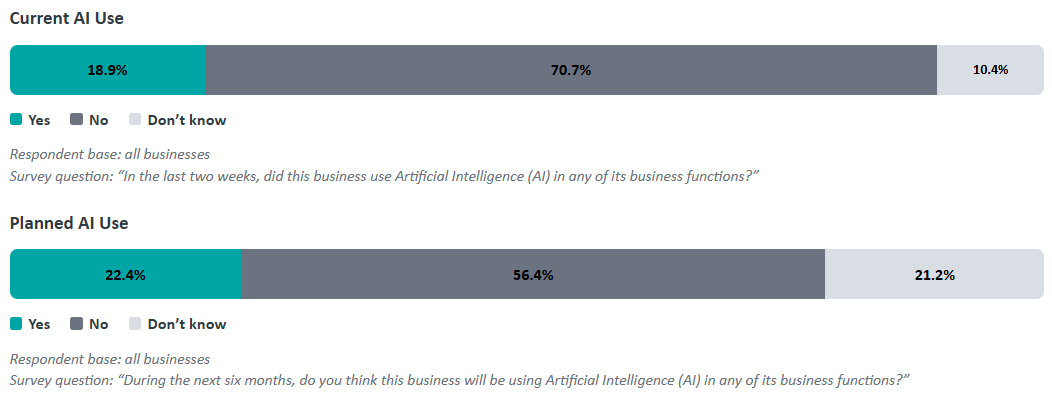
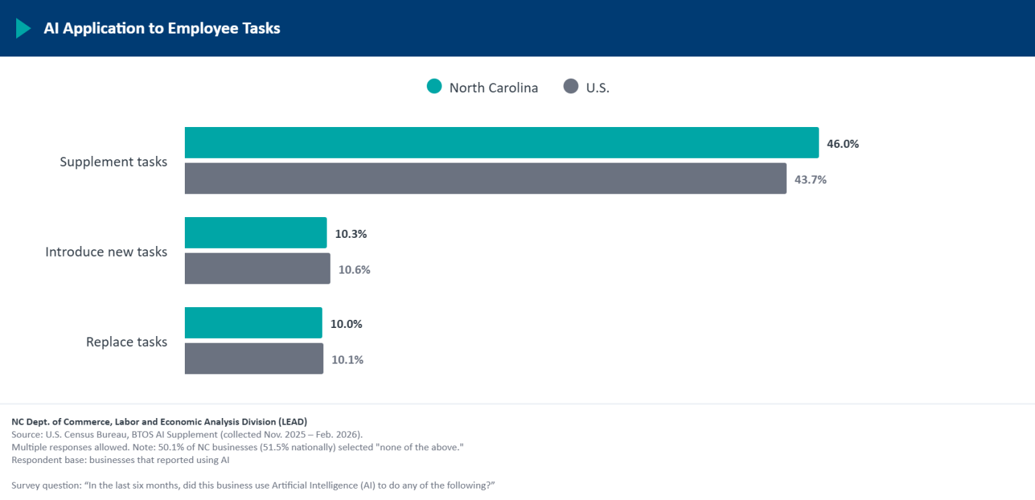
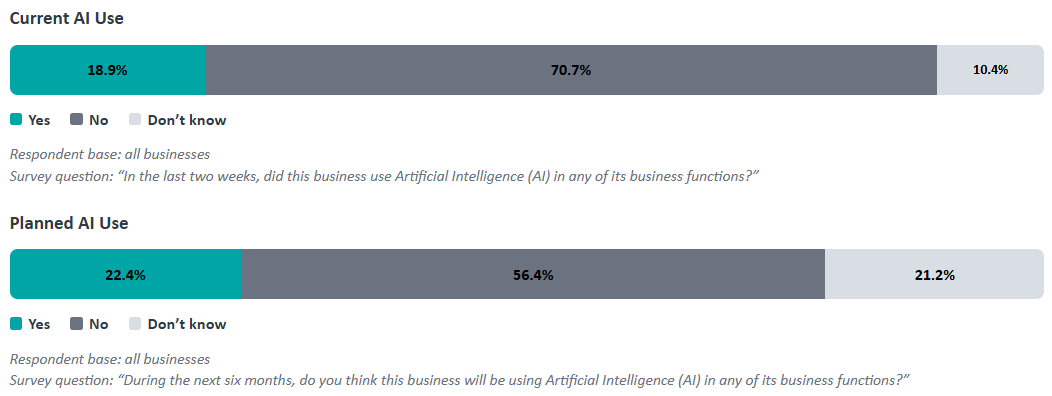
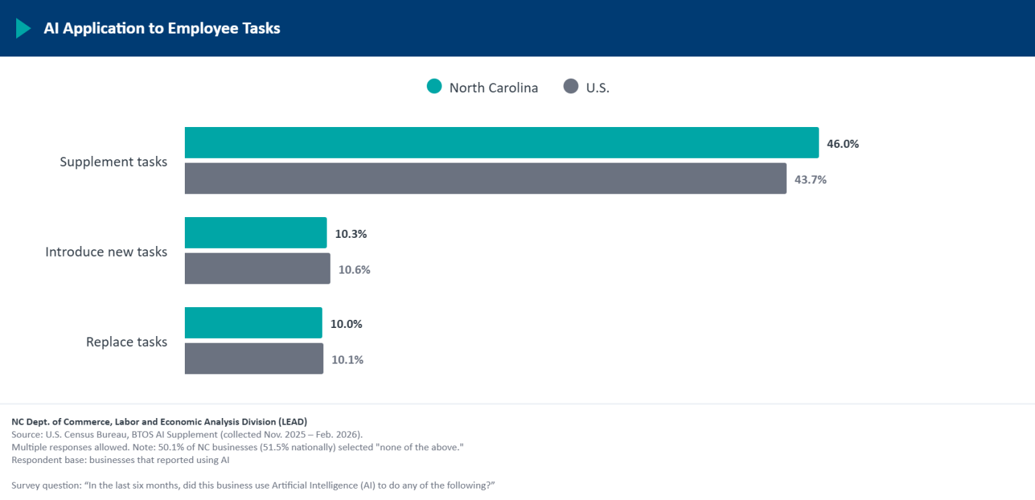
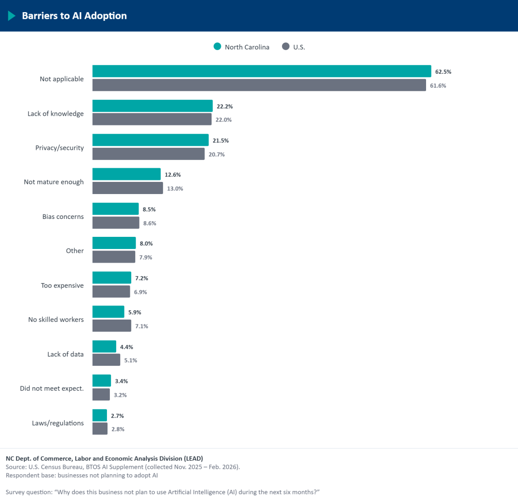
New data from the U.S. Census Bureau’s BTOS show that artificial intelligence (AI) adoption among North Carolina businesses is limited and that businesses using the technology are applying it mainly to support employee work. The findings also suggest that some workers may be using AI before their employers have more broadly integrated it into business operations. Among businesses with no plans to use AI in the next six months, the leading obstacle is relevance rather than cost, with most reporting that the technology does not apply to their operations. Overall, North Carolina closely tracks national results, indicating that these patterns are not unique to the state.
These findings are drawn from LEAD's data story, How North Carolina Businesses Are Using AI. The analysis is based on the BTOS AI Supplement, collected November 2025 - February 2026.
Employee use may extend beyond business adoption
People are also reading…
Approximately 19% of North Carolina businesses report currently using AI in at least one business function, closely matching the national estimate of 18%. Although these results cannot be directly compared with earlier estimates because of changes to the BTOS questionnaire, businesses' expectations about future use suggest AI adoption may continue to expand, at least modestly. The larger share of businesses uncertain about future adoption also suggests many organizations are still evaluating how AI may fit into their operations.
Employee use of AI appears somewhat more common than organization-level adoption. A separate question found that approximately 23% of North Carolina businesses reported that their employees use AI tools, compared with 19% reporting AI use in at least one business function. This difference could indicate that some employees are using AI tools before their organizations have more broadly incorporated the technology into their operations.
Businesses are using AI to support work, not replace workers
Much of the discussion surrounding AI has focused on its potential to displace workers. However, survey responses suggest that North Carolina businesses are currently using AI primarily to support employee work rather than reduce staffing levels. Among businesses using AI, 46% report using it to supplement tasks, while only 10% use it to replace tasks and another 10% report that AI has introduced new tasks. Consistent with this data, a separate question found that approximately 97% of North Carolina businesses reported no impact on overall employment.
Perceived relevance is a bigger barrier than cost
Among North Carolina businesses not planning to use AI during the next six months, about 63% say the technology is not applicable to their operations. Lack of knowledge about AI and privacy or security concerns follow at roughly 22% each. Cost ranks much lower at about 7%, and approximately 6% indicate a lack of skilled workers. Businesses could select more than one reason, but the results point to relevance rather than cost as the main barrier.
AI adoption remains in its early stages
The results suggest that AI has not been widely integrated into business operations across North Carolina. While relatively few businesses currently report using AI, adoption may continue to increase if more organizations identify practical applications for the technology. AI also appears to be used primarily to support existing work activities rather than reshape employment, though its longer-term effects on business operations and the workforce remain uncertain.
The figures in this article come from LEAD's data story, a new format combining analysis with interactive visualizations. Explore the full AI Adoption data story to see how North Carolina businesses are using AI in more detail.


